
📊 Full opportunity report: Appointment no-show recovery planner for therapy practices on IdeaNavigator AI — validation score, market gap, and execution plan.

Prime made for students and young adults
- Fast, free delivery for dorm and study essentials
- Prime Video and Amazon Music included
- Member-only deals
TL;DR
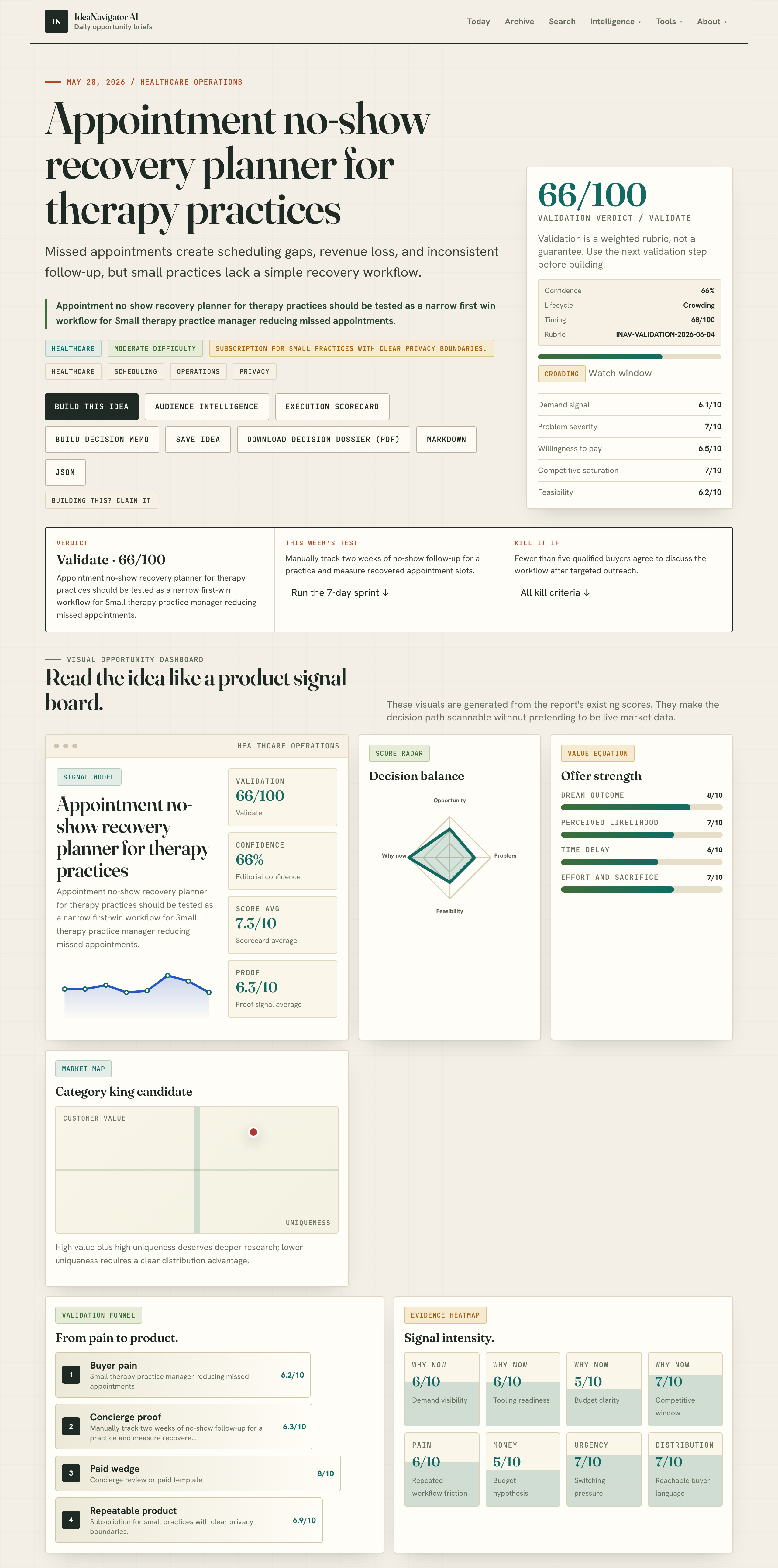
A prototype no-show recovery planner is under testing for small therapy practices. It aims to log missed appointments, automate reminders, and facilitate follow-up to recover lost sessions, addressing a common operational challenge.
A new appointment no-show recovery planner designed for small therapy practices is entering a testing phase to evaluate its effectiveness in reducing missed appointments and improving scheduling efficiency.
The proposed tool is a non-clinical workflow that tracks missed appointments, records reminder attempts, and manages rescheduling and outreach templates. It aims to address a common challenge faced by small therapy practices: missed sessions that lead to revenue loss and scheduling gaps.
According to an internal plan from IdeaNavigator AI, this recovery planner will initially be tested by manually tracking no-shows and follow-up efforts over a two-week period in a selected practice. The goal is to measure the number of appointment slots recovered through automated outreach and rescheduling efforts.
The tool is intended to be offered via a subscription model, with privacy boundaries clearly defined to ensure compliance with healthcare data regulations. It is not designed to make clinical claims or interfere with therapeutic processes, focusing solely on operational improvements.
Operational Impact for Small Therapy Practices
This development could provide small therapy practices with a solution to reduce missed appointments and increase revenue. Automating follow-up and rescheduling efforts may help practices improve patient engagement and optimize their schedules without adding clinical workload.
The tool’s emphasis on privacy and non-clinical workflow makes it suitable for small practices that lack extensive administrative resources, potentially leading to more consistent patient care and financial stability.
appointment reminder software for therapy practices
As an affiliate, we earn on qualifying purchases.
As an affiliate, we earn on qualifying purchases.
Addressing a Common Practice Challenge
Missed appointments are a widespread issue in healthcare, especially for small therapy practices that often lack dedicated administrative staff or sophisticated scheduling systems. Current solutions are either too complex or require significant investment.
This initiative reflects a broader trend toward operational tools that improve practice management without claiming to influence clinical outcomes. The focus on simple tracking and outreach aligns with the needs identified by small practice managers for cost-effective, easy-to-implement solutions.
“This no-show recovery planner aims to provide a straightforward workflow that small practices can adopt quickly, with measurable results over a short period.”
— an anonymous researcher
no-show recovery tools for small clinics
As an affiliate, we earn on qualifying purchases.
As an affiliate, we earn on qualifying purchases.
Effectiveness and Adoption Uncertainties
It remains to be seen how effective the recovery planner will be in practice, as validation is still in the early testing phase. The actual impact on appointment recovery and practice revenue has not yet been verified at scale.
Questions remain regarding how readily small practices will adopt the tool, whether they will find it user-friendly, and how it will integrate with existing scheduling systems.
therapy practice scheduling automation
As an affiliate, we earn on qualifying purchases.
As an affiliate, we earn on qualifying purchases.
Next Steps for Validation and Deployment
The initial two-week manual tracking period will provide data on the tool’s effectiveness in recovering missed appointments. If results are promising, the developers plan to refine the workflow and consider broader testing across multiple practices.
Following validation, the goal is to launch a subscription-based version with easy onboarding, aiming for wider adoption among small therapy practices seeking operational improvements.
patient appointment rescheduling system
As an affiliate, we earn on qualifying purchases.
As an affiliate, we earn on qualifying purchases.
Key Questions
How does the no-show recovery planner work?
The tool logs missed appointments, automates reminder attempts, manages rescheduling, and uses outreach templates to follow up with patients and recover missed sessions.
Is this tool intended to replace clinical decision-making?
No, it is purely an operational workflow designed to improve scheduling and follow-up, without making clinical claims or affecting therapeutic content.
Will this work with existing scheduling systems?
The initial version is designed to be simple and may require manual logging; future iterations could include integrations, but this has not yet been confirmed.
When will the tool be available for wider use?
Following successful validation over the next two weeks, a subscription version may be launched in the coming months, with broader deployment planned afterward.
Source: IdeaNavigator AI
Evergreen bestsellers Picks
bestsellers
As an affiliate, we earn on qualifying purchases.