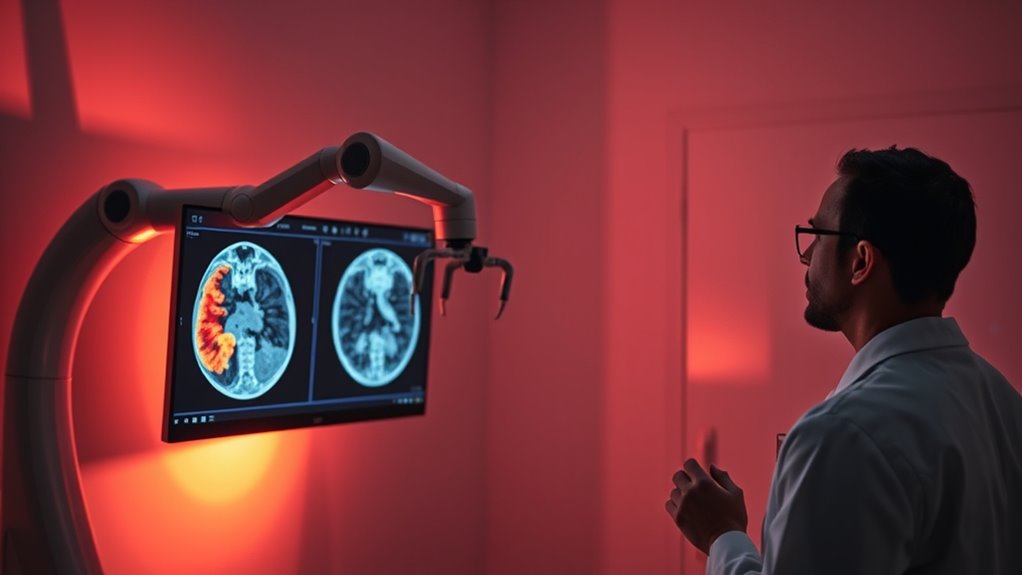

AI is revolutionizing radiology by speeding up image analysis and improving cancer detection. It helps you identify tumors and fractures that you might miss manually, enhancing your diagnostic confidence. With continuous learning from vast datasets, AI tools streamline your workflow, allowing you to manage more cases efficiently. This leads to quicker, more accurate diagnoses and better patient outcomes. Keep exploring to see how AI’s impact extends beyond cancer detection and into the future of healthcare.
Key Takeaways
- AI enhances cancer detection by analyzing imaging data faster and more accurately than traditional methods.
- Advanced algorithms identify anomalies like tumors, improving early diagnosis and treatment outcomes.
- Continuous learning from extensive datasets allows AI to refine its diagnostic capabilities over time.
- AI streamlines radiology workflows, enabling radiologists to focus on complex cases and manage higher case volumes.
- The integration of AI in radiology is revolutionizing patient care, leading to improved accuracy and confidence in diagnoses.
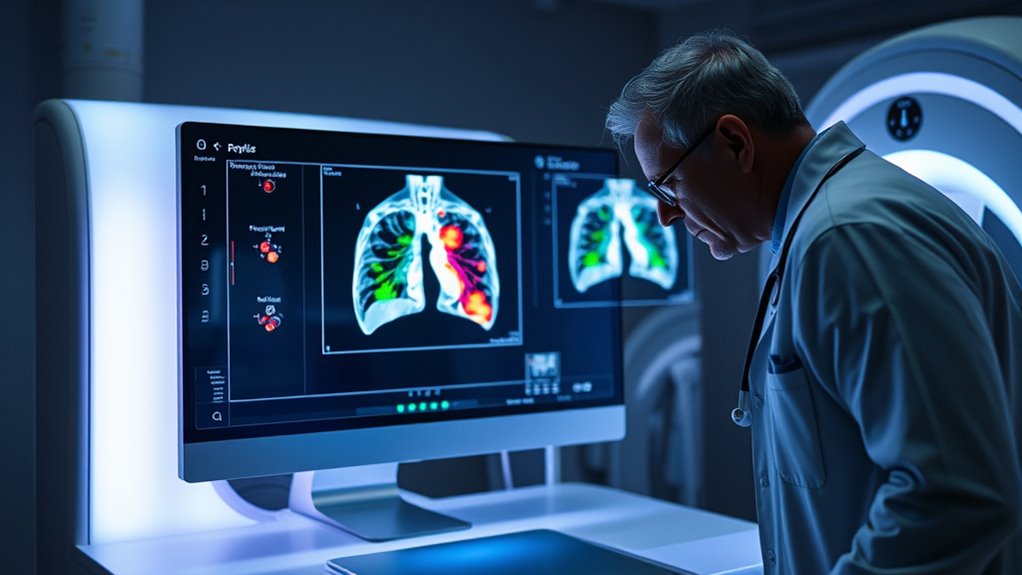
How is artificial intelligence transforming the field of radiology? It’s reshaping how radiologists diagnose and interpret medical images, making the process faster and more accurate. With AI diagnostic tools, you now have powerful allies that can analyze images with incredible precision. These tools utilize advanced algorithms and machine learning to identify anomalies, such as tumors or fractures, that might be missed by the human eye. Imagine having a partner that never tires, consistently working to enhance the diagnostic process.
As you navigate the radiology workflow, you’ll notice that integrating AI can streamline tasks. Traditional workflows often involve a significant amount of time spent on image evaluation and reporting. However, with AI assisting in the preliminary analysis, you can focus on the more complex cases that require your expertise. The efficiency gained allows you to manage a higher volume of cases without compromising quality, which is essential in today’s fast-paced healthcare environment.
AI diagnostic tools don’t just stop at improving efficiency; they also enhance accuracy. Studies have shown that these tools can reduce the rate of false positives and negatives, giving you greater confidence in your diagnoses. You won’t have to second-guess your findings as much, knowing that AI has corroborated your observations. This added layer of validation is fundamental, especially in fields like oncology, where early detection can profoundly impact patient outcomes.
Moreover, AI’s ability to learn from vast amounts of data means it continually improves. As more images are analyzed, the algorithms refine their accuracy over time. You could find yourself relying on these advancements as AI diagnostic tools evolve and adapt to new challenges in radiology. It’s like having a research assistant that’s always up-to-date with the latest findings and techniques.
Incorporating AI into your radiology practice isn’t just a trend; it’s becoming a standard. Understanding the impact of AI on diagnostic accuracy can significantly enhance your practice. As you embrace these technological advancements, you’ll likely notice that the quality of patient care improves. You can provide faster diagnoses, which can lead to earlier treatment and better patient outcomes. In this way, AI is not just transforming radiology; it’s revolutionizing it, making your role more impactful than ever before. As you move forward, the partnership between you and AI will redefine what’s possible in this essential field of medicine.
Frequently Asked Questions
How Does AI Improve Radiology Workflow Efficiency?
AI improves radiology workflow efficiency by enabling automated image analysis, which speeds up the interpretation process. You’ll find that AI can quickly highlight abnormalities, allowing you to focus on critical cases. This leads to better workflow optimization, as you can handle more patients in less time. By reducing manual tasks, you’re less likely to experience burnout, ultimately enhancing both your productivity and the quality of care you provide.
What Are the Limitations of AI in Radiology?
AI can’t fully replace human judgment in radiology, as studies show that 20% of diagnoses may still be missed. You’ll face ethical concerns, especially when algorithms exhibit bias, which can lead to unequal treatment outcomes. Additionally, AI’s reliance on quality data can limit its effectiveness if the data isn’t diverse. So, while AI enhances efficiency, it’s vital to remain aware of its limitations and the need for human oversight in decision-making.
How Is Patient Data Privacy Maintained With AI?
Patient data privacy is maintained through robust data encryption and access controls. You’ll find that encryption scrambles sensitive information, ensuring unauthorized users can’t read it. Access controls limit who can view or manipulate data, so only authorized personnel get in. Regular audits and compliance with regulations further enhance security. By implementing these measures, healthcare providers protect your personal information while leveraging AI technology effectively. Your privacy remains a top priority throughout the process.
Are There Certifications for AI Radiology Tools?
Yes, there are certifications for AI radiology tools. These tools often undergo rigorous evaluation to obtain AI certification, ensuring they meet specific standards for safety and efficacy. Radiology credentials also play a vital role, as professionals must be trained to interpret AI outputs accurately. By choosing certified tools, you can trust that they adhere to industry guidelines, enhancing diagnostic accuracy and patient care while maintaining compliance with regulations.
How Can Radiologists Stay Updated on AI Advancements?
To stay updated on AI advancements, you should immerse yourself in ongoing AI training and education. Attend workshops, webinars, and conferences focused on AI in radiology. Join professional organizations that offer resources and networking opportunities. Connect with peers and experts in the field to share insights and experiences. By actively engaging with the latest research and technologies, you’ll enhance your knowledge and skills, ensuring you remain at the forefront of radiology innovation.
Conclusion
In the ever-evolving field of radiology, AI isn’t just enhancing cancer detection; it’s revolutionizing how we approach diagnosis and treatment. Imagine a world where every scan holds the potential for instant insights, guiding physicians with unprecedented accuracy. As technology advances, can you envision the future where AI not only saves lives but also transforms the entire landscape of healthcare? Embracing these innovations will certainly lead us to breakthroughs that once seemed impossible, making the future brighter for patients everywhere.