📊 Full opportunity report: Pre-Call Memory Cards: Essential For Relationship-Focused Sales Success on IdeaNavigator AI — validation score, market gap, and execution plan.

Prime made for students and young adults
- Fast, free delivery for dorm and study essentials
- Prime Video and Amazon Music included
- Member-only deals
TL;DR
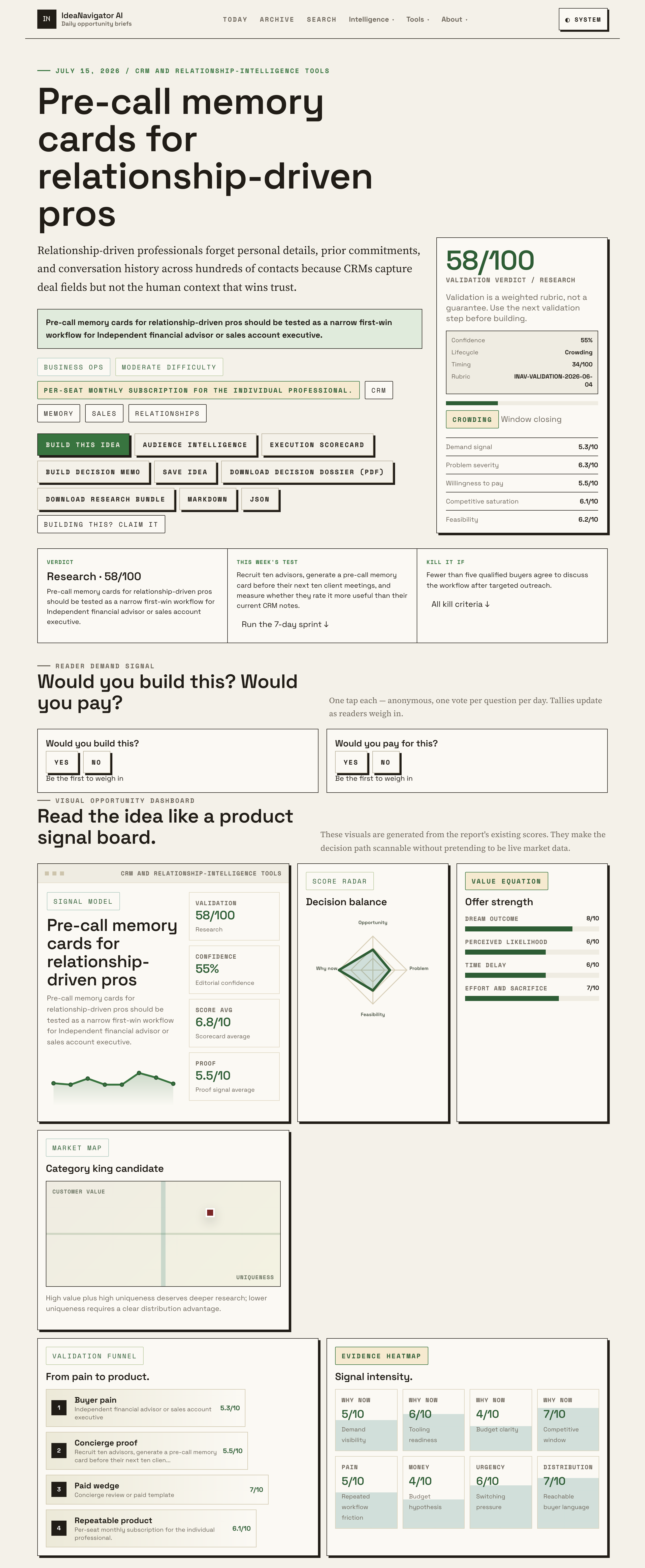
Pre-call memory cards are being tested as a tool for relationship-focused sales professionals to better recall client details and conversation history. This innovation could enhance trust and efficiency in client interactions, with early validation underway.
Pre-call memory cards for relationship-driven professionals are being tested as a targeted workflow to help independent financial advisors and sales account executives recall key client details. This development aims to address the gap in current CRM tools, which often fail to capture the human context necessary for building trust. The initiative is driven by recent advances in large-language-model summarization technology, making it feasible to distill extensive conversation histories into concise, searchable memory aids.
The core idea involves creating a pre-call brief generator that connects a contact’s past emails and notes to produce a one-page memory card. This card summarizes who the client is, what was last promised, and any open threads, enabling professionals to have more meaningful and personalized conversations. The approach is currently in the validation stage, with plans to recruit ten advisors to test the tool across their next ten client meetings.
According to sources familiar with the project, the goal is to measure whether advisors find the memory cards more useful than their existing CRM notes. The subscription-based model targets individual professionals, with the potential to expand into broader CRM and relationship intelligence markets. The initiative is motivated by the decreasing cost and increasing accuracy of large-language-model summarization, which now makes such tools practical.
Impact of Memory Cards on Relationship-Driven Sales
This development could significantly improve how relationship-focused professionals manage client interactions. By providing quick, accurate summaries of past conversations and commitments, pre-call memory cards may enhance trust and rapport, leading to better client retention and satisfaction. If successful, this workflow could become a standard part of relationship management, reducing the cognitive load on advisors and making client interactions more personalized and effective.
client relationship management memory cards
As an affiliate, we earn on qualifying purchases.
As an affiliate, we earn on qualifying purchases.
Limitations of Current CRM Systems for Relationship Professionals
Current CRM tools primarily capture deal-related data but often lack the human context that fosters trust in relationship-driven sectors like financial advising. Professionals frequently forget personal details, previous commitments, or nuances of past conversations, which can hinder relationship building. Recent technological advances in large-language models now allow for summarizing extensive conversation histories into concise, searchable formats, addressing a longstanding gap in relationship management tools.
This initiative builds on the trend of integrating AI-driven summarization into client management workflows, aiming to make relationship insights more accessible and actionable during client interactions.
“The ability to distill long conversation histories into a single, searchable memory card could transform relationship management for professionals who rely heavily on personal trust.”
— an anonymous researcher
As an affiliate, we earn on qualifying purchases.
Uncertainties Around Adoption and Effectiveness
It remains unclear how widely this tool will be adopted by professionals and whether it will significantly outperform existing note-taking or CRM practices. The success of the validation process, involving ten advisors, is still pending, and results could vary based on individual workflows and preferences. Additionally, questions about integration with existing CRM systems and data privacy considerations are yet to be addressed.
As an affiliate, we earn on qualifying purchases.
Next Steps in Validation and Market Testing
Following the initial testing phase with ten advisors, developers plan to analyze feedback and usage data to refine the pre-call memory card tool. If results demonstrate a clear benefit, broader rollout and integration into existing CRM platforms are expected. Further validation may involve larger sample sizes and diverse professional sectors to assess scalability and impact on relationship management outcomes.
personalized client interaction aids
As an affiliate, we earn on qualifying purchases.
As an affiliate, we earn on qualifying purchases.
Key Questions
How does the pre-call memory card differ from current CRM notes?
The memory card summarizes key client details, past promises, and open threads into a single, concise page, whereas CRM notes often focus on transactional data and may lack personalized context.
What technology enables the creation of these memory cards?
Large-language-model summarization technology, which distills extensive conversation histories into brief, searchable summaries, makes this possible.
Who can benefit most from pre-call memory cards?
Independent financial advisors, sales account executives, and other relationship-driven professionals who manage many contacts and need to recall personal details quickly.
What are the main challenges in implementing this tool?
Integration with existing CRM systems, ensuring data privacy, and demonstrating clear benefits over traditional note-taking are key challenges to address.
When will this tool be widely available?
The current phase involves testing and validation; a broader market launch depends on successful validation outcomes and subsequent development efforts.
Source: IdeaNavigator AI
Halloween Picks
halloween
As an affiliate, we earn on qualifying purchases.