Vertical seaweed farms help fight climate change by absorbing CO2, filtering pollutants, and reducing ocean acidification. Their innovative multi-tiered structures maximize space and productivity, while automation streamlines harvesting and monitoring. These farms also support ecosystems, promote resource efficiency, and provide sustainable food sources. If you want to discover how these advanced systems can be part of climate solutions, there’s more to explore on their potential impacts and future applications.
Key Takeaways
- Vertical seaweed farms absorb CO2 efficiently, helping reduce greenhouse gases and mitigate climate change.
- Multi-layered structures maximize biomass production, increasing their capacity to sequester carbon.
- Cultivating seaweed without land, freshwater, or fertilizers minimizes environmental impact.
- Seaweed filters excess nutrients from water, improving ocean health and reducing acidification.
- The scalable, automated farms promote sustainable ocean farming, supporting resilient ecosystems and climate solutions.
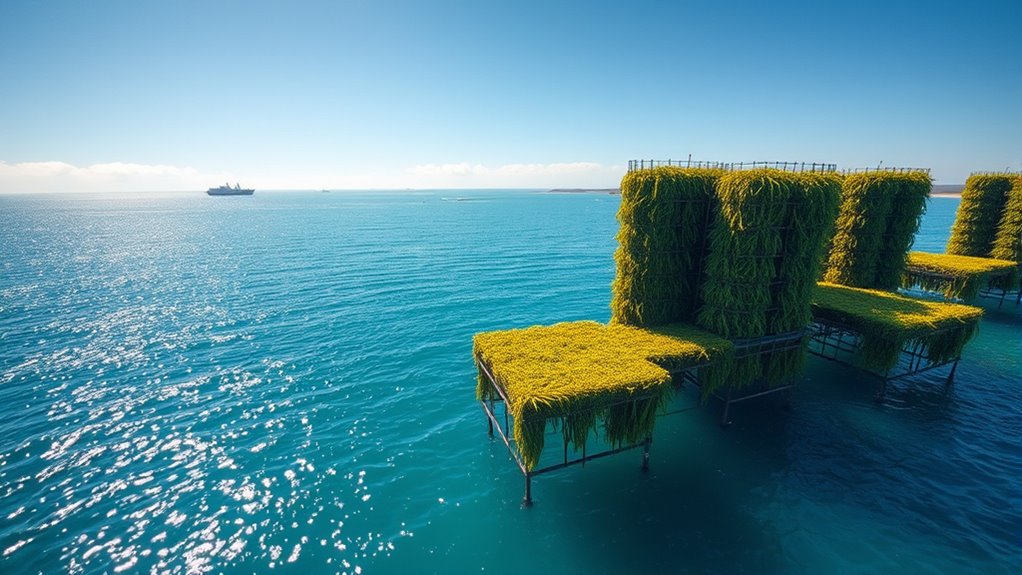
Vertical seaweed farms are revolutionizing ocean cultivation by combining automation with innovative 3D structures. This new approach transforms traditional, labor-intensive seaweed farming into a highly efficient, scalable system. By utilizing modular offshore vertical grid structures, you can maximize space and increase seaweed yield considerably. These farms employ automated seeding, often using robotics or drones, to precisely deposit spores, reducing the need for manual labor and ensuring consistent planting. Continuous monitoring through remote sensors keeps track of water quality, growth rates, and potential damage, allowing you to make real-time adjustments and enhance production. Mechanized harvesting, via autonomous boats or cutters, further streamlines operations, enabling large-scale farming with less effort and lower costs.
Vertical seaweed farms leverage automation and innovative structures to boost efficiency and scalability in ocean cultivation.
The multi-tiered design of vertical ocean farming allows you to cultivate multiple aquatic species simultaneously. You can grow seaweed alongside shellfish like scallops, mussels, and oysters on stacked layers, creating a synergistic ecosystem. This not only boosts overall productivity but also amplifies environmental benefits. Seaweed naturally filters water by absorbing excess nutrients, helping to mitigate ocean acidification and improve water quality. Since seaweed requires no freshwater, land, or fertilizers, it’s a resource-efficient crop that supports sustainability. Furthermore, fast-growing varieties like kelp and dulse offer nutritional and commercial value, making your farm economically viable while contributing to climate change mitigation by absorbing CO2 and reducing greenhouse gases. Incorporating high-fiber crops like seaweed also enhances the overall resilience of your farm’s ecosystem.
Integration with aquaculture further enhances the farm’s ecological impact. Horizontal surface ropes anchored to hurricane-resistant floats support vertical underwater lines for seaweed cultivation. This setup allows shellfish to thrive alongside seaweed, creating a resilient and productive ecosystem that provides additional benefits such as storm surge protection and habitat creation for marine wildlife. Because most of the farm remains submerged and minimally visible from shore, it reduces visual impact on coastal landscapes. This multi-layered, multi-species approach promotes sustainable sea farming by making maximum use of the same footprint.
To maximize growth, you can optimize the design of your structures for light absorption. Angled or conical vertical modules help increase sunlight capture underwater through refraction, while rotating modules ensures even light distribution. Adjusting the angle of your structures based on geographic location allows for better sunlight utilization, boosting photosynthesis. Using vertical frustums in your design further enhances biomass production by maximizing photosynthetic efficiency per unit area. Advances in automated nursery systems improve seedling viability and uniformity, making it easier to expand your farm sustainably. Vertical seed propagation reduces reliance on wild stocks and increases scalability. Additionally, understanding the nutritional benefits of seaweed can help you promote its commercial and health value to consumers. Standardized harvesting protocols tailored for 3D vertical systems streamline operations, ensuring efficient and sustainable crop management. All these innovations come together to create a powerful tool against climate change, as seaweed farms naturally absorb CO2, improve water quality, and promote healthier oceans — turning ocean farming into a formidable climate solution.
Frequently Asked Questions
How Do Vertical Seaweed Farms Affect Local Marine Ecosystems?
You might wonder how vertical seaweed farms influence local marine ecosystems. These farms create habitats, offering shelter and food for fish, shellfish, and invertebrates, boosting biodiversity. They naturally filter water, improving quality and reducing pollutants like nitrogen and phosphorus. Plus, they sequester carbon, combat ocean acidification, and support healthier ecosystems. By providing safe habitats without disrupting natural behaviors, they promote ecological resilience and help restore marine environments.
What Are the Cost Comparisons Between Vertical Farms and Traditional Farming?
Imagine exploring the financial landscape of farming—vertical farms, with their futuristic charm, often come with higher costs than traditional methods. You’ll find that while they save land and water, energy and labor expenses can make the overall investment steeper. Despite initial higher capital and operational costs, these farms offer unmatched efficiency and year-round yields, hinting at a promising, innovative future that could reshape how we grow our food.
How Scalable Are Vertical Seaweed Farms Worldwide?
You’re wondering about the scalability of vertical seaweed farms worldwide. These farms have strong growth potential due to technological advances, increased demand, and supportive policies. However, challenges like high upfront costs, infrastructure needs, environmental considerations, and regulatory hurdles can slow expansion. If these issues are managed effectively, vertical farms could profoundly boost global seaweed production, helping meet market demands and environmental goals while reducing ecological impact.
What Technology Innovations Are Advancing Vertical Seaweed Farming?
Imagine a farm using the Rapid Line-Seeder technology, where drones quickly deploy seaweed spores onto underwater structures. This innovation boosts seed planting efficiency and reduces damage, making large-scale operations feasible. You benefit from mechanized seeding, remote monitoring, and multi-tiered systems, which together streamline production and enhance sustainability. These advancements enable you to expand your farm’s capacity, improve yields, and adapt quickly to environmental changes, driving the future of sustainable ocean farming.
How Do Vertical Farms Impact Local Communities Economically?
You see, local communities benefit economically from vertical farms by creating new job opportunities and increasing income. These farms often require low capital, making them accessible to small-scale farmers and marginalized groups, including women and youth. As a result, they diversify income sources, reduce reliance on overfished resources, and boost local economies. Plus, by expanding markets for eco-friendly products, vertical farms help communities grow financially and socially resilient.
Conclusion
By embracing vertical seaweed farms, you can help combat climate change while boosting local economies. Imagine a city where towering seaweed structures absorb carbon, provide food, and create jobs. For instance, a coastal town that installs these farms might see improved air quality and new industries flourish. Your support for innovative farming methods like this can make a real difference—showing that small actions, when scaled up, create powerful environmental change.