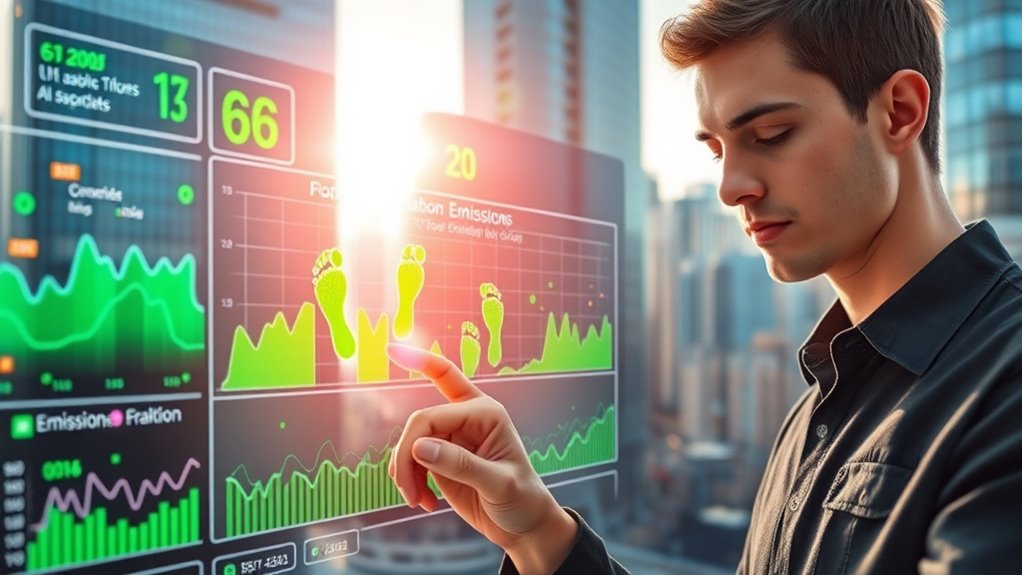

AI revolutionizes carbon tracking by automating data collection and offering real-time insights into emissions. You can monitor your carbon footprint accurately, allowing for quick responses to any spikes or inefficiencies. This technology integrates various data sources, providing a all-encompassing view of your environmental impact. With predictive capabilities, it also helps you plan for future scenarios effectively. As you explore further, you’ll discover more ways AI can support your sustainability goals.

Prime made for students and young adults
- Fast, free delivery for dorm and study essentials
- Prime Video and Amazon Music included
- Member-only deals
Key Takeaways
- AI automates real-time data collection and analysis of emissions, providing precise insights into carbon footprints.
- Continuous monitoring allows for immediate identification of emission spikes, facilitating prompt operational adjustments.
- Predictive capabilities enable organizations to forecast future emissions and simulate the impacts of operational changes.
- Data visualization tools enhance clarity and communication of emissions trends to stakeholders, promoting transparency.
- Centralized platforms for data integration foster collaboration across departments, aligning sustainability efforts organization-wide.

How can artificial intelligence transform our approach to carbon tracking? As we face the urgent challenge of climate change, understanding and managing our carbon footprint is more critical than ever. AI offers powerful tools to help you monitor emissions in real-time, providing insights that can drive more sustainable practices. By leveraging data analytics, you can take meaningful steps toward reducing your environmental impact.
Artificial intelligence revolutionizes carbon tracking, enabling real-time monitoring and informed decision-making for a sustainable future.
Imagine you’re a business owner looking to assess your carbon footprint. Traditional methods often rely on manual data collection and estimations, which can be time-consuming and prone to errors. However, AI can automate this process, utilizing advanced algorithms to analyze vast amounts of data quickly. By integrating various data sources, such as energy consumption, transportation logistics, and waste management, AI provides an extensive view of your emissions. This means you won’t just be guessing; you’ll have precise information to make informed decisions.
Real-time monitoring is another game-changer. With AI-driven tools, you can track emissions as they occur, allowing you to respond promptly to any spikes in carbon output. This immediate feedback loop enables you to identify inefficiencies in operations or areas where you can implement more eco-friendly practices. Instead of waiting for periodic reports, you’ll have continuous visibility into your carbon footprint, helping you stay on top of your sustainability goals.
AI’s predictive capabilities can also offer you a roadmap for the future. By analyzing historical data, machine learning algorithms can forecast your emissions based on different operational scenarios. This means you can simulate the impact of changes, such as switching to renewable energy sources or optimizing supply chains. With this insight, you can proactively design strategies that align with your sustainability objectives, rather than reacting to issues as they arise. Additionally, high contrast ratios can help ensure that visual presentations of your carbon data are clear and impactful, making it easier to communicate findings to stakeholders.
Moreover, AI can enhance collaboration across your organization. By providing a centralized platform for data analytics, you can ensure that all departments are aligned in their efforts to reduce emissions. This shared understanding fosters a culture of sustainability, empowering your team to work together toward common goals.
AI-powered carbon footprint monitoring device
As an affiliate, we earn on qualifying purchases.
As an affiliate, we earn on qualifying purchases.
Frequently Asked Questions
How Can Businesses Implement AI for Carbon Tracking Effectively?
To effectively implement AI for carbon tracking, you should start with robust data integration across all departments. This guarantees accurate emissions data collection. Next, establish a system that adheres to regulatory compliance requirements, keeping you aligned with local and global standards. Regularly update your AI models with new data to enhance accuracy. Finally, encourage a culture of sustainability within your organization, motivating employees to engage actively in emissions reduction efforts.
What Industries Benefit Most From AI Carbon Tracking Solutions?
You’ll find that industrial agriculture and transportation logistics benefit the most from AI carbon tracking solutions. In fact, studies show that these sectors contribute over 30% of global carbon emissions. By implementing AI, businesses in these industries can monitor emissions in real time, optimize supply chains, and reduce waste. This not only helps you meet regulatory requirements but also enhances your sustainability efforts, improving your brand’s reputation and operational efficiency.
How Does AI Improve the Accuracy of Carbon Emissions Data?
AI improves the accuracy of carbon emissions data by enhancing sensor calibration and data validation processes. When you implement AI, it fine-tunes sensors to guarantee they’re measuring emissions correctly, reducing errors. Plus, AI verifies the collected data in real-time, identifying anomalies and inconsistencies. This continuous monitoring helps you trust the information you’re getting, allowing for better decision-making regarding emissions reduction and compliance with regulations.
What Are the Costs Associated With AI Carbon Tracking Systems?
The costs associated with AI carbon tracking systems can vary markedly. You’ll need to take into account the initial investment for software and hardware, along with ongoing maintenance expenses. Conducting a thorough cost analysis is vital to identify potential savings and efficiency gains. However, investment challenges might arise, such as finding skilled professionals to manage the systems and ensuring data accuracy. Balancing these costs against long-term benefits is essential for successful implementation.
Can AI Carbon Tracking Integrate With Existing Sustainability Initiatives?
Absolutely, AI carbon tracking can seamlessly weave into your existing sustainability initiatives, like a skilled tailor stitching a new patch onto a cherished quilt. As you integrate this technology, keep data privacy in mind, ensuring sensitive information remains protected. You’ll also need to navigate regulatory compliance, ensuring your initiatives align with legal frameworks. By doing this, you enhance your sustainability efforts and create a more robust, eco-friendly strategy that resonates with your values.
real-time emissions tracking software
As an affiliate, we earn on qualifying purchases.
As an affiliate, we earn on qualifying purchases.
Conclusion
Ultimately, using AI for carbon tracking is like having a compass in a dense forest—it guides you through the complexities of emissions monitoring in real time. By harnessing this technology, you’re not just keeping tabs on your carbon footprint; you’re actively participating in a larger movement towards sustainability. Embracing these tools empowers you to make informed decisions, ensuring a healthier planet for generations to come. Together, you can chart a clearer path to a greener future.
sustainability data visualization tools
As an affiliate, we earn on qualifying purchases.
As an affiliate, we earn on qualifying purchases.
As an affiliate, we earn on qualifying purchases.
Fall Picks
fall essentials
As an affiliate, we earn on qualifying purchases.