📊 Full opportunity report: Top 8 External GPU Picks For AI Innovators In 2026 on ThorstenMeyerAI.com — validation score, market gap, and execution plan.
TL;DR
In 2026, the top external GPUs offer AI developers high performance and compatibility, with models like Razer Core X V2 and ASUS ROG XG Mobile leading the market. This list helps users find suitable solutions for demanding workloads.
Eight external GPU models stand out in 2026 for AI innovators seeking high-performance graphics acceleration. These models balance power, compatibility, and portability, making them essential tools for AI research, data processing, and machine learning tasks. For comprehensive reviews, visit the market overview. The list is based on performance benchmarks, connectivity standards, and user reviews, reflecting current market offerings. For a detailed analysis, see the original analysis.
The Razer Core X V2 remains a top choice due to its broad compatibility with Thunderbolt 3/4 and USB4, along with an affordable price point. It supports a wide range of GPUs, including high-end options like the RTX 4090, and features a user-friendly, plug-and-play design. The ASUS ROG XG Mobile offers premium performance with an integrated design, optimized for AI workloads and creative tasks, though at a higher cost.
Other notable models include the Sonnet eGPU Breakaway Box, known for its robust power delivery and support for PCIe 4.0, and the Gigabyte AORUS Gaming Box, which combines portability with high GPU compatibility. To explore more options, check out the best external GPUs list. Several enclosures now support future-proof features such as PCIe 4.0 and high wattage supplies, ensuring they remain relevant for upcoming hardware upgrades.
Implications for AI Development and Performance
The availability of high-quality external GPUs in 2026 significantly benefits AI professionals by enabling laptop-based high-performance computing without the need for desktop setups. These models facilitate faster data processing, model training, and real-time inference, which are critical for AI research and deployment. They also extend the lifespan of existing laptops, offering a cost-effective upgrade path for AI teams and individual researchers.

WayPonDEV D-Robotics RDK X5 AI Robot Development Board, LPDDR4 4GB/8GB RAM – 8X A55@1.5GHz CPU 10TOPS BPU 32GFlops GPU, for AI Development ROS Deep Learning Robotics Applications (KIT,4GB RAM)
- High Performance Computing: 10Tops BPU and 32GFlops GPU
- Fast Wireless Connectivity: Wi-Fi 6 and Bluetooth 5.4
- Multiple Interface Support: HDMI, USB3.0, MIPI, CAN bus
As an affiliate, we earn on qualifying purchases.
As an affiliate, we earn on qualifying purchases.
Market Trends and Hardware Compatibility in 2026
External GPUs have evolved considerably since their inception, with 2026 marking a peak in compatibility and performance. Thunderbolt 4 and USB4 standards dominate, ensuring broad device support and high data transfer rates. The market has responded to the rising demand from AI and creative professionals for portable yet powerful graphics solutions, leading to a surge in models supporting PCIe 4.0, high wattage, and easy setup.
Leading brands like Razer, ASUS, Sonnet, and Gigabyte continue to innovate, balancing performance with user experience. The trend toward integrated, compact designs with high power capacity reflects the needs of AI developers working in mobile or constrained environments. As GPU technology advances, external enclosures are increasingly future-proof, supporting upcoming hardware generations.
“Our Core X V2 remains the most versatile and affordable eGPU for AI and creative professionals in 2026.”
— Razer spokesperson
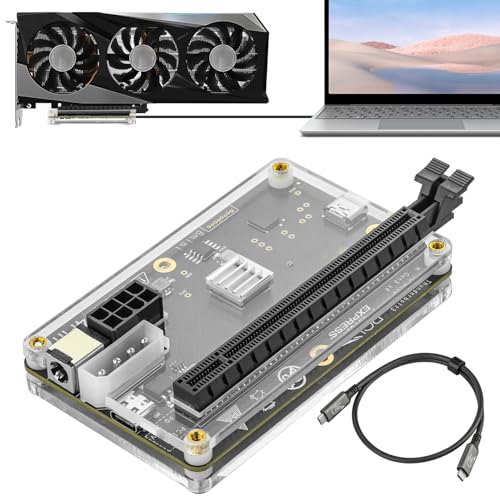
PCIE 3.0 x16 22Gbps eGPU DOCK, Thunderbolt 4 cable, compatible with external GPU NVIDIA AMD Graphics Card for Windows Laptop Console featuring Thunderbolt 3/4 USB 4, Powered by PD/8PinCPU/Molex/DC5521
- Compatible Graphics Cards: Supports NVIDIA and AMD GPUs with drivers
- Device Compatibility: Works with Windows, Linux, Thunderbolt devices
- Transfer Speed: Up to 22Gbps with JHL6340 controller
As an affiliate, we earn on qualifying purchases.
As an affiliate, we earn on qualifying purchases.
Remaining Questions About Compatibility and Longevity
While many models support current high-end GPUs, it is still unclear how well these external enclosures will handle future GPU releases or software updates. Compatibility with upcoming AI hardware and standards remains to be tested, and long-term durability of some designs is yet to be confirmed.

OwlTree PCIe 5.0 x4 128Gbps eGPU Dock, for 50 Series Graphics Cards, M.2 NVME to PCIe x16 Riser Cable 50cm, Supports Standard ATX Power Supply & External GPU for Mini PC NUC Laptop
- Package Contents: NVMe M.2 to PCIe x16 enclosure, 50cm cable
- Compatibility: Supports NVMe M.2 interfaces on laptops and motherboards
- Supported Graphics Cards: NVIDIA RTX 50 Series, AMD RX 90xx Series, PCIe 5.0 cards
As an affiliate, we earn on qualifying purchases.
As an affiliate, we earn on qualifying purchases.
Upcoming Releases and Compatibility Improvements in 2026
Manufacturers are expected to introduce new models with enhanced PCIe 5.0 support, better cooling, and increased power delivery within the next few months. AI developers should anticipate firmware updates and new enclosure designs that improve compatibility with future GPU architectures, ensuring sustained performance and expandability.

K80 24GB Graphics GPU for accelerating Machine Learning
- Graphics Card Model: K80 24GB GPU
- Intended Use: Accelerates Machine Learning
As an affiliate, we earn on qualifying purchases.
As an affiliate, we earn on qualifying purchases.
Key Questions
Can I use any external GPU with my laptop?
Compatibility depends on your laptop’s connection standards (Thunderbolt 3/4 or USB4) and physical GPU size. Always verify the enclosure’s supported GPU dimensions and your device’s port support before purchasing.
How much performance boost can I expect from an external GPU for AI tasks?
A high-quality external GPU can significantly accelerate AI training and inference, often approaching desktop GPU performance levels. The actual boost depends on the GPU and connection speed, with Thunderbolt 4 providing optimal bandwidth.
Are external GPUs worth it for AI development?
Yes, especially for those needing portable high-performance graphics for machine learning, data processing, or real-time inference. They extend laptop capabilities without the need for a full desktop setup.
What should I consider when choosing an external GPU for AI work?
Focus on connection compatibility, power delivery, GPU support, and future-proof features like PCIe 4.0 or PCIe 5.0 support. Also, consider size, cooling, and upgrade options to match your long-term needs.
Source: ThorstenMeyerAI.com