
📊 Full opportunity report: Build vs Buy a Prebuilt AI Workstation on ThorstenMeyerAI.com — validation score, market gap, and execution plan.

Prime made for students and young adults
- Fast, free delivery for dorm and study essentials
- Prime Video and Amazon Music included
- Member-only deals
TL;DR
In 2026, prebuilt AI workstations often match or beat DIY prices due to supply chain issues. Buyers gain faster deployment and support, while builders retain control and customization. A hybrid approach is increasingly common.
In 2026, prebuilt AI workstations can often match or exceed the value of DIY builds in terms of cost, speed, and reliability, driven by component shortages and price fluctuations. This shift makes the buying option more attractive for many organizations seeking rapid deployment and operational support, while custom builders focus on control and flexibility.
Recent data indicates that the cost of sourcing high-end GPU components has increased due to global shortages, making DIY AI workstations more expensive and time-consuming to assemble. Meanwhile, vendors like Lambda and Puget now offer prebuilt systems with validated thermals, integrated software stacks, and warranties, often at comparable or lower prices than DIY options. These prebuilt systems can be delivered within 1-2 weeks, enabling faster deployment—crucial for organizations needing immediate AI capabilities.
Choosing between build and buy depends on priorities. Prebuilt systems excel in deployment speed, reliability, and support, reducing operational risks. Conversely, building offers maximum customization and control but demands significant technical expertise, time, and ongoing maintenance. Hidden costs such as troubleshooting, upgrades, and compliance also influence the total cost of ownership, often favoring prebuilt solutions despite their higher upfront price in some cases.
Overall, the landscape in 2026 favors hybrid approaches, where organizations combine prebuilt hardware with custom configurations to balance speed, cost, and control.
Build vs buy
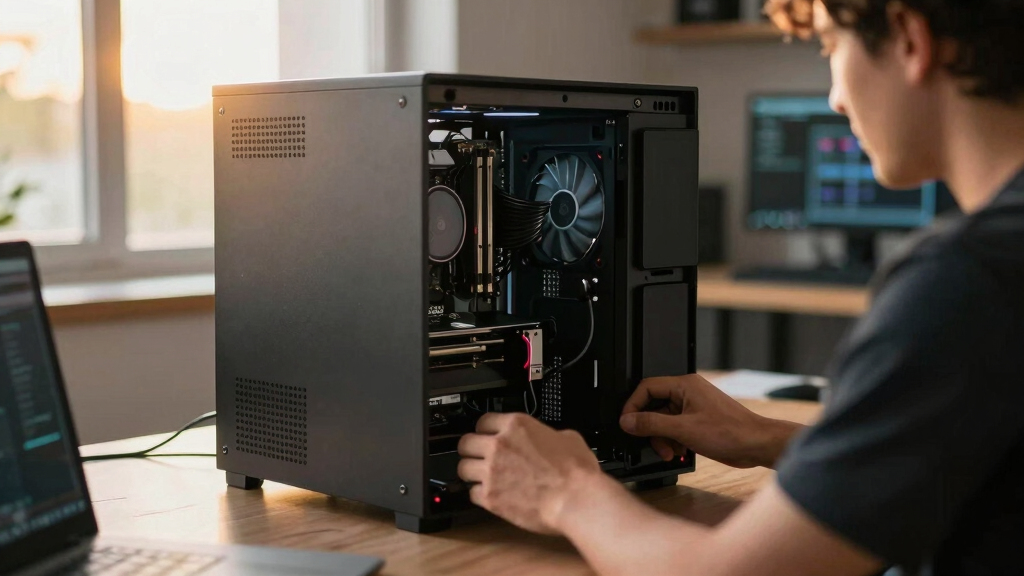
an AI workstation.
The real question behind this whole series: do you pull the five heat-and-noise levers yourself, or buy a prebuilt where the vendor pulled them for you? And in 2026, the old “building is cheaper” rule has broken. Match your situation in Part 3.
Impact of Supply Chain Disruptions on AI Hardware Choices
The shift toward prebuilt AI workstations reflects broader supply chain disruptions and rising component costs, making rapid deployment and operational reliability more critical. For organizations, this means faster time-to-value and reduced risk of hardware failures, which can be costly in AI projects. The trend emphasizes the importance of evaluating total ownership costs and strategic needs when choosing hardware solutions.
prebuilt AI workstation with high-end GPU
As an affiliate, we earn on qualifying purchases.
As an affiliate, we earn on qualifying purchases.
2026 Supply Chain and Market Dynamics for AI Hardware
Historically, building an AI workstation was often cheaper, with DIY costs around $1,000–$1,250 for high-end components. However, recent global chip shortages and price spikes have increased component costs, pushing DIY prices higher. Vendors like Lambda and Puget now leverage bulk purchasing and validated testing to offer prebuilt systems that can match or beat DIY prices. The availability of preconfigured, support-backed systems has shifted the decision landscape, especially for organizations that prioritize deployment speed and operational support.
Prior to 2026, the build option was favored for cost savings and customization, but current market conditions have blurred this advantage, making prebuilt solutions more appealing for many users.
"Our prebuilt AI systems are tested for thermals and stability, providing clients with ready-to-run solutions that reduce deployment time and operational risk."
— Representative from Lambda
customizable AI workstation build kit
As an affiliate, we earn on qualifying purchases.
As an affiliate, we earn on qualifying purchases.
Unresolved Questions About Long-Term Cost and Performance
It remains unclear how future supply chain developments will influence component prices and availability. Additionally, the long-term performance and upgradeability of prebuilt systems compared to custom builds are still being evaluated, especially as AI workloads evolve and hardware requirements change. Further data is needed on total cost of ownership over multiple years, including maintenance and upgrade costs.
professional AI workstation prebuilt
As an affiliate, we earn on qualifying purchases.
As an affiliate, we earn on qualifying purchases.
Future Trends in AI Hardware Procurement Strategies
As supply chains stabilize and new hardware generations emerge, organizations will likely reassess their build vs buy strategies. Hybrid models combining prebuilt systems with custom upgrades are expected to grow in popularity. Industry vendors may also expand support services and flexible configurations to meet evolving AI demands. Monitoring these developments will be critical for making informed procurement decisions in 2026 and beyond.
AI workstation with warranty and support
As an affiliate, we earn on qualifying purchases.
As an affiliate, we earn on qualifying purchases.
Key Questions
Is building an AI workstation still cheaper in 2026?
Not necessarily. Due to component shortages and price spikes, DIY builds often cost more than in previous years, and the time investment is significant. Prebuilt systems now offer competitive or lower prices with added support.
How long does it typically take to deploy a prebuilt AI workstation?
Most prebuilt systems can be delivered and set up within 1–2 weeks, enabling rapid deployment for urgent projects. DIY builds can take several weeks or longer due to sourcing and assembly challenges.
What are the main advantages of prebuilt AI workstations?
They include validated hardware performance, reduced setup time, warranty and support, and lower operational risk. These factors are especially valuable for organizations needing quick, reliable AI capabilities.
Can I customize a prebuilt AI workstation?
Yes, many vendors offer configurable options, but the extent of customization is generally less than building from scratch. Hybrid approaches are also common, combining prebuilt hardware with custom software or upgrades.
What should I consider when choosing between build and buy?
Priorities such as deployment speed, control, long-term ownership, and budget influence the decision. Organizations should evaluate total ownership costs, including hidden expenses like maintenance and troubleshooting.
Source: ThorstenMeyerAI.com
Halloween Picks
halloween
As an affiliate, we earn on qualifying purchases.