
Large format 3D printers open up new possibilities for creating bigger, more complex models. The best options balance build volume, print quality, and ease of use, but tradeoffs are common. For instance, some models excel at multi-material printing but come with higher costs, while others prioritize speed over detail. The Bambu Lab P2S Combo stands out as the overall top pick for its versatility and reliability, while the Creality Ender 5 Max offers a large build volume at a more accessible price. Continue reading for a detailed comparison of these options and more, helping you find the right fit for your needs.

Get school and study supplies delivered free — and shop member deals
- Fast, free delivery on millions of items
- Access to Prime Big Deal Days deals on October 6–7
- Prime Video, Amazon Music and more included
Complete the kit


Key Takeaways
- The top-ranked printers balance build volume with user-friendly features like auto-leveling and multi-material support.
- Price ranges vary widely; some high-end models offer advanced features but at a premium, while budget options focus on core functionality.
- Multi-color and multi-material capabilities are major differentiators, but they often increase complexity and cost.
- Speed and print quality are often inversely related; choosing the right model depends on your primary use case.
- Build chamber temperature and stability are critical for large prints, especially with materials like ABS or PETG.
| Bambu Lab P2S Combo, P2S 3D Printer & AMS 2 Pro, Multi-Color 3D Printing |  | Best Overall for Speed and Multi-Material Flexibility | Print Speed: 600 mm/s | Setup Time: 15 minutes | Filament Drying Temperature: 65 °C | VIEW ON AMAZON | See Our Full Breakdown |
| Bambu Lab P1S Combo 3D Printer with Multi-Color Printing and Auto Bed Leveling |  | Best for Versatile Multi-Color and Enclosed Printing | Product Dimensions: 15.31 x 18.03 x 15.31 inches | Item Weight: 40.8 pounds | Supported Filament: PLA, PETG, TPU, PVA, PET ABS, ASA | VIEW ON AMAZON | See Our Full Breakdown |
| Creality Ender 5 Max 3D Printer 400×400×400mm Large Build Volume, Fast Speed, Auto Leveling, All-Metal Frame & Dual Gear Extruder |  | Best for Large-Scale Batch Production and Oversized Models | Build Volume: 400×400×400 mm | Max Speed: 700 mm/s | Auto Leveling: 64-point | VIEW ON AMAZON | See Our Full Breakdown |
| FlashForge AD5X Multi-Material 3D Printer with 4-Color Printing and Auto Calibration |  | Best for Multi-Color, Multi-Material Precision in Compact Form | Build Speed: 600mm/s | Acceleration: 20000mm/s² | Materials Compatible: PLA, TPU, PETG, SILK, PLA-CF, PETG-CF | VIEW ON AMAZON | See Our Full Breakdown |
| QIDI Max4 Combo 3D Printer, 390×390×340mm Build Volume, 65℃ Heated Chamber |  | Best for Large, High-Temperature Industrial-Grade Printing | Build Volume: 390×390×340 mm | Heated Chamber: 65°C | Max Printing Speed: 800mm/s | VIEW ON AMAZON | See Our Full Breakdown |
| FLASHFORGE Adventurer 5M 3D Printer with Auto Leveling and High-Speed Printing |  | Best Overall for Speed and Convenience | Print Size: 220x220x220mm | Max Speed: 600mm/s | Extruder Temperature: 280°C | VIEW ON AMAZON | See Our Full Breakdown |
| Creality K2 Plus Combo 3D Printer with Multi-Color Filament System |  | Best for Multi-Color and Large-Scale Projects | Print Speed: 600mm/s | Print Precision: 0.05mm | Build Volume: 350×350×350mm | VIEW ON AMAZON | See Our Full Breakdown |
| QIDI Max4 3D Printer, 390×390×340mm Large Build Volume, 65℃ Heated Chamber |  | Best for Industrial-Grade Large Prints | Build Volume: 390×390×340mm | Heated Chamber: 65℃ | Maximum Speed: 800mm/s | VIEW ON AMAZON | See Our Full Breakdown |
| Creality K2 Combo (A) 3D Printer, Multicolor Printing, 600mm/s Speed, Auto Leveling, 260x260x260mm Build Volume |  | Best for Versatile, Multi-Material Small to Medium Projects | Build Volume: 260 x 260 x 260 mm | Printing Speed: 600 mm/s | Color Capabilities: Up to 16 colors | VIEW ON AMAZON | See Our Full Breakdown |
| FLASHFORGE AD5X Multi-Color 3D Printer, CoreXY, 600mm/s High-Speed, 1-Click Auto Leveling, 300°C Direct Drive Extruder | 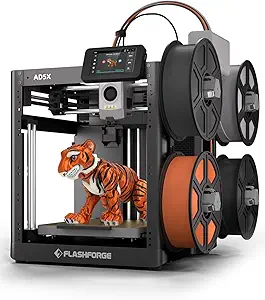 | Best for Multi-Color, High-Speed Industrial-Grade Printing | Build Volume: 220x220x220mm | Max Speed: 600mm/s | Extruder Temperature: 300°C | VIEW ON AMAZON | See Our Full Breakdown |
| large format 3d printer | Build Volume |
|---|---|
| Bambu Lab P2S Combo | — |
| Bambu Lab P1S Combo 3D Printer | — |
| Creality Ender 5 Max 3D Printe | 400×400×400 mm |
| FlashForge AD5X Multi-Material | — |
| QIDI Max4 Combo 3D Printer | 390×390×340 mm |
| FLASHFORGE Adventurer 5M 3D Pr | — |
| Creality K2 Plus Combo 3D Prin | 350×350×350mm |
| QIDI Max4 3D Printer | 390×390×340mm |
| Creality K2 Combo | 260 x 260 x 260 mm |
| FLASHFORGE AD5X Multi-Color 3D | 220x220x220mm |
More Details on Our Top Picks
Bambu Lab P2S Combo, P2S 3D Printer & AMS 2 Pro, Multi-Color 3D Printing
The Bambu Lab P2S Combo stands out for its ability to combine ultra-fast printing speeds of up to 600 mm/s with seamless multi-color and multi-material capabilities via the AMS 2 Pro. Compared with the QIDI Max4, it offers a more streamlined workflow with automatic calibration, though it doesn’t support multi-color printing without the combo. Its high speed and advanced features make it ideal for professionals needing rapid prototyping, but the complex setup may challenge beginners. The smart airflow and drying system optimize print quality across materials, although the lack of multi-color support in the base P2S model limits versatility for less technical users.
Pros:- Speeds up to 600 mm/s for rapid prototyping
- Automatic calibration reduces setup time
- Multi-material/multi-color support via AMS 2 Pro
- Smart airflow system enhances print quality
Cons:- Multi-color printing unsupported without Combo package
- Complex features require learning curve for newcomers
- Higher cost due to advanced technology
Best for: Professionals and advanced hobbyists seeking rapid, multi-material, multi-color prints with minimal downtime
Not ideal for: Beginners or users who prioritize simple operation over advanced multi-material features
- Print Speed:600 mm/s
- Setup Time:15 minutes
- Filament Drying Temperature:65 °C
- Chamber Temperature:50 °C
- Filament Compatibility:Multi-color/multi-material (AMS 2 Pro)
Our verdict“This printer suits experienced users demanding high-speed, multi-material, multi-color production in a professional environment.”
Bambu Lab P1S Combo 3D Printer with Multi-Color Printing and Auto Bed Leveling
The Bambu Lab P1S Combo offers a well-rounded package with automatic bed leveling, high-speed printing up to 500 mm/s, and support for up to 16 colors, making it a versatile choice for creative projects. Compared to the Creality Ender 5 Max, it provides easier setup and more consistent multi-color results thanks to its enclosed design and auto leveling. While it excels in multi-material versatility, its connection to Bambu Lab’s AMS system means it’s less flexible for standalone use. Its weight of over 40 pounds makes portability a challenge, but this is less of an issue for dedicated workshop setups.
Pros:- Supports multi-color/multi-material printing up to 16 colors
- Automatic bed leveling enhances print quality
- Enclosed design improves performance with sensitive filaments
- High-speed printing reduces project times
Cons:- Requires Bambu Lab AMS for multi-color features
- Relatively heavy for portable use
- Limited compatibility with fiber-reinforced or exotic filaments
Best for: Creative makers and professionals wanting multi-color, multi-material capability in an enclosed, easy-to-use system
Not ideal for: Users needing a lightweight or portable machine, or those working with fiber-reinforced filaments requiring more robust support
- Product Dimensions:15.31 x 18.03 x 15.31 inches
- Item Weight:40.8 pounds
- Supported Filament:PLA, PETG, TPU, PVA, PET ABS, ASA
- Maximum Speed:500mm/s
- Auto Bed Leveling:Yes
Our verdict“Ideal for creative professionals seeking multi-color, multi-material printing in a reliable, enclosed setup.”
Creality Ender 5 Max 3D Printer 400×400×400mm Large Build Volume, Fast Speed, Auto Leveling, All-Metal Frame & Dual Gear Extruder
The Creality Ender 5 Max is built for high-volume, large-format printing with a 400×400×400mm build volume. Its speed peaks at 700 mm/s, making it suitable for rapid prototyping and batch manufacturing, especially compared to smaller, less powerful models. The 64-point auto leveling simplifies setup, while the all-metal frame ensures stability during high-speed operation. However, its high power consumption and size mean it requires substantial workspace and energy, and its complex setup may challenge those new to large-format printers. This model is an excellent choice for production environments where size and speed are priorities.
Pros:- Generous 400×400×400 mm build volume for large models
- High-speed operation up to 700 mm/s
- Automated 64-point leveling for consistent quality
- All-metal, reinforced frame for stability
Cons:- High energy consumption with 1000W heated bed
- Size and weight require significant workspace
- Setup complexity may deter beginners
Best for: Professional users and workshops needing large, oversized parts or batch production capabilities
Not ideal for: Home hobbyists with limited space or those new to 3D printing who prefer plug-and-play solutions
- Build Volume:400×400×400 mm
- Max Speed:700 mm/s
- Auto Leveling:64-point
- Frame:All-metal
- Heated Bed:1000W
Our verdict“Perfect for professionals needing large-scale, fast, and reliable 3D printing for industrial or batch projects.”
FlashForge AD5X Multi-Material 3D Printer with 4-Color Printing and Auto Calibration
The FlashForge AD5X excels in multi-color and multi-material printing within a compact, CoreXY design. Its ability to print four colors simultaneously makes it a strong choice for vibrant, detailed prototypes, especially when compared to the QIDI Max4, which offers larger volume but less multi-color flexibility. The AD5X’s auto calibration and vibration compensation ensure sharp first layers and reliable results, though its filament compatibility is limited to standard materials, and the advanced features can be overwhelming for beginners. Its high speed of 600 mm/s boosts productivity without sacrificing detail, making it suited for demanding creative projects.
Pros:- Supports four-color simultaneous printing
- High-speed operation at 600 mm/s
- Auto calibration ensures consistent quality
- Compact, all-metal CoreXY structure
Cons:- Limited to certain filament types
- Complex features may intimidate novices
- Higher cost compared to basic printers
Best for: Designers and educators needing precise multi-color/multi-material prints in a space-efficient machine
Not ideal for: Users working with high-temperature or fiber-reinforced filaments, or beginners preferring simple operation
- Build Speed:600mm/s
- Acceleration:20000mm/s²
- Materials Compatible:PLA, TPU, PETG, SILK, PLA-CF, PETG-CF
- Color Capability:4-color printing
- Auto Leveling:Yes
Our verdict“A strong choice for multi-color, multi-material projects requiring high speed and precision in a compact setup.”
QIDI Max4 Combo 3D Printer, 390×390×340mm Build Volume, 65℃ Heated Chamber
The QIDI Max4 Combo provides a massive 390×390×340mm build volume suitable for large industrial parts and complex prototypes. Its 65°C heated chamber supports high-temperature materials like ABS and nylon, outperforming many smaller, less capable large-format printers like the Creality Ender 5 Max. Equipped with smart AI camera monitoring, it offers enhanced control and error detection, though its maximum speed of 800mm/s requires careful calibration. The need for a separate polar cooler adds an extra step to setup, and its advanced features present a learning curve for beginners, making it best suited for experienced users with ample workspace.
Pros:- Largest build volume in this roundup for oversized parts
- Supports high-temperature materials like nylon and ABS
- Smart AI camera for real-time monitoring
- Expandable multi-color capability
Cons:- Separate cooler purchase required
- Complex setup and calibration process
- High power and space demands
Best for: Professionals and advanced enthusiasts printing large, high-temperature components or complex industrial parts
Not ideal for: Beginners or hobbyists with limited space or those prioritizing plug-and-play simplicity
- Build Volume:390×390×340 mm
- Heated Chamber:65°C
- Max Printing Speed:800mm/s
- Material Compatibility:High-temp materials like ABS, nylon
- Touch Screen:Yes
Our verdict“Best suited for industrial-grade large prints requiring high-temperature support and advanced monitoring, with a readiness for complex setup.”
FLASHFORGE Adventurer 5M 3D Printer with Auto Leveling and High-Speed Printing
The FLASHFORGE Adventurer 5M shines for its blend of fast printing up to 600mm/s and user-friendly features like automatic bed leveling, making it ideal for those prioritizing quick turnaround times and easy setup. Its coreXY all-metal structure ensures reliable performance, and remote monitoring adds convenience. Compared with the Creality K2 Plus, it offers faster speeds but has fewer options for multi-color printing. The tradeoff is that its reliability appears mixed based on user ratings, and long-term durability remains uncertain without extensive feedback. Still, for users who want rapid, reliable results with minimal fuss, this model fits the bill.
Pros:- Automatic bed leveling simplifies setup and ensures consistent quality
- High-speed printing drastically reduces production time
- Fast warm-up and versatile nozzle options improve efficiency
- Remote monitoring via mobile app enhances workflow control
Cons:- Limited detailed feedback on long-term durability
Best for: Hobbyists or small businesses needing fast, reliable prints with minimal calibration effort
Not ideal for: Users seeking extensive multi-color capability or large build volumes for complex projects
- Print Size:220x220x220mm
- Max Speed:600mm/s
- Extruder Temperature:280°C
- Nozzle:3S Detachable Nozzle
- Build Structure:CoreXY All Metal
- Item Weight:22 pounds
Our verdict“This printer works best for users who need quick, straightforward prints and can accept some reliability tradeoffs.”
Creality K2 Plus Combo 3D Printer with Multi-Color Filament System
The Creality K2 Plus Combo stands out for its impressive 350×350×350mm build volume and advanced multi-color filament system capable of dynamic blending, making it suitable for vibrant, detailed models. Its support for up to 16 colors with four CFS units offers creative flexibility unmatched by most large-format printers like the QIDI Max4. However, this versatility comes with complexity—setup can be challenging, and no filament is included, which might increase initial costs. While the system’s sophistication caters well to experienced users, beginners may find the learning curve steep. This makes it an excellent choice for those who want large, multicolor prints and are prepared for some technical setup.
Pros:- Supports up to 16 colors with dynamic blending for vibrant prints
- Large build volume ideal for complex models and prototypes
- Smart filament management minimizes failures
- AI monitoring enhances print reliability
Cons:- Filaments are not included, adding to upfront costs
- Complex system setup may challenge newcomers
Best for: Experienced hobbyists or professionals needing large, multicolor prototypes
Not ideal for: Beginners or users seeking a plug-and-play experience with minimal setup
- Print Speed:600mm/s
- Print Precision:0.05mm
- Build Volume:350×350×350mm
- Filament System:CFS with four slots
- Noise Level:45dB
- Frame Material:Aerospace-grade aluminum alloy
Our verdict“Perfect for those who want expansive, multicolor prints but are comfortable with technical assembly and setup.”
QIDI Max4 3D Printer, 390×390×340mm Large Build Volume, 65℃ Heated Chamber
The QIDI Max4 offers a substantial 390×390×340mm build space, making it ideal for printing large, complex parts like industrial prototypes. Its heated chamber supports high-temperature materials such as ABS and carbon fiber-reinforced nylons, giving it an edge over many smaller or lower-temperature printers like the FLASHFORGE AD5X. The smart AI camera aids in error detection and real-time monitoring, but the heavy, bulky design—combined with the need to purchase a polar cooler separately—means it’s better suited for dedicated workspace setups. Its high speed of 800mm/s is impressive, but may require careful management to maintain print quality. This model caters to professionals and serious enthusiasts handling large-scale projects.
Pros:- Enormous build volume supports large parts and complex assemblies
- Supports high-temperature and abrasive materials for industrial applications
- Smart AI camera for seamless error detection
- User-friendly touch screen interface
Cons:- Heavy and bulky design complicates placement and transport
- Requires an additional polar cooler for optimal operation
Best for: Industrial users or advanced enthusiasts printing large, high-temperature materials
Not ideal for: Small-scale hobbyists or those with limited space due to its size and weight
- Build Volume:390×390×340mm
- Heated Chamber:65℃
- Maximum Speed:800mm/s
- Print Bed:Full-surface silicone heated bed
- Material Compatibility:PLA, ABS, nylon, high-temp materials
- Dimensions:28 x 28 x 30 inches
Our verdict“Best suited for professional environments requiring large, high-temperature prints with smart monitoring features.”
Creality K2 Combo (A) 3D Printer, Multicolor Printing, 600mm/s Speed, Auto Leveling, 260x260x260mm Build Volume
The Creality K2 Combo (A) offers a compact yet capable solution for multicolor printing with up to 16 colors, supported by four CFS units. Its 260×260×260mm build volume strikes a balance between size and versatility, making it suitable for a variety of small to medium projects. Auto leveling with AI camera simplifies setup, and its quiet operation appeals to shared workspaces. Compared to the larger QIDI Max4, it’s more manageable in smaller environments, but its smaller build volume limits large or highly complex parts. This model is ideal for users who want multicolor versatility in a compact footprint without sacrificing speed or material flexibility.
Pros:- Supports up to 16 colors with multiple CFS units
- Pre-assembled for quick setup
- Quiet operation suitable for shared environments
- Auto leveling simplifies calibration
Cons:- Setup for multiple CFS units can be technically demanding
- Limited build volume for large or complex models
Best for: Creative professionals or hobbyists needing multicolor prints in limited space
Not ideal for: Large-scale industrial printing or projects requiring extensive build volume
- Build Volume:260 x 260 x 260 mm
- Printing Speed:600 mm/s
- Color Capabilities:Up to 16 colors
- Auto Leveling:Yes
- Pre-assembled:Yes
- Supported Materials:PLA, PETG, ABS, PLA-CF
Our verdict“Ideal for users seeking multicolor capabilities in a compact, easy-to-setup package for small to medium projects.”
FLASHFORGE AD5X Multi-Color 3D Printer, CoreXY, 600mm/s High-Speed, 1-Click Auto Leveling, 300°C Direct Drive Extruder
The FLASHFORGE AD5X leverages CoreXY mechanics and a 300°C direct drive extruder to deliver vibrant, multi-color prints at speeds up to 600mm/s. Its 1-Click auto leveling and smart features like resume printing make it a strong choice for demanding environments where quick, colorful prototypes are needed. While its 220x220x220mm build volume is smaller than some competitors like the QIDI Max4, it excels in fast, detailed multi-color production. The complex setup and high speed might challenge less experienced users, and managing print quality at such high speeds requires careful calibration. It’s well-suited for makers and professionals looking for rapid, multi-color, detailed results in a compact form.
Pros:- Supports multiple colors simultaneously for vibrant effects
- Fast speeds up to 600mm/s reduce production times
- 1-Click auto leveling ensures consistent quality
- Resumes printing after power outages
Cons:- Complex setup may require technical expertise
- High speeds can impact print quality if not carefully managed
Best for: Prototyping teams or advanced hobbyists focused on colorful, fast-turnaround projects
Not ideal for: Beginners or those needing large-scale or high-temperature material printing
- Build Volume:220x220x220mm
- Max Speed:600mm/s
- Extruder Temperature:300°C
- Nozzle Sizes:0.25mm to 0.8mm
- Auto Leveling:Yes
- Color Support:Up to 4 colors
Our verdict“Best for experienced users prioritizing rapid, multi-color, detailed prototypes with smart features.”

How We Picked
These large format 3D printers were selected based on a combination of build volume, print quality, ease of use, and feature set. Priority was given to models that demonstrate reliability, consistent performance, and versatility for different user needs—whether for hobbyist, educational, or professional applications. We also considered value for money, maintenance requirements, and the availability of support and upgrades. The ranking reflects a balanced view of these factors, emphasizing models that deliver the best overall experience for large-scale printing in 2026.Factors to Consider When Choosing Large Format 3d Printers
Choosing a large format 3D printer involves multiple considerations beyond just build size. Understanding these factors can help you avoid common pitfalls and select a model that aligns with your specific needs, whether for prototyping, manufacturing, or artistic projects. Here are key areas to evaluate:Build Volume and Size
While larger build volumes enable bigger prints, they also require more space and can increase costs. Consider your typical project size and whether the extra capacity justifies the price and footprint. Some models offer modular or expandable chambers, providing flexibility as your needs evolve.
Print Quality and Resolution
High-resolution prints demand precise motion systems and quality components, especially for large models where imperfections are magnified. Look for features like stabilized axes, quality extruders, and reliable cooling systems. Remember that larger prints may take longer, so speed and stability are equally important.
Material Compatibility and Chamber Conditions
Many large printers support a variety of filaments, but some require heated chambers for materials like ABS or PETG. Consider the materials you plan to use regularly and whether the printer’s chamber temperature and enclosure design support consistent results. Inadequate chamber control can lead to warping or layer separation on big prints.
Ease of Use and Maintenance
Features like auto-leveling, touchscreen interfaces, and quick-change nozzles simplify operation. However, larger machines often need more maintenance, so check for reliable support and accessible parts. Investing in a model with robust community or manufacturer support can save headaches down the road.
Price and Total Cost of Ownership
Prices for large format printers vary greatly, and so do ongoing costs for filament, upgrades, and maintenance. A higher upfront investment might reduce future expenses if it offers better durability, support, or multi-material capabilities. Balance your budget against anticipated usage to avoid overspending on features you won’t need.
Frequently Asked Questions
Can I print large models in one piece or do I need to split them?
Many large format 3D printers are capable of printing entire models in one piece, which can save time and improve structural integrity. However, extremely big prints might still require splitting designs into sections for practical reasons, such as reducing print time or fitting within the build volume. Consider your project requirements and whether your chosen printer supports multi-part assembly or seamless large prints.
What materials are compatible with large format 3D printers?
Most large printers support common filaments like PLA, PETG, and ABS, but some advanced models accommodate specialty materials such as nylon or composite filaments. Heated chambers and high-temperature extruders expand material options and improve print quality for challenging filaments. Always verify the specific material compatibility and chamber conditions before purchasing.
Is faster printing always better for large models?
Faster speeds can significantly reduce print times but often compromise detail and layer adhesion. For large projects, a balance must be struck—speeding up too much can lead to warping or layer separation. High-quality large printers often include features like high-speed extruders and stable motion systems to optimize both speed and quality for different tasks.
How important is an enclosed chamber for large prints?
An enclosed chamber helps maintain consistent temperatures, reducing warping and cracking, especially with ABS and other temperature-sensitive materials. For larger models, chamber stability becomes even more critical because temperature fluctuations are magnified across the big volume. If you plan to use materials requiring a stable environment, prioritize models with enclosure options.
What maintenance should I expect with large format 3D printers?
Large printers require regular maintenance, including bed leveling, extruder cleaning, and checking motion components. Enclosures and moving parts can accumulate dust or filament debris, impacting print quality. Choosing a model with accessible parts, clear maintenance procedures, and good support can reduce downtime and extend the printer’s lifespan.
Conclusion
For users seeking the best overall experience, the Bambu Lab P2S Combo offers exceptional versatility and reliability, making it ideal for professionals and serious hobbyists. Those prioritizing value will find the Creality Ender 5 Max a compelling choice for its large build volume at a more accessible price. Beginners aiming to start with large prints should consider the FLASHFORGE Adventurer 5M for its simplicity and auto-leveling features. For users needing multi-material or multi-color capabilities, models like the QIDI Max4 or FLASHFORGE AD5X stand out, though often at a higher cost. Matching your specific project size, material needs, and budget will help you identify the perfect large format 3D printer for 2026.
As an affiliate, we earn on qualifying purchases.Fall Picks
fall essentials