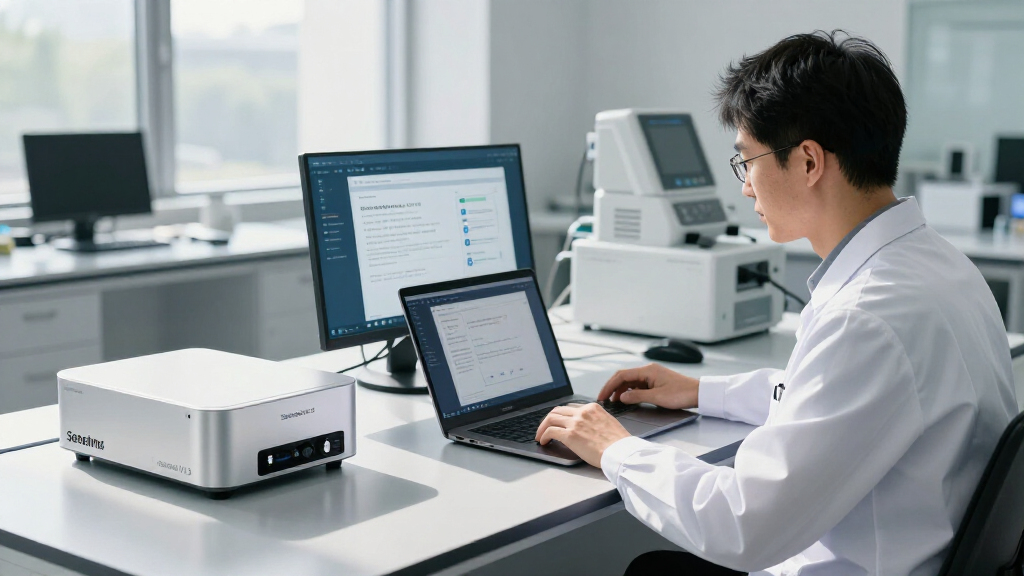

🔍 Read the full analysis: The Power Of Open Training In SenseTime SenseNova U1.5’s AI Framework on ThorstenMeyerAI.com

Prime made for students and young adults
- Fast, free delivery for dorm and study essentials
- Prime Video and Amazon Music included
- Member-only deals
TL;DR
SenseTime has announced the SenseNova U1.5 model, a 8-billion-parameter unified vision-language system built on a Mixture-of-Transformers architecture. The company has also released its training code publicly, marking a significant step toward transparency in multimodal AI research. Independent benchmark results and detailed licensing information are still pending, highlighting the importance of transparency in AI development, as discussed in this report.
SenseTime has announced the release of its SenseNova U1.5 model’s training code, a move that underscores its commitment to transparency and open research in the rapidly evolving field of multimodal AI. The 8-billion-parameter model, built on a Mixture-of-Transformers architecture, is designed as a natively unified vision-language system, and the release aims to enable external researchers to verify, reproduce, and adapt the training pipeline.
The SenseNova U1.5 model is positioned as a unified multimodal system that handles visual and textual data within a single architecture, rather than combining separate vision and language components. The model’s size, 8 billion parameters, makes it accessible for research labs and smaller companies with limited hardware resources, while still offering the potential for strong performance.
SenseTime’s decision to publish the training code—not just the model weights—marks a notable shift toward transparency. This allows external entities to verify the architecture’s design, study its training dynamics, and customize it for new domains. However, the initial announcement did not specify whether the model weights are also openly available or clarify licensing terms for commercial use. Additionally, detailed information about training datasets, hardware requirements, and benchmark results remains undisclosed, with independent evaluations still forthcoming.
Impact of Open Training Code on AI Transparency
The release of training code by SenseTime is significant because it raises transparency standards in the development of large-scale multimodal models. Unlike many competitors that only publish model weights, providing the training pipeline enables the research community to reproduce and scrutinize the model’s construction, fostering trust and innovation.
Furthermore, in a competitive landscape where open models are becoming a strategic differentiator, SenseTime’s move could influence industry norms and encourage other companies to adopt similar transparency practices. Given the company’s recent shift toward its SenseNova platform amidst geopolitical pressures, this openness may also be part of a broader strategy to rebuild developer engagement and credibility in AI research.
As an affiliate, we earn on qualifying purchases.
Background of SenseTime’s AI Strategy and Model Development
SenseTime, historically known for its expertise in facial recognition and computer vision, has been repositioning itself around its SenseNova generative AI platform since 2023. The company has launched several large language and multimodal models, aligning with a broader trend among Chinese AI firms to embrace open research as a means of accelerating adoption and collaboration. The Mixture-of-Transformers architecture used in U1.5 is part of a class of sparse-architecture models designed to efficiently handle multiple modalities within a single framework, aiming to overcome the limitations of separate vision and language encoders.
While the technical design has been announced, detailed performance metrics, benchmark results, and dataset specifics are still pending independent validation. The move to release training code follows a pattern seen in other industry players aiming to foster transparency and community engagement, especially amid geopolitical and market pressures that challenge proprietary AI development.
As an affiliate, we earn on qualifying purchases.
Unverified Performance and Licensing Details
At present, independent benchmark results for SenseNova U1.5 have not been published, so claims about its performance remain unconfirmed. It is also unclear whether the released code includes pre-trained weights or only the training pipeline, and what licensing terms apply for commercial use. The composition of training datasets, hardware costs, and direct comparisons with other 8B models are still unknown, making it difficult to assess the model’s competitiveness or practical deployment potential at this stage.
As an affiliate, we earn on qualifying purchases.
Expected Third-Party Evaluations and Technical Clarifications
Within the coming weeks, expect independent researchers to attempt reproducing the training process using the released code, which will provide insights into the model’s actual capabilities. SenseTime is likely to publish additional technical documentation, clarify licensing terms, and possibly release model weights for broader use. The first credible benchmark evaluations will be crucial in determining whether U1.5 offers tangible advantages over existing models, influencing its adoption in research and industrial applications.
As an affiliate, we earn on qualifying purchases.
Key Questions
Will the SenseNova U1.5 model weights be publicly available?
It has not yet been confirmed whether the pre-trained model weights will be released alongside the training code. The initial announcement focused on the code, with further details expected in the coming weeks.
What are the licensing terms for using the SenseNova U1.5 code?
Licensing details have not been specified in the initial announcement. Clarification from SenseTime is anticipated as the code is reviewed and tested by external researchers.
How does the Mixture-of-Transformers architecture differ from traditional models?
This architecture involves multiple transformer components handling different modalities or tasks within a single unified framework, aiming to improve efficiency and avoid information bottlenecks present in separate vision and language encoders.
When will independent benchmark results for U1.5 be available?
Third-party evaluations are expected within weeks, once researchers attempt to reproduce the training process and test the model on standard multimodal benchmarks.
What is the significance of open training code in AI development?
Open training code enhances transparency, allows verification of model claims, fosters community collaboration, and can accelerate innovation by enabling researchers to adapt and improve models more easily.
Source: ThorstenMeyerAI.com
Halloween Picks
halloween
As an affiliate, we earn on qualifying purchases.