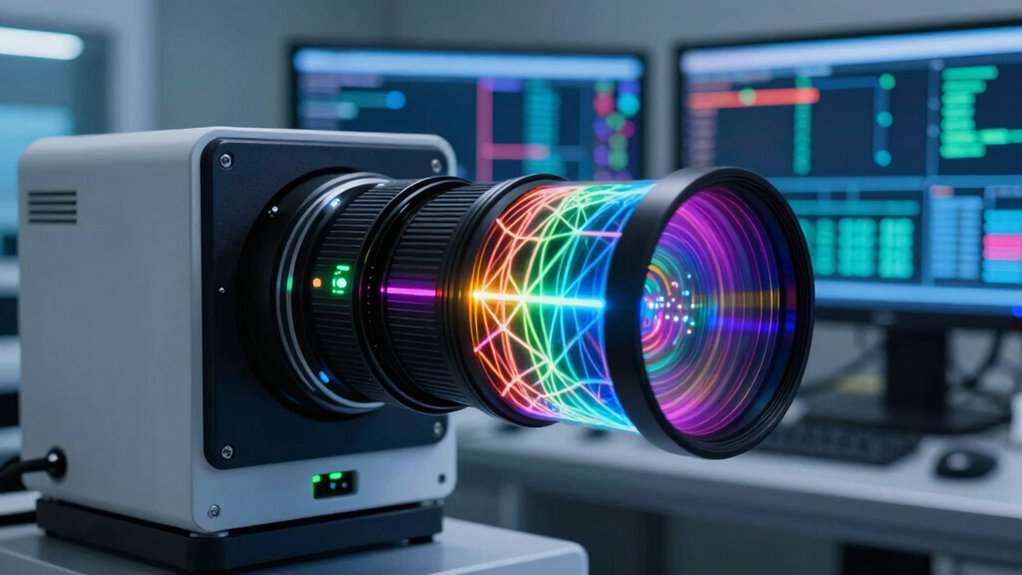

Advanced imaging hardware is expanding your perception by letting you see beyond what your eyes can naturally observe. It uses technologies like quantum sensing to detect tiny signals and phenomena that were once invisible, such as subtle magnetic or electrical fields, and internal biological processes. With neural interfaces, you can even visualize or project internal structures directly into your mind. If you keep exploring, you’ll discover how these breakthroughs push human senses into a whole new domain.

Prime made for students and young adults
- Fast, free delivery for dorm and study essentials
- Prime Video and Amazon Music included
- Member-only deals
Key Takeaways
- Advanced imaging hardware surpasses natural sight by detecting phenomena beyond human visual limits using quantum sensing technology.
- Neural interfaces enable real-time visualization and projection of internal structures directly into human perception.
- Integration of quantum sensors with portable devices allows field measurements and immediate data interpretation outside labs.
- Technologies combine to create augmented reality experiences rooted in high-sensitivity, quantum-level data.
- These innovations redefine perception, allowing humans to view beyond the visible spectrum and interpret signals at a quantum level.

Advancements in imaging hardware are transforming the way we perceive the world around us, pushing the boundaries of human sight beyond natural limits. With cutting-edge technology like quantum sensing, you can now detect phenomena previously invisible to the naked eye. Quantum sensing leverages the principles of quantum mechanics to achieve unprecedented sensitivity in measuring magnetic and electric fields, temperature, and even gravitational variations. This allows you to see subtle changes in environments, from medical diagnostics to geological surveys, with remarkable precision. Imagine being able to detect minute brain activity or trace tiny magnetic signals, giving you insights into complex biological and physical processes that were once out of reach.
Quantum sensing reveals hidden phenomena, enabling precision insights into biological, physical, and environmental processes previously beyond reach.
Neural interfaces further expand your perception by directly connecting your brain to advanced imaging systems. These interfaces enable real-time data transfer, allowing you to interpret signals from devices that visualize internal structures with extraordinary clarity. For example, through neural interfaces, you could potentially see inside a living body without invasive procedures, observing blood flow, tissue health, or neural activity as it happens. This technology bridges the gap between human senses and machine-enhanced perception, transforming how you interpret sensory information. Instead of relying solely on external displays, neural interfaces can project images directly into your mind, creating a seamless integration of machine and human perception. The integration of advanced imaging systems with neural technology is rapidly evolving, opening new possibilities for sensory augmentation.
Together, quantum sensing and neural interfaces are revolutionizing imaging technology, making it more precise and accessible. Quantum sensors can be integrated into portable devices, enabling you to perform complex measurements in the field rather than in specialized labs. Meanwhile, neural interfaces can adapt these images directly into your consciousness, removing the need for external screens and allowing for instant, intuitive understanding of complex data. This synergy pushes human perception into a new domain, where the limits of natural sight are no longer barriers but challenges to be surpassed. You could experience a form of augmented reality rooted in real-world data, providing insights that are both immediate and deeply detailed.
Ultimately, these innovations empower you to see beyond the visible spectrum, interpret signals at a quantum level, and connect with imaging systems through your neural pathways. They redefine what it means to perceive, opening doors to discoveries in medicine, environmental science, security, and beyond. As these technologies continue to evolve, your understanding of the universe becomes richer, more nuanced, and more interconnected than ever imagined. Quantum sensing is at the forefront of expanding human perception, enabling new realms of exploration and understanding.
As an affiliate, we earn on qualifying purchases.
Frequently Asked Questions
How Does Imaging Hardware Improve Real-Time Perception?
Imaging hardware improves your real-time perception by enhancing sensor accuracy and processing speed. It captures detailed visuals quickly, allowing you to interpret surroundings more precisely and respond faster. Advanced sensors reduce errors, giving clearer images, while faster processing ensures data is analyzed instantly. This combination helps you perceive your environment more clearly and react more effectively, making your interactions with the world more accurate and immediate.
What Are the Ethical Concerns With Advanced Imaging Technology?
Like Orwell’s Big Brother, advanced imaging tech raises serious privacy concerns, knowing what you see or reveal can be exploited. You should consider ethical regulations that keep this technology from infringing on personal rights, ensuring transparency and accountability. Without proper safeguards, misuse could lead to surveillance, discrimination, or loss of autonomy. It’s essential you support policies that balance innovation with respect for individual privacy and ethical standards.
Can Imaging Hardware Detect Hidden or Obscured Objects?
Yes, imaging hardware can detect hidden or obscured objects through techniques like X-ray, MRI, or radar, which excel at object concealment and obscured detection. These technologies penetrate materials or surfaces that block normal vision, revealing what’s hidden behind walls, inside objects, or beneath the skin. You can rely on advanced imaging for precise detection, making it invaluable in security, medical diagnostics, and scientific research.
How Accessible Is Advanced Imaging Hardware Globally?
Advanced imaging hardware’s global accessibility varies widely. In developed countries, you have easier access due to better infrastructure and lower cost barriers, but in developing regions, high costs and limited resources restrict availability. You might find some affordable options, but cutting-edge systems often remain out of reach for many. Overall, while progress is ongoing, cost barriers still hinder universal access to the latest imaging technology worldwide.
What Are Future Innovations in Imaging Technology?
Future innovations in imaging technology seem to promise you’ll see the invisible—thanks to quantum sensors and neural interfaces. Ironically, as these tools become more advanced, they might reveal just how limited our natural senses truly are. Expect sharper images and real-time brain data, making perception more data-driven and less intuitive. These breakthroughs will challenge your understanding of reality, pushing boundaries you never knew existed, all while subtly questioning what “seeing” really means.
As an affiliate, we earn on qualifying purchases.
Conclusion
As you explore the frontiers of imaging technology, remember that these innovations are transforming how you see the world—literally. With devices capable of capturing images beyond the visible spectrum, you’re now part of a universe where 95% of the electromagnetic spectrum remains unseen to the naked eye. This leap in perception lets you uncover hidden details, revealing a richer, more intricate reality. Embrace these advancements, and you’ll find your understanding of the world expanding in astonishing ways.
portable magnetic field detector
As an affiliate, we earn on qualifying purchases.
As an affiliate, we earn on qualifying purchases.
As an affiliate, we earn on qualifying purchases.
Halloween Picks
halloween
As an affiliate, we earn on qualifying purchases.