
Acoustic levitation devices use sound waves to suspend objects mid-air by creating standing waves with pressure nodes and antinodes. You can control these systems with focus and real-time adjustments, often using components like transducers and advanced algorithms. They can manipulate delicate samples or small particles without contact, with recent tech improvements ensuring stability and precision. If you explore further, you’ll discover how ongoing innovations are expanding their capabilities and applications.
Key Takeaways
- Acoustic levitation devices use precisely tuned sound waves to create pressure nodes that suspend objects mid-air.
- They employ transducers, signal generators, and real-time control systems to generate and stabilize standing sound waves.
- Focused acoustic fields and adaptive feedback techniques enable precise manipulation and stable levitation of various objects.
- Advanced materials and holography enhance focus, stability, and multi-object control in acoustic levitation systems.
- Innovations aim to improve energy efficiency, scalability, and stability for broader practical applications.
The Science Behind Acoustic Levitation

Acoustic levitation relies on the power of sound waves to suspend objects in mid-air. The key is adjusting the sound frequency to create precise pressure nodes that hold objects steady. Higher or lower frequencies influence levitation stability; too high can cause instability, while ideal frequencies ensure the object remains balanced. When sound waves are properly tuned, they produce standing waves that generate areas of high and low pressure, effectively trapping small items. Maintaining levitation stability depends on controlling the sound frequency to sustain these pressure nodes consistently. This delicate balance allows objects to float without physical contact, showcasing the remarkable capabilities of sound-based technology. Understanding how sound frequency affects levitation is essential to developing effective acoustic levitation systems. Additionally, advances in Remote Hackathons could facilitate collaborative development of new acoustic levitation devices by teams worldwide.
How Sound Waves Suspend Objects

You can understand how sound waves suspend objects by looking at pressure nodes and antinodes, where energy concentrates and creates stable points. Standing wave formation allows these points to hold objects in midair, counteracting gravity. Precise sound control is essential to maintain these conditions and keep objects suspended reliably. Additionally, understanding the benefits of raw food can provide insights into natural and unprocessed approaches to health and nutrition.
Pressure Nodes and Antinodes
When sound waves travel through a medium, they create regions of varying pressure known as nodes and antinodes. These areas result from wave interference, where overlapping sound waves either reinforce or cancel each other. At nodes, destructive interference causes minimal pressure variation, while antinodes experience maximum pressure fluctuations. This pattern occurs due to resonance phenomena, where specific frequencies produce stable pressure points. In acoustic levitation, objects are positioned at pressure nodes, where the net force balances gravity. The pressure differences between nodes and antinodes generate the forces needed to suspend objects in mid-air. Understanding this pressure variation is essential for designing devices that manipulate sound waves precisely, harnessing wave interference to create stable levitation points without physical contact. Additionally, the pressure distribution is influenced by the frequency and amplitude of the sound waves, which determines the stability and size of the levitated objects.
Standing Wave Formation
Standing wave formation occurs when sound waves reflect and interfere within a medium, creating a pattern of alternating high and low pressure regions. This process relies on resonance phenomena, where specific frequencies cause waves to reinforce each other, forming stable nodes and antinodes. Wave interference is key here; when waves meet in phase, they amplify, while out-of-phase waves cancel each other out. These interactions produce a consistent pattern of pressure variations that can trap small objects at nodes, enabling levitation. Your device must generate the right frequency to establish a stable standing wave, ensuring the pressure nodes stay fixed. Headphone technology can be used to fine-tune sound delivery for precise wave formation, which is crucial for effective acoustic levitation. By understanding how wave interference shapes these patterns, you can manipulate the sound field to suspend objects effortlessly in midair.
Precise Sound Control
Achieving precise sound control is key to reliably suspending objects with acoustic levitation devices. You do this through advanced sound filtering techniques that isolate specific frequencies, ensuring only the desired sound waves interact with the object. Frequency modulation allows you to adjust the waves’ frequency in real-time, maintaining stable suspension and adapting to changes in object size or position. By fine-tuning these parameters, you create a focused acoustic field that holds objects steady in mid-air. Precise sound control also helps eliminate unwanted noise and interference, which could destabilize the levitation. When you master sound filtering and frequency modulation, you gain the ability to suspend a variety of objects with high accuracy, making acoustic levitation more reliable and versatile. Incorporating Crochet Styles for Locs can even inspire creative ways to visualize sound wave patterns for educational demonstrations.
Components of an Acoustic Levitation System
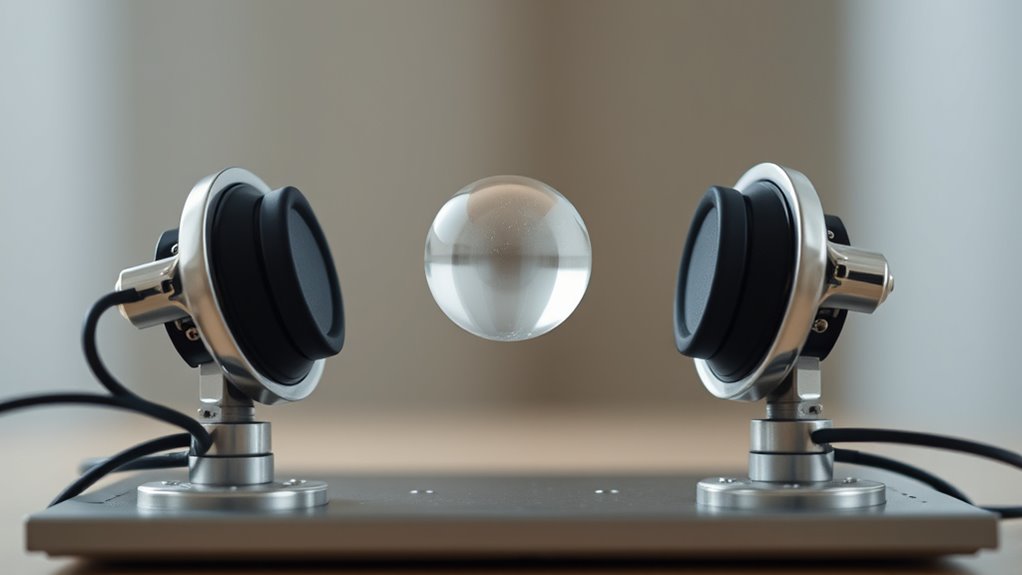
An acoustic levitation system relies on several key components that work together to suspend objects in mid-air using sound waves. You’ll need transducers to generate high-frequency sound, and precise sound wave modulation to control the levitation position. Signal generators produce the sound signals, while amplifiers boost their power. Modern device miniaturization allows compact setups, making the system more portable. The following table highlights essential parts:
| Component | Function | Key Feature |
|---|---|---|
| Transducers | Emit sound waves | High-frequency output |
| Signal Generator | Create sound wave patterns | Precise modulation |
| Amplifiers | Strengthen signals | Power efficiency |
Additionally, advancements in AI chip technology support more sophisticated control of sound wave modulation, enhancing levitation precision.
Techniques for Precise Object Manipulation
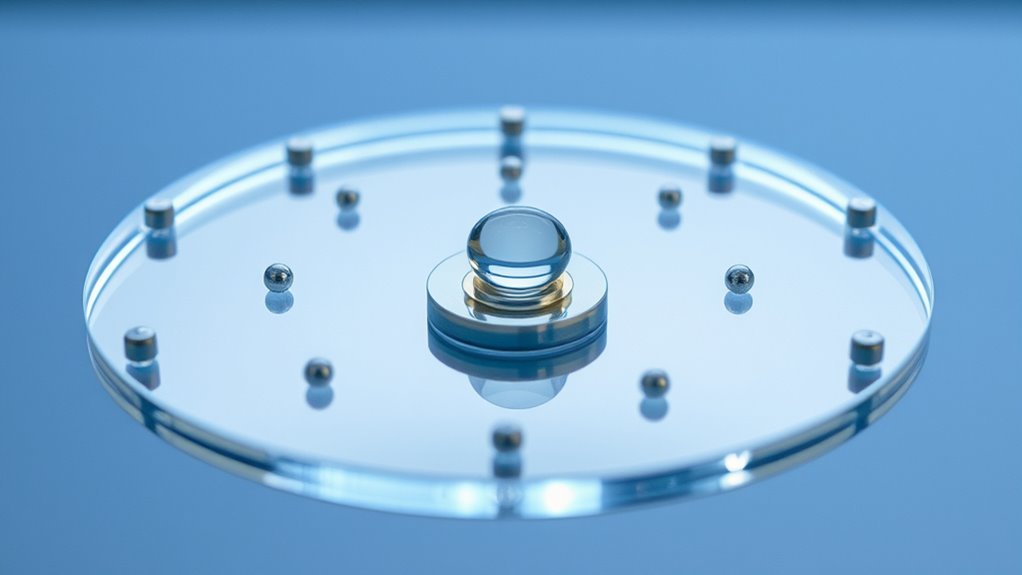
Once the components of an acoustic levitation system are in place, precise object manipulation becomes possible through advanced control techniques. You can adjust the sound field dynamically to position objects accurately, which is essential for delicate biological experiments where contamination must be minimized. In food processing, these techniques allow you to handle fragile items without physical contact, preserving quality and hygiene. By modulating phase and amplitude of sound waves, you can move objects in three dimensions with high precision. Feedback systems, like laser sensors or cameras, help you monitor object positions in real-time, ensuring stability. This combination of control methods enables you to manipulate tiny biological samples or fragile food items safely, efficiently, and with exceptional accuracy. Mindful decluttering techniques can also be applied to organize and optimize your workspace for more efficient operation of acoustic levitation devices.
Applications in Science and Industry

Acoustic levitation devices are transforming scientific research and industrial processes by enabling contactless manipulation of objects. In biomedical research, they allow for precise handling of delicate samples without contamination or damage, improving experimental accuracy. This technology also facilitates the study of fragile biological materials, such as cells or proteins, in controlled environments. Yoga techniques that promote mental clarity and focus can enhance researchers’ concentration during experiments. In environmental monitoring, acoustic levitation helps scientists analyze small particles or droplets suspended in air or liquids, providing real-time data without physical contact. These devices enable safer, cleaner testing methods and reduce contamination risks. Overall, acoustic levitation enhances research capabilities and streamlines industrial workflows, making it a valuable tool across multiple fields that require precise, contactless handling of sensitive materials.
Advancements in Acoustic Levitation Technology

Recent advancements have markedly improved the stability of acoustic levitation devices, allowing for more precise control. Researchers are also exploring new materials that enhance the effectiveness and versatility of levitation systems. These innovations are opening up exciting possibilities for practical applications across various fields. Additionally, understanding the safety measures involved in acoustic levitation is crucial as these technologies become more widespread.
Enhanced Stability Techniques
Advancements in acoustic levitation technology have considerably improved the stability of trapped objects, allowing for more precise control during experiments and applications. You now benefit from techniques like vibration damping, which reduces unwanted oscillations, and feedback stabilization, which continuously adjusts sound waves to keep objects steady. These methods prevent objects from drifting or wobbling, even in dynamic environments. Additionally, innovations in stability techniques from the grobal world have contributed to more reliable levitation performance. Technologies include: 1. Active vibration damping systems that absorb and minimize vibrations. 2. Real-time feedback stabilization that monitors object position and adjusts acoustics instantly. 3. Adaptive control algorithms that fine-tune sound pressure for consistent levitation. Together, these innovations enable longer, more reliable levitation sessions, expanding potential uses across research, manufacturing, and entertainment.
Novel Material Applications
Novel materials are transforming acoustic levitation by enabling the manipulation of objects with unique physical properties. Advances in biomaterial interfaces allow you to carefully handle delicate biological samples, improving precision in biomedical research and tissue engineering. Acoustic metamaterials, with their engineered structures, enhance control over sound waves, leading to more efficient and versatile levitation systems. These materials can focus or redirect acoustic energy, creating stable trapping zones for complex objects. By integrating these innovations, you gain the ability to levitate fragile materials or biological tissues without damage. This progress opens new avenues for medical applications and material science, allowing you to explore levitation techniques that were previously impossible. As novel materials continue to evolve, so will the capabilities and potential uses of acoustic levitation technology.
Challenges and Limitations

Despite their impressive capabilities, acoustic levitation devices face several significant challenges and limitations. One major issue is energy constraints; maintaining precise acoustic fields requires high power, limiting efficiency. Scalability issues also hinder widespread use, as larger setups become complex and costly to implement. Additionally, the stability of levitated objects can be unpredictable, especially with varying sizes or shapes. To overcome these challenges, engineers must optimize energy use and improve design scalability. Here are some specific limitations:
- High energy consumption for sustained operation
- Difficulties in scaling devices for larger objects or volumes
- Limited stability and control over complex or irregularly shaped objects
Future Perspectives and Innovations
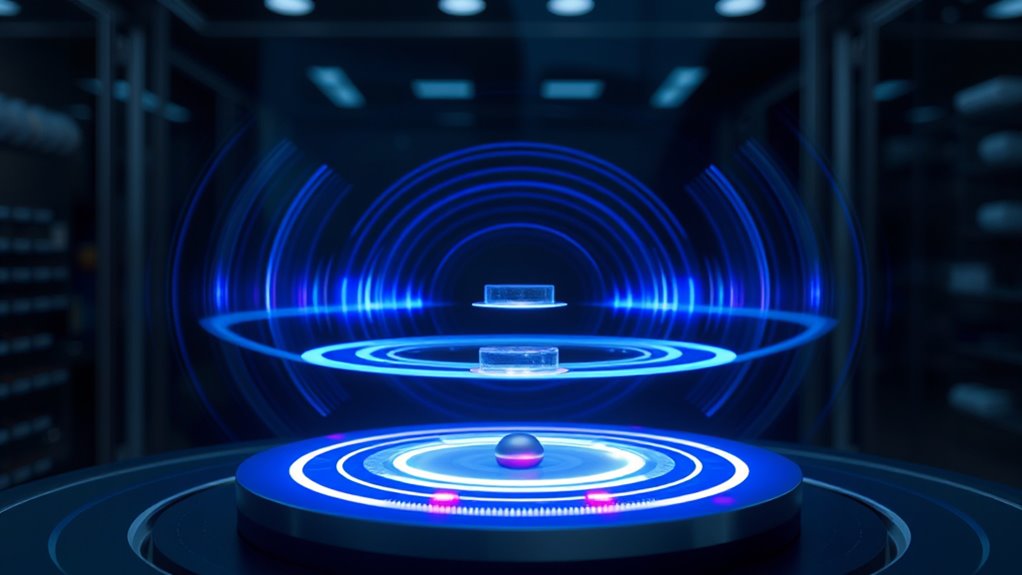
As researchers continue to address the challenges of energy consumption and scalability, innovative approaches are emerging to enhance the capabilities of acoustic levitation devices. Quantum resonance offers promising potential by enabling more efficient energy transfer at the atomic level, which could lead to lower power requirements and more stable levitation. Additionally, acoustic holography is advancing as a method to precisely shape sound fields, allowing you to manipulate multiple objects simultaneously with high accuracy. These innovations could liberate new applications in manufacturing, medicine, and research. By harnessing quantum effects and refining holographic techniques, you’ll see acoustic levitation evolve into more versatile, energy-efficient systems. This progress promises to expand the boundaries of what acoustic levitation can achieve in the future.
Frequently Asked Questions
Can Acoustic Levitation Work With Liquids or Gases?
You might wonder if acoustic levitation works with liquids or gases. It’s possible, but more challenging than with solids. Acoustic levitation can enable liquid manipulation and gas suspension, but you need specialized setups because liquids and gases respond differently to sound waves. While solids are easier to levitate, researchers are exploring ways to extend this technology for liquids and gases, opening new possibilities in scientific experiments and industrial applications.
What Are the Safety Concerns Using Acoustic Levitation Devices?
Using acoustic levitation devices isn’t a walk in the park; safety concerns are real and significant. You need to prioritize hazard mitigation and follow strict safety protocols to prevent accidents or injuries. The powerful sound waves involved could cause hearing damage or interfere with sensitive equipment. Always wear protective gear and ensure proper training. By doing so, you safeguard yourself and others from potential dangers lurking in this fascinating technology.
How Energy-Efficient Are Acoustic Levitation Systems?
You’re curious about how energy-efficient acoustic levitation systems are. These devices typically have moderate energy consumption, as they need continuous sound waves to keep objects floating. Efficiency metrics vary depending on size and application but generally focus on how well the system uses power to maintain levitation. While they can be energy-intensive, advancements aim to improve their efficiency, reducing power needs without sacrificing performance.
Can Acoustic Levitation Be Scaled for Larger Objects?
You wonder if acoustic levitation can be scaled for larger objects. Scaling challenges include increased power requirements and maintaining stable sound fields. Size limitations arise because larger objects need stronger and more precisely controlled sound waves, which can be difficult to generate and sustain. While technically feasible, you’ll face significant engineering hurdles to overcome these challenges, making it complex to safely and reliably levitate bigger items using sound waves.
What Are the Environmental Impacts of Acoustic Levitation Technology?
Think of acoustic levitation as a gentle breeze through a forest. While it uses sound waves, it can create noise pollution that disturbs wildlife. You should consider how high-frequency sounds might impact ecosystems, potentially upsetting animal communication or migration. Though eco-friendly in some ways, the technology’s environmental footprint depends on how you manage sound levels and wave intensity, ensuring you minimize wildlife disturbance and protect natural harmony.
Conclusion
Now that you understand how acoustic levitation works, imagine the endless possibilities it offers—from delicate scientific experiments to innovative manufacturing. As technology advances, you might wonder, what incredible discoveries could sound waves help us achieve next? With each breakthrough, you’re reminded that the future of science is built on the power of sound. Are you ready to see how these floating wonders will change our world?