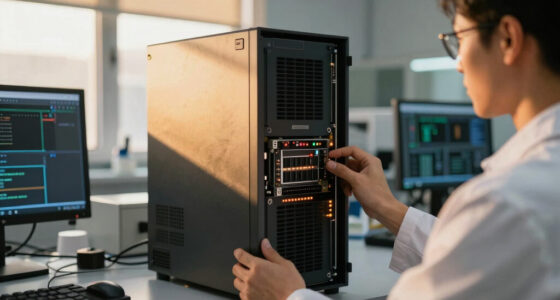
Neuromorphic chips mimic the architecture and functionality of the human brain, allowing you to experience computing that’s more efficient and adaptable. These chips use spiking neural networks, which enable real-time learning and dynamic processing. They consume less power, making them ideal for applications in AI, robotics, and IoT devices. With their ability to handle complex decision-making and ambiguous data, these chips could revolutionize how you interact with technology. There’s more to uncover about their potential.

Prime made for students and young adults
- Fast, free delivery for dorm and study essentials
- Prime Video and Amazon Music included
- Member-only deals
Key Takeaways
- Neuromorphic chips mimic the human brain’s architecture, utilizing spiking neural networks for dynamic and efficient data processing.
- They offer significant energy efficiency, consuming less power than traditional processors, enhancing sustainability in computing.
- These chips replicate neural structures, enabling real-time learning and adaptability in complex decision-making processes.
- Applications span healthcare, robotics, AI development, and IoT, facilitating faster analysis, natural interactions, and smarter systems.
- Neuromorphic computing focuses on intelligence over speed, improving handling of ambiguity and enhancing machine learning capabilities.
As technology continues to evolve, neuromorphic chips are emerging as a groundbreaking solution that mimics the human brain’s architecture and functioning. These innovative chips represent a shift toward brain-inspired architectures, enabling machines to process information in ways that resemble human cognition. Instead of traditional computing methods that rely on binary operations, neuromorphic chips use spiking neural networks, which allow for more dynamic and efficient processing of data.
Neuromorphic chips revolutionize computing by mimicking human brain functions, enabling efficient, brain-inspired information processing.
You might be wondering why this matters. Well, neuromorphic chips excel at energy-efficient processing. In a world increasingly focused on sustainability, these chips consume considerably less power compared to conventional processors. This efficiency isn’t just a bonus; it’s essential for developing applications in areas like artificial intelligence, robotics, and Internet of Things (IoT) devices. By closely emulating the brain’s neural structure, they can perform complex calculations with minimal energy expenditure.
When you think about the way the human brain operates, it’s remarkable. It doesn’t just process information linearly; it’s constantly adapting and learning. Neuromorphic chips aim to replicate this adaptability, allowing machines to learn from their environment in real-time. This capability opens the door to advancements in machine learning, where systems can become smarter and more efficient without the need for extensive reprogramming.
Consider how this technology can impact various sectors. In healthcare, for instance, neuromorphic chips could analyze patient data more intuitively, leading to quicker diagnoses and personalized treatment plans. In robotics, they can enable robots to navigate and interact with their surroundings more naturally, mimicking human-like decision-making. As these chips become more prevalent, they could revolutionize how we interact with technology, making it more intuitive and responsive.
You may also appreciate that neuromorphic computing isn’t just about speed; it’s about intelligence. The brain-inspired architectures of these chips facilitate complex decision-making processes that traditional processors struggle with. They handle ambiguity and uncertainty better, which is vital for applications that require real-time input and response. Additionally, the development of supporting informational content for various applications can enhance the efficacy of neuromorphic chips in real-world scenarios.
neuromorphic computing development kit
As an affiliate, we earn on qualifying purchases.
As an affiliate, we earn on qualifying purchases.
Frequently Asked Questions
What Are the Main Applications of Neuromorphic Chips Today?
Today, you’ll find neuromorphic chips powering brain-inspired sensors and enhancing autonomous robotics. These chips mimic how your brain processes information, enabling machines to interpret sensory data and make decisions in real-time. They’re used in applications like smart cameras, drones, and self-driving vehicles, where quick, efficient processing is essential. By leveraging their unique architecture, you can achieve improved performance in tasks requiring adaptability and learning, revolutionizing how technology interacts with the environment.
How Do Neuromorphic Chips Differ From Traditional Processors?
Imagine if your phone could think like you do. Neuromorphic chips differ from traditional processors by using brain-inspired architectures that mimic the way neurons function. While traditional processors process information sequentially, these chips operate on parallel pathways, allowing them to handle complex tasks more efficiently. They excel in pattern recognition and learning, adapting to new information much like your brain does, making them ideal for advanced applications like artificial intelligence and robotics.
What Companies Are Leading in Neuromorphic Chip Development?
You’ll find several companies leading in neuromorphic chip development, including IBM, Intel, and Qualcomm. They’re focused on hardware innovation that mimics biological inspiration to enhance processing capabilities. IBM’s TrueNorth chip, for instance, showcases a brain-like architecture, while Intel’s Loihi aims to revolutionize AI applications. Qualcomm’s efforts also highlight the potential of neuromorphic designs in mobile computing. These companies are at the forefront of changing how we think about computational efficiency.
Are Neuromorphic Chips Energy-Efficient Compared to Conventional Chips?
Yes, neuromorphic chips are generally more energy-efficient compared to conventional chips. Their brain-inspired designs mimic the way our brains process information, drastically reducing energy consumption. Unlike traditional chips that require constant power to maintain functionality, neuromorphic chips activate only when needed, optimizing energy use. This efficiency makes them particularly suited for applications like artificial intelligence and machine learning, where processing power and energy savings are vital for performance and sustainability.
What Challenges Exist in the Commercialization of Neuromorphic Chips?
You’ll face several challenges in commercializing neuromorphic chips, primarily scalability hurdles and manufacturing complexities. As you try to produce these chips on a larger scale, you may encounter difficulties in maintaining performance and efficiency. Additionally, the intricate designs require advanced manufacturing techniques, which aren’t widely adopted yet. Without addressing these issues, bringing neuromorphic chips to market effectively could be tough, limiting their potential impact in various industries.
As an affiliate, we earn on qualifying purchases.
Conclusion
In a world where technology often feels like a distant star, neuromorphic chips bring us closer to the brilliance of the human brain. They’re not just circuits; they’re a dance of neurons, mimicking our own cognitive processes. As we harness this innovation, we step into a new era of computing, much like Prometheus bringing fire to humanity. Embrace this shift, and you’ll find endless possibilities waiting at your fingertips, ready to disclose the secrets of intelligence itself.
energy-efficient neuromorphic processor
As an affiliate, we earn on qualifying purchases.
As an affiliate, we earn on qualifying purchases.
brain-inspired neural network hardware
As an affiliate, we earn on qualifying purchases.
As an affiliate, we earn on qualifying purchases.
Fall Picks
fall essentials
As an affiliate, we earn on qualifying purchases.