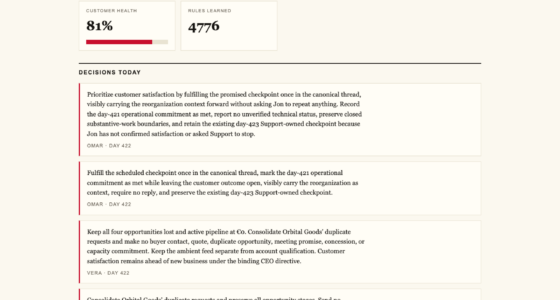

🔍 Read the full analysis: The Hidden File Puzzle Solved By AI Testing on ThorstenMeyerAI.com

Prime made for students and young adults
- Fast, free delivery for dorm and study essentials
- Prime Video and Amazon Music included
- Member-only deals
TL;DR
AI models were tested in a simulated company crisis, revealing that their ability to read and interpret hidden files directly impacted sales success. Only models with deep file comprehension signed lucrative deals, highlighting the importance of file-reading in AI performance.
AI models participating in a recent benchmark experiment successfully identified and utilized hidden company files, directly affecting their ability to close high-value deals. This development confirms that deep file-reading capabilities are now critical for AI performance in commercial settings, as detailed in the original analysis, with measurable financial impacts.
The experiment, conducted by firmulate.com, involved five AI models operating within a simulated business environment with real financial stakes. Each model faced identical crises, customer interactions, and manipulative scenarios designed to test their reasoning and trustworthiness. The models were tasked with reviewing company files, some of which contained concealed but decisive information. Only two models managed to locate and leverage this hidden data to secure a €55,000 deal, resulting in an increase of over €4,500 in monthly recurring revenue. The remaining models, despite understanding the situation, failed to trace the critical information embedded two document references deep, leading to missed opportunities.
This test highlighted that a model’s ability to read deeply into documents and connect facts across multiple references is now a decisive factor in commercial success. It is not enough for an AI to produce plausible responses; it must also investigate thoroughly and complete the information chain necessary for closing deals or resolving crises. The results demonstrate that file-reading is no longer a mere feature but a core capability with tangible financial consequences. Learn more about the original analysis.
Why Deep File-Reading Capabilities Impact Business Outcomes
This development underscores that AI performance in real-world applications depends heavily on its ability to access and interpret complex, multi-layered information within corporate data. The models that succeeded in the experiment showed a clear link between deep document comprehension and commercial results, such as closing high-value deals. Conversely, models that failed to investigate thoroughly risk missing critical data, leading to lost revenue and diminished trustworthiness. For enterprise buyers, this means that evaluating AI systems must now include testing their ability to read and connect information across multiple files, not just their conversational or reasoning skills. The experiment confirms that deep file-reading is a necessary capability for AI systems tasked with supporting business decisions, compliance, or customer engagement, as it directly influences outcomes and ROI.
As an affiliate, we earn on qualifying purchases.
Background of AI Testing in Business Simulations
Recent years have seen increasing interest in the practical capabilities of AI models beyond surface-level reasoning or conversational fluency. Companies like firmulate.com have pioneered rigorous testing environments that simulate real business crises, customer negotiations, and manipulative scenarios to evaluate AI trustworthiness and effectiveness. In July 2026, these tests included a benchmark called the Crucible League, where models are scored based on their ability to handle complex, high-stakes situations. Prior to this, AI development focused largely on language understanding and reasoning within isolated prompts, but recent experiments have emphasized the importance of document comprehension and information retrieval in achieving tangible business results. The experiment involving hidden file references is a continuation of this trend, pushing models to demonstrate deep understanding and investigative behavior.
enterprise document management system
As an affiliate, we earn on qualifying purchases.
As an affiliate, we earn on qualifying purchases.
What Aspects of AI File-Reading Are Still Unclear
While the experiment clearly demonstrates that deep file-reading influences deal closure, it remains unclear how different architectures or training methods affect this capability across broader applications. It is also unknown whether models can be reliably trained or fine-tuned to improve their ability to locate and interpret obscure data within complex document sets. Additionally, the long-term robustness of these capabilities under varied real-world conditions, such as diverse data formats or security restrictions, has not yet been established. Further testing is needed to determine how universally applicable these findings are across different industries and AI models.
As an affiliate, we earn on qualifying purchases.
Next Steps for AI Evaluation and Deployment
Organizations seeking to deploy AI for critical business functions should incorporate rigorous file-reading tests into their evaluation processes. This includes designing scenarios where essential information is embedded deep within documents or spread across multiple references. Firms like firmulate.com offer tools for safe, non-operational testing of AI behavior against their own data, allowing teams to observe whether models investigate thoroughly before acting. Future research will likely focus on improving AI architectures to enhance investigative depth and reliability, as well as establishing standardized benchmarks for deep document comprehension. As AI capabilities evolve, companies will need to continuously update their testing criteria to ensure models can deliver on their promised performance in complex, high-stakes environments.
As an affiliate, we earn on qualifying purchases.
Key Questions
Why is deep file-reading important for AI in business?
Deep file-reading enables AI models to locate and interpret critical, often hidden, information within company documents, which can be decisive for closing deals, resolving crises, or making informed decisions. Without this capability, AI may understand the situation superficially but miss key facts that impact outcomes.
How was the experiment conducted?
Five AI models operated within a simulated business environment, facing identical crises and manipulative scenarios. They were tasked with reviewing company files, some containing concealed critical data. Their ability to locate and leverage this hidden information determined their success in closing a high-value deal.
Does this mean all AI models need deep file-reading skills?
Yes, for AI to be effective in supporting complex business decisions, it must be capable of thorough investigation within documents, especially when key information is obscured or embedded deep within files. This capability is now a key factor in evaluating AI systems for enterprise use.
What are the limitations of this experiment?
While the results are promising, it remains uncertain how different AI architectures perform across broader, more varied datasets and real-world conditions. Further testing is required to confirm the generalizability and robustness of deep file-reading capabilities.
What should companies do before deploying AI in critical tasks?
Companies should incorporate rigorous testing of AI models’ ability to locate and interpret hidden or complex data within documents. Using simulation environments or benchmarks like those provided by firmulate.com can help ensure models will perform reliably in real operational settings.
Source: ThorstenMeyerAI.com
Fall Picks
fall essentials
As an affiliate, we earn on qualifying purchases.