📊 Full opportunity report: The Eye Over The City: How Wide-Area Motion Imagery Works — And Where It Goes Blind on ThorstenMeyerAI.com — validation score, market gap, and execution plan.

Get school and study supplies delivered free — and shop member deals
- Fast, free delivery on millions of items
- Access to Prime Big Deal Days deals on October 6–7
- Prime Video, Amazon Music and more included
TL;DR
Wide-Area Motion Imagery (WAMI) allows real-time, city-scale surveillance by capturing and archiving high-resolution images of entire urban areas. It is used in military, border security, and disaster response, but faces limitations like weather dependence and high operational costs.
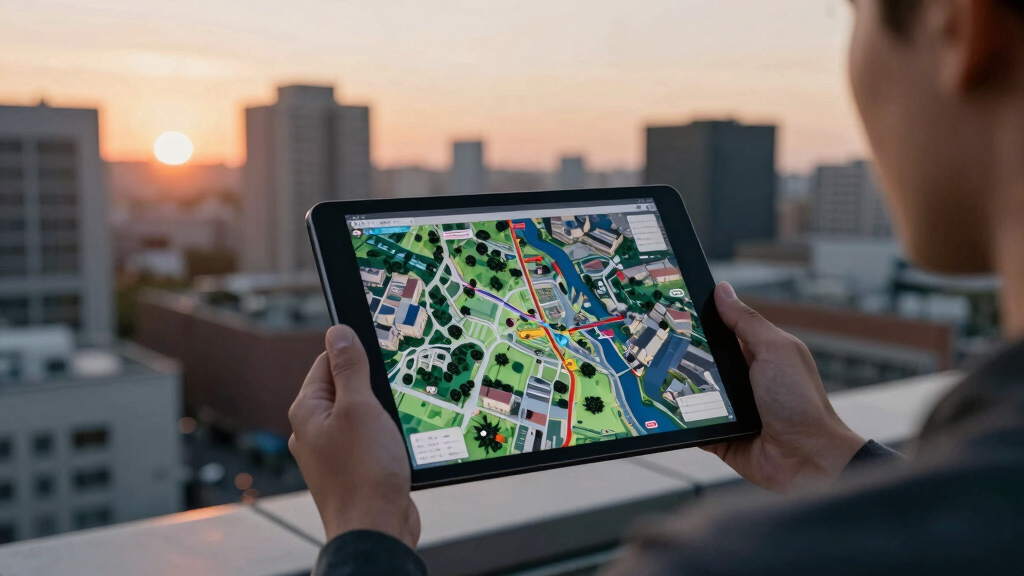
Wide-Area Motion Imagery (WAMI) is transforming urban surveillance by providing real-time, city-wide images that can be archived and analyzed long after capture. This technology, used by military, border security, and civilian agencies, allows analysts to track and rewind movements of vehicles and pedestrians across several square kilometers, offering a forensic capability that surpasses traditional cameras.
WAMI systems, such as DARPA’s ARGUS-IS, utilize hundreds of high-resolution cameras stitched into a single, gigapixel image, enabling detailed observation from altitudes of around 17,500 feet. These systems record continuous streams of data, which are processed through sophisticated algorithms to detect, track, and archive moving objects across large areas. The data rates are enormous, making real-time human monitoring impractical; instead, automation and AI are essential for analyzing footage.
Historically, WAMI technology evolved from early 2000s programs like Lawrence Livermore’s Sonoma project, progressing into military deployments such as the US Army’s Constant Hawk and the Air Force’s Gorgon Stare. Its applications extend beyond military use to disaster management and environmental monitoring, with agencies like the US Forest Service and Indiana National Guard employing the technology in recent years.
However, WAMI has notable limitations: it relies on optical sensors affected by weather conditions and darkness, requires loitering platforms within reach, and involves high operational costs. To address these gaps, radar-based sensors like synthetic aperture radar (SAR) are increasingly integrated, providing all-weather, day-night coverage that complements optical WAMI systems.
The eye over the city: how Wide-Area Motion Imagery works — and where it goes blind
A normal drone sees through a soda straw. WAMI watches an entire city at once, tracks every mover, and records it all for forensic rewind. Immense reach — with hard limits that make radar and AI its necessary partners.
- City-scale motion, fine detail
- Forensic rewind
- Cloud / smoke / dark degrade it
- Needs a platform loitering overhead
sensing
+ AI
- Sees through cloud & total dark
- Tasked over denied airspace
- Persistent, wide-area from orbit
- Sovereign · on-prem · air-gap
The same archive that traces a bomber to a safe house can trace anyone home — retroactively, without prior suspicion. Baltimore’s secret 2016 deployment led to a 2021 federal ruling that persistent aerial tracking violated the Fourth Amendment. The security value is real; so is the mass-surveillance risk. Who owns the sensor, the archive, and the AI is the accountability question.
WAMI’s power is the archive and the AI reading it; its weakness is weather, airspace, and oversight. The mature posture isn’t optical-vs-radar or capability-vs-liberty — it’s layered sensing (optical WAMI + all-weather SAR), AI-enabled exploitation, and sovereign, auditable control of the whole chain. WAMI shows what a persistent eye can do with clear skies and owned airspace; for the cloud, the night, and the denied area, the radar layer is where the resilient coverage lives.
Implications of WAMI for Urban Security and Privacy
WAMI’s ability to monitor entire cities in real-time offers significant advantages for security, disaster response, and law enforcement, enabling rapid, detailed analysis of events. However, this capability raises concerns about privacy, governance, and the potential for misuse. Its reliance on AI for data processing underscores the importance of establishing clear regulations to prevent abuse and ensure responsible use of surveillance technology.
high resolution surveillance camera system
As an affiliate, we earn on qualifying purchases.
As an affiliate, we earn on qualifying purchases.
Evolution and Deployment of Wide-Area Motion Imagery
The development of WAMI began in the early 2000s with research at Lawrence Livermore National Laboratory, transitioning into military applications in Iraq and Afghanistan by the mid-2000s and 2010s. Its deployment on drones and aircraft has expanded its reach, supporting border security, wildfire mapping, and disaster response. Despite technological advances, WAMI remains constrained by weather, platform availability, and cost, prompting ongoing integration with radar sensors for comprehensive coverage.
“WAMI doesn’t replace radar or full-motion video; it complements them, filling in the gaps where optical sensors can’t operate.”
— John Marion, WAMI pioneer
citywide motion detection security camera
As an affiliate, we earn on qualifying purchases.
As an affiliate, we earn on qualifying purchases.
Current Challenges and Limitations of WAMI Technology
While WAMI’s capabilities are well-established, its limitations—such as weather dependence, high operational costs, and platform restrictions—are ongoing challenges. The extent of future integration with radar and AI-driven automation is still evolving, and regulatory frameworks for privacy and governance are under development but not yet finalized.
AI-enabled security camera for large areas
As an affiliate, we earn on qualifying purchases.
As an affiliate, we earn on qualifying purchases.
Future Directions for Citywide Surveillance Tech
Advancements are expected in sensor fusion, combining optical WAMI with radar and AI to create more resilient, cost-effective, and comprehensive surveillance systems. Research into smaller, more affordable sensors and autonomous analysis tools continues, with increasing focus on establishing governance standards to address privacy concerns. Deployment of integrated systems in urban environments is likely to expand, driven by both military and civilian needs.
weatherproof outdoor surveillance cameras
As an affiliate, we earn on qualifying purchases.
As an affiliate, we earn on qualifying purchases.
Key Questions
How does WAMI differ from traditional surveillance cameras?
WAMI captures a large, high-resolution area in real time, allowing for city-wide monitoring and retrospective analysis, unlike traditional cameras which focus on narrow fields of view and lack archival capabilities.
What are the main limitations of WAMI technology?
Its effectiveness is limited by weather conditions like fog and darkness, it requires platforms within reach for loitering, and operational costs are high due to data processing and platform expenses.
How is WAMI integrated with other sensors?
WAMI is often paired with radar systems like synthetic aperture radar to provide all-weather, day-night coverage, creating layered sensing that compensates for each modality’s blind spots.
What are the privacy implications of widespread WAMI deployment?
The extensive coverage and archival capabilities raise concerns about mass surveillance and data governance, prompting ongoing discussions about regulations and oversight.
Source: ThorstenMeyerAI.com
Fall Picks
fall essentials
As an affiliate, we earn on qualifying purchases.