
TL;DR
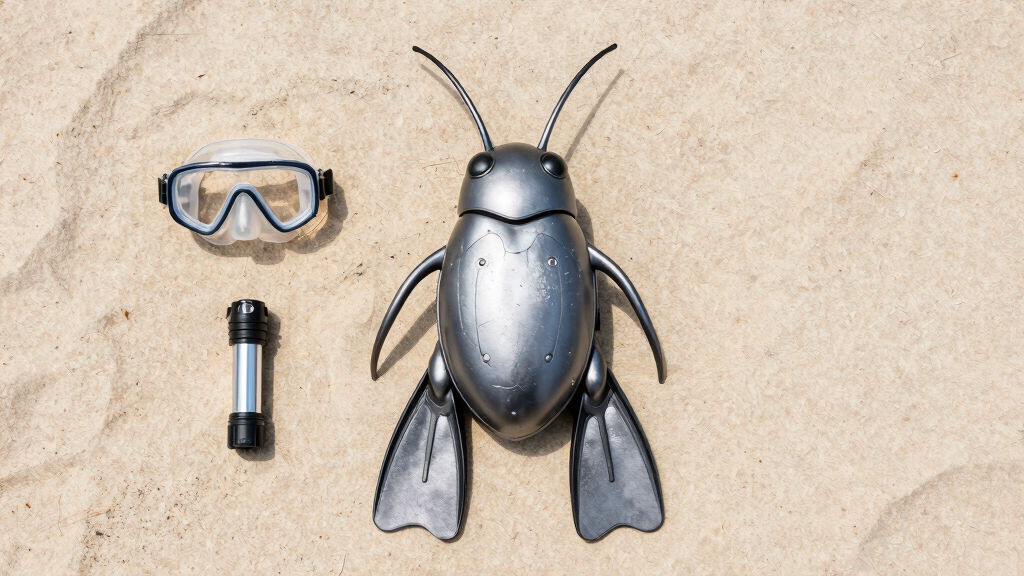
Researchers have developed a cyborg insect fitted with an underwater suit, enabling it to dive and traverse both terrestrial and aquatic terrains. This innovative design could impact robotics and environmental monitoring.
Scientists have introduced a cyborg insect equipped with an underwater suit that can dive and travel across terrestrial and aquatic environments. This development, announced in October 2023, demonstrates a significant advance in bio-inspired robotics, with potential applications in environmental monitoring and search-and-rescue operations.
The robotic insect, developed by a team of researchers at the Institute of Bio-Robotics, features a lightweight, flexible exoskeleton integrated with a miniaturized underwater propulsion system. The device is designed to mimic the movement of real insects, with enhanced capabilities for underwater navigation and terrestrial mobility. During initial tests, the cyborg insect successfully demonstrated diving, surface swimming, and land crawling, showcasing its ability to operate seamlessly across different environments.
According to the lead researcher, Dr. Emily Chen, the device employs advanced sensors and control algorithms that allow it to adapt to varying terrains and water conditions. The underwater suit includes waterproof actuators and a compact battery pack, enabling extended operation beneath the surface. Researchers claim this hybrid mobility could enable new approaches to environmental data collection, especially in hard-to-reach aquatic zones.
Potential Impact on Robotics and Environmental Monitoring
This innovation could transform how robots are used in environmental and ecological research by providing a versatile platform capable of exploring both land and underwater ecosystems. The ability to dive and traverse terrestrial terrain opens new possibilities for monitoring wildlife, detecting pollutants, and conducting search-and-rescue missions in complex environments. The development also advances the field of bio-inspired robotics, demonstrating how insect biomechanics can inform practical engineering solutions.
underwater robotic insect
As an affiliate, we earn on qualifying purchases.
As an affiliate, we earn on qualifying purchases.
Advances in Bio-Inspired Robotics and Underwater Mobility
Recent years have seen significant progress in bio-inspired robots mimicking insect and animal movements for diverse applications. Previous efforts focused mainly on terrestrial or aquatic robots separately. The integration of underwater capabilities into insect-like robots marks a notable step forward, prompted by increasing demands for versatile exploration tools. The concept of hybrid terrestrial-aquatic robots has been explored before, but practical implementations with insect-scale designs remain limited. This development builds on prior research by combining lightweight design with underwater propulsion, aiming for real-world deployment.
“This cyborg insect represents a new frontier in robotics, blending biological inspiration with advanced engineering to operate seamlessly across land and water.”
— Dr. Emily Chen, lead researcher
bio-inspired underwater drone
As an affiliate, we earn on qualifying purchases.
As an affiliate, we earn on qualifying purchases.
Limitations and Unanswered Questions About the Cyborg Insect
Details about the device’s long-term durability, autonomy, and operational range are still emerging. It is not yet clear how well the insect can perform in complex, real-world environments over extended periods. The scalability of production and potential ecological impacts also remain unaddressed, and further testing is needed to confirm its practical applications.
terrestrial aquatic hybrid robot
As an affiliate, we earn on qualifying purchases.
As an affiliate, we earn on qualifying purchases.
Next Steps for Development and Real-World Testing
Researchers plan to conduct extended field trials in diverse environments to assess the robot’s durability and efficiency. They also aim to refine control algorithms for better autonomy and explore integration with sensor arrays for environmental data collection. Commercial and governmental agencies are expected to evaluate the device for potential deployment in ecological monitoring and disaster response scenarios.
miniature underwater propulsion system
As an affiliate, we earn on qualifying purchases.
As an affiliate, we earn on qualifying purchases.
Key Questions
How does the cyborg insect move underwater?
The insect uses waterproof actuators and miniature propulsion systems integrated into its exoskeleton, allowing it to swim and maneuver beneath the water surface.
What are the potential applications of this technology?
Potential uses include environmental monitoring, wildlife research, pollution detection, and search-and-rescue missions in areas difficult for traditional robots or humans to access.
Is this technology ready for commercial use?
Not yet. The device is still in the experimental stage, with further testing needed to evaluate its durability, autonomy, and scalability for practical deployment.
What challenges remain for the development of hybrid terrestrial-aquatic robots?
Challenges include improving long-term operational stability, energy efficiency, environmental adaptability, and minimizing ecological impacts during deployment.
Source: hn