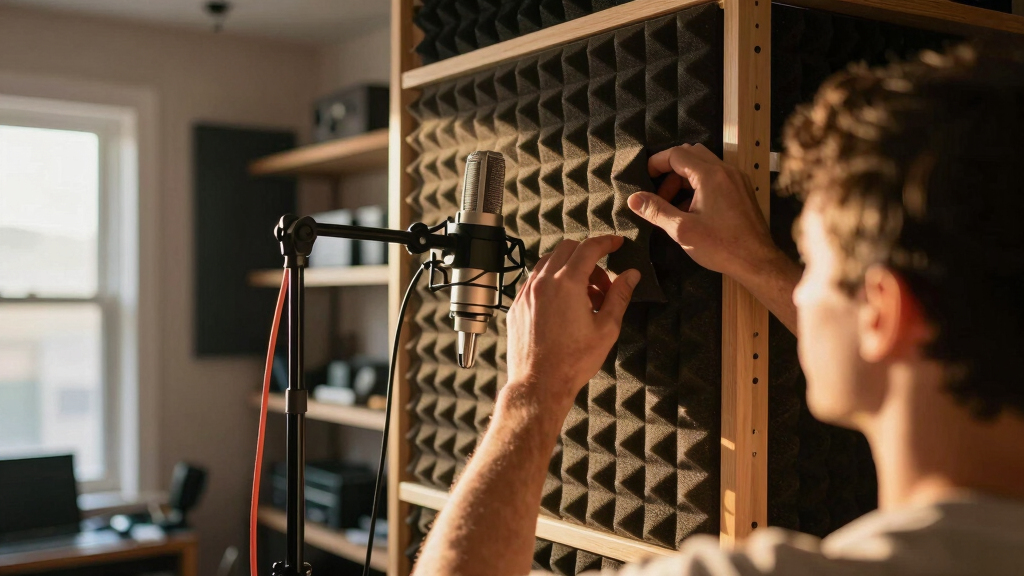

📊 Full opportunity report: Acoustic Dampening, Placement, and the “Rig in the Closet” Setup on ThorstenMeyerAI.com — validation score, market gap, and execution plan.

Prime made for students and young adults
- Fast, free delivery for dorm and study essentials
- Prime Video and Amazon Music included
- Member-only deals
TL;DR
This article explains how to minimize noise from AI workstations by strategic placement and acoustic treatment. Moving the rig away or into a ventilated closet can significantly reduce sound issues.
Moving a high-power AI workstation into a separate room or closet with proper ventilation is the most effective way to reduce noise, according to industry experts.
Experts emphasize that the primary way to reduce noise from powerful AI rigs is to increase physical distance and isolation. Placing the machine in another room, basement, or closet can eliminate most noise issues, especially when the system is operated headless over a network.
A common approach is the ‘rig in the closet’ setup, which involves placing the machine in an enclosed space with active ventilation. This method effectively contains noise while preventing heat buildup, provided proper airflow and temperature control are maintained. You can learn more about this setup in Acoustic Dampening, Placement, and the “Rig in the Closet” Setup.
Additional acoustic treatment, such as soundproof panels or foam, is less effective than strategic placement and ventilation but can be used as a supplementary measure for residual noise.
Acoustic dampening
& the rig in the closet.
The most powerful noise fix isn’t a material — it’s a floor plan. A rig you can’t hear because it’s in another room beats any amount of foam. Tap the approaches in Part 1 to see what actually works.
(another room)
(levers 1–4)
(door / barrier)
(acoustic foam)
Contain the noise, not the heat
Why Placement and Ventilation Are Key for Quiet AI Workstations
Effective noise reduction enhances workspace comfort and productivity, especially in shared environments. It also prolongs hardware lifespan by preventing overheating caused by trapped heat in enclosed spaces. For professionals relying on remote inference or networked workflows, physical placement becomes a practical and cost-effective solution to noise issues.
soundproofing acoustic panels for computer rooms
As an affiliate, we earn on qualifying purchases.
As an affiliate, we earn on qualifying purchases.
Understanding the Hierarchy of Noise Control in High-Power Workstations
Traditional noise mitigation focuses on acoustic foam and barriers, which address airborne sound but do little for structure-borne vibrations. Experts recommend prioritizing distance and isolation first, followed by source reduction and transmission blocking. The concept of placing rigs in separate rooms or closets aligns with this hierarchy, offering the most significant noise reduction. For more details, see Acoustic Dampening, Placement, and the "Rig in the Closet" Setup.
While acoustic foam and barriers are commonly used, they are last in effectiveness because they do not address the primary sources of noise—fans, GPUs, and vibrations—directly. Proper placement and ventilation are thus crucial for effective noise management.
"Moving the rig into another room or closet with proper airflow is the most effective way to eliminate noise issues, especially for headless operation."
— Thorsten Meyer, AI workspace expert
ventilated closet for high-performance workstation
As an affiliate, we earn on qualifying purchases.
As an affiliate, we earn on qualifying purchases.
Remaining Challenges in Quiet High-Power AI Workstation Setups
It is not yet clear how best to balance noise reduction with heat dissipation in various enclosure designs, especially in DIY setups. The effectiveness of different ventilation solutions and their impact on hardware longevity requires further study.
noise reduction enclosure for AI rig
As an affiliate, we earn on qualifying purchases.
As an affiliate, we earn on qualifying purchases.
Next Steps for Implementing Quiet, Cool AI Workstation Environments
Users should evaluate their workspace to identify the best placement options, such as relocating the rig to a separate room or installing a purpose-built soundproof cabinet with active ventilation. Further research and development of affordable, effective cooling and soundproofing solutions are expected to improve practical implementation.
high airflow server closet enclosure
As an affiliate, we earn on qualifying purchases.
As an affiliate, we earn on qualifying purchases.
Key Questions
Is placing my AI rig in a closet safe?
Yes, if proper ventilation and airflow are maintained, placing your rig in a closet can be safe and effective for noise reduction. Ensure there is active cooling to prevent overheating.
What are the best ventilation options for a 'rig in the closet' setup?
Quiet exhaust fans with ducting, passive vents, and thermostatically controlled airflow systems are recommended to keep temperatures safe and hardware cool.
Can acoustic foam alone reduce noise effectively?
Acoustic foam primarily reduces echo and reflections within a room but does not block airborne or structure-borne noise. Placement and isolation are more effective for noise reduction.
How far should I place my AI rig from my workspace?
The farther away, the better. Ideally, place the rig in another room or a dedicated closet with ventilation to maximize noise reduction.
Are there commercial solutions for quiet AI workstations?
Yes, purpose-built soundproof cabinets with integrated cooling systems are available, though they can be costly. DIY solutions with proper ventilation are also effective.
Source: ThorstenMeyerAI.com
Halloween Picks
halloween
As an affiliate, we earn on qualifying purchases.