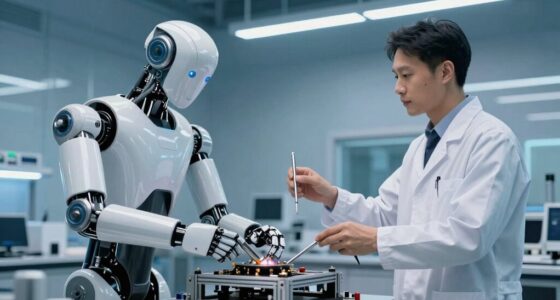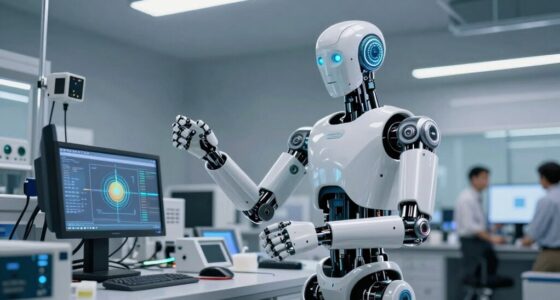
Mixed reality tools transform training and design by allowing you to immerse yourself in realistic environments and interact with 3D models in real-time. You can visualize complex designs within physical spaces, catch potential issues early, and make informed decisions faster. These tools also enable you to collaborate virtually with others, regardless of location, and tailor training scenarios to your needs. Keep exploring to discover how these innovations can elevate your projects further.

Prime made for students and young adults
- Fast, free delivery for dorm and study essentials
- Prime Video and Amazon Music included
- Member-only deals
Key Takeaways
- Enable real-time interaction with 3D models, enhancing understanding and collaboration in design processes.
- Facilitate immersive, safe training environments that mimic real-world conditions for skill development.
- Improve design accuracy by visualizing complex structures within physical spaces before construction.
- Customize training scenarios to match specific skill levels and industry standards, increasing engagement.
- Streamline decision-making and reduce costly errors through virtual walkthroughs and early issue detection.
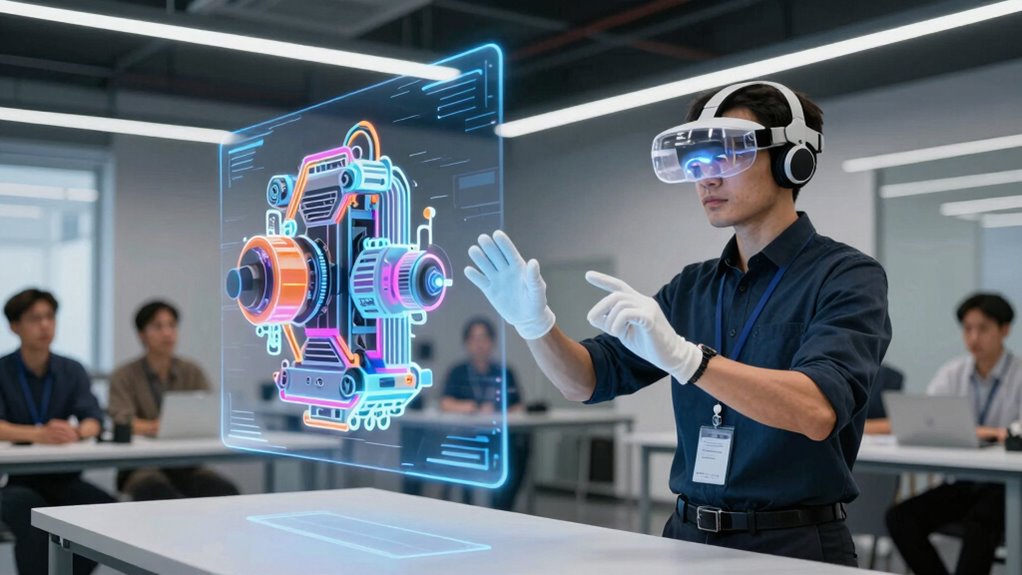
Mixed reality tools are transforming how industries approach training and design, offering immersive experiences that bridge the gap between the physical and digital worlds. When you use these tools, you gain the ability to engage in virtual collaboration, where multiple team members can work together seamlessly, regardless of their physical locations. Instead of relying solely on static plans or 2D images, you can interact with 3D models in real-time, making discussions more dynamic and productive. This enhanced level of collaboration streamlines decision-making processes and reduces miscommunication, saving you time and resources.
Mixed reality enhances collaboration, enabling real-time interaction with 3D models and streamlining decision-making across teams.
Spatial visualization is another critical aspect that mixed reality tools improve. You can visualize complex designs and concepts within a physical space, giving you a better understanding of how a product, environment, or system will look and function in the real world. For instance, architects and engineers can walk through a virtual building, examining structural details and spatial relationships from every angle. This hands-on experience enables you to identify potential issues early in the design process, making adjustments before any physical construction begins. As a result, you make more informed decisions and create more accurate, efficient designs. Additionally, spatial awareness is enhanced, allowing users to better grasp their environment and interactions within it, which is crucial for effective planning and development. Incorporating spatial visualization techniques further improves design accuracy by providing a clearer picture of how elements fit together in real space. The ability to visualize in context also helps teams anticipate how new features will perform in real-world settings, reducing costly revisions later on.
In training scenarios, mixed reality tools immerse you in realistic environments that mimic real-world conditions. Whether you’re learning to operate machinery or practicing emergency procedures, these tools allow you to gain practical experience in a safe, controlled setting. You’re not just observing or reading about procedures—you’re actively performing tasks within a simulated environment that reacts to your actions. This experiential learning accelerates skill development and boosts confidence, as you’re exposed to situations that closely resemble real-life challenges. Moreover, the ability to simulate real-world conditions provides a more comprehensive understanding of complex tasks, further enhancing training effectiveness.
Furthermore, mixed reality enhances the customization of training programs. You can tailor scenarios to specific needs, adjusting complexity or focusing on particular skills. This flexibility guarantees you’re training effectively for your unique role or project. As you progress, the immersive nature of mixed reality keeps engagement high, making learning more effective and less monotonous. Additionally, the integration of digital content allows for continually updating and refining training modules to stay current with technological advances. This ongoing adaptability ensures that training remains relevant and aligned with evolving industry standards.
As an affiliate, we earn on qualifying purchases.
Frequently Asked Questions
What Are the Main Technical Challenges of Implementing Mixed Reality Tools?
You face technical challenges like hardware integration, ensuring mixed reality devices work seamlessly with existing systems. You also need to create an intuitive user interface that’s easy to navigate, avoiding user frustration. Power consumption, latency, and tracking accuracy can also pose problems, affecting the overall experience. Addressing these issues requires ongoing technical development, testing, and fine-tuning to deliver smooth, effective mixed reality training and design solutions.
How Cost-Effective Are Mixed Reality Solutions for Small Businesses?
Mixed reality solutions can be surprisingly cost-effective for small businesses, especially when you consider long-term benefits. While upfront costs may seem high, you’ll save on physical materials, travel, and training time. Plus, mixed reality enhances accessibility, allowing your team to train anytime, anywhere. This flexibility reduces downtime and boosts productivity, making mixed reality a smart investment that delivers significant cost savings and accessibility improvements over time.
What Industries Are Most Rapidly Adopting Mixed Reality Training?
You’ll find industries like manufacturing, healthcare, and aerospace adopting mixed reality training the fastest. Industry integration simplifies complex procedures, making training more interactive and realistic. As a user experience, mixed reality enhances engagement and retention, leading to better skill development. These sectors prioritize rapid adoption to improve safety, efficiency, and outcomes, embracing mixed reality’s immersive capabilities to revolutionize traditional training methods effectively and swiftly.
How Do Mixed Reality Tools Impact Learner Engagement and Retention?
Mixed reality tools boost your engagement and retention by immersing you in realistic simulations that make learning more interactive. As you navigate these immersive environments, you receive real-time feedback, helping you understand mistakes instantly and improve quickly. This active participation keeps you focused and motivated, leading to better memory retention. Overall, mixed reality transforms passive learning into an engaging, hands-on experience that enhances your understanding and skills more effectively.
What Are Future Developments Expected in Mixed Reality Technology?
You can expect future mixed reality tech to enhance virtual collaboration and immersive storytelling profoundly. As hardware becomes more compact and affordable, you’ll experience more seamless, real-time interactions with remote teams. Advances in AI will personalize experiences, making virtual environments more intuitive. These developments will make training and design more engaging and realistic, allowing you to collaborate globally and immerse yourself fully in storytelling, transforming how you learn and create.
3D modeling augmented reality glasses
As an affiliate, we earn on qualifying purchases.
As an affiliate, we earn on qualifying purchases.
Conclusion
As you embrace mixed reality tools, you’re opening the door to a future where training and design become a canvas of endless possibilities. These tools are the brushstrokes transforming complex ideas into vivid, interactive experiences. Like a lighthouse guiding ships through fog, mixed reality illuminates new pathways, making learning more immersive and design more intuitive. Step into this vibrant world, and watch your skills and creativity soar beyond the horizon.
As an affiliate, we earn on qualifying purchases.
As an affiliate, we earn on qualifying purchases.
Fall Picks
fall essentials
As an affiliate, we earn on qualifying purchases.