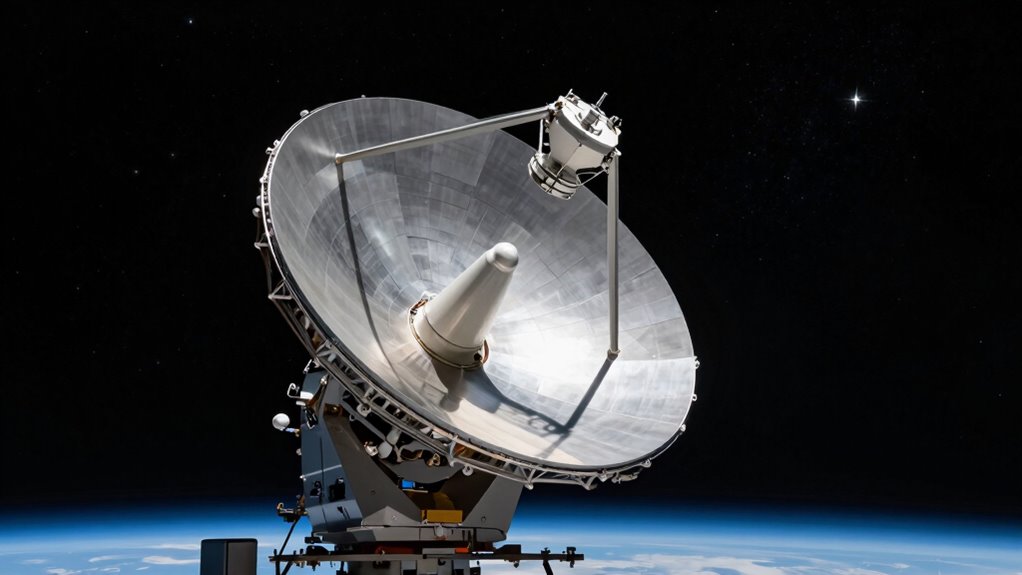

New space telescopes let you explore the universe in new ways by providing sharper views and deeper insights into distant worlds and cosmic phenomena. They improve your ability to detect tiny signals, analyze exoplanet atmospheres, and study the universe’s earliest moments through cosmic microwave background measurements. With these advances, you can ask bigger questions about our cosmic origins, evolution, and fundamental physics. Keep exploring to discover how these innovations expand your understanding even further.
Key Takeaways
- Enable detection of smaller, more distant exoplanets, expanding questions about potential habitability and planetary diversity.
- Provide clearer, more detailed observations of exoplanet atmospheres, allowing inquiries into signs of life or life-supporting conditions.
- Improve measurements of the cosmic microwave background, fostering questions about the universe’s origin and early moments.
- Enhance analysis of the universe’s large-scale structure, leading to deeper questions about cosmic evolution and fundamental physics.
- Open new research avenues into dark matter, dark energy, and the universe’s ultimate fate through advanced observational data.
New space telescopes are revolutionizing our ability to explore the universe, opening up questions that were once beyond reach. With their advanced technology, you now have a clearer view of distant worlds and the faint signals from the universe’s earliest moments. One of the most exciting developments is in exoplanet detection. Instead of relying solely on ground-based observations, these telescopes can detect tiny dips in starlight caused by planets passing in front of their stars. This method allows you to find planets that are smaller and farther from their stars, expanding the catalog of worlds you can study. As a result, you’re gaining a better understanding of planetary systems’ diversity and potential habitability. The new telescopes’ sensitivity also enables you to analyze the atmospheres of these exoplanets, searching for signs of life or conditions suitable for life as we know it. This leap in observational capacity pushes you to ask deeper questions about the origins of life and the uniqueness of our planet. Additionally, the improved instrument sensitivity allows for more precise measurements of faint signals, enhancing your ability to explore the universe’s fundamental properties. This increased precision also helps you refine our understanding of the cosmic microwave background and its role in cosmic evolution.
Beyond planets, these telescopes are transforming our grasp of the universe’s earliest history through the cosmic microwave background. This faint glow, a remnant of the Big Bang, holds clues about the universe’s infancy. With improved instruments, you’re able to measure tiny fluctuations in this background radiation with unprecedented precision. These measurements help you refine models of the universe’s evolution, testing theories about its origin, composition, and ultimate fate. The ability to analyze the cosmic microwave background more thoroughly leads you to ask questions about the fundamental physics governing the cosmos, such as the nature of dark matter and dark energy. You’re now better equipped to investigate how the universe’s large-scale structure formed and evolved over billions of years.
exoplanet atmosphere analysis kit
As an affiliate, we earn on qualifying purchases.
As an affiliate, we earn on qualifying purchases.
Frequently Asked Questions
How Do Space Telescopes Differ From Ground-Based Telescopes?
You see, space telescopes differ from ground-based ones because they avoid atmospheric interference, giving clearer images of distant objects. Since they’re in space, you don’t have to worry about weather or light pollution disrupting observations. However, maintenance challenges are tougher because repairing them requires costly and complex space missions. Overall, space telescopes provide sharper data, but managing them involves overcoming significant logistical hurdles.
What Are the Limitations of Current Space Telescopes?
You might think space telescopes have no limits, but instrument limitations and observational constraints still hold them back. They can struggle with resolution, sensitivity, or wavelength range, missing faint signals or details. Additionally, their positions in space restrict observation time and target selection, often requiring precise planning. These constraints keep scientists enthusiastic for newer, more advanced telescopes that can push boundaries further, revealing secrets still hidden in the cosmos.
How Long Do Space Telescopes Typically Operate?
You can expect space telescopes to operate for around 5 to 15 years, depending on their orbit lifespan and design. Some, like the Hubble, have lasted decades due to ongoing maintenance challenges and upgrades. Others, like newer telescopes, are built with limited lifespans because maintenance in orbit is complex and costly. Your observations depend on these factors, influencing the scope and duration of your research.
Can Space Telescopes Detect Extraterrestrial Life?
You wonder if space telescopes can detect extraterrestrial life, and the answer is yes, indirectly. They search for alien biosignatures—signs of life’s chemical footprints—and extraterrestrial signals that might hint at intelligent civilizations. While they can’t confirm life directly, these instruments act as cosmic detectives, revealing faint clues that suggest life could exist elsewhere. Their discoveries open new questions about our place in the universe and the possibility of other worlds teeming with life.
How Do Space Telescopes Impact Our Understanding of Dark Matter?
You see, space telescopes considerably impact your understanding of dark matter by enabling dark matter detection through methods like gravitational lensing. These telescopes observe how dark matter bends light from distant objects, revealing its distribution in the universe. With advanced sensors, you can analyze subtle gravitational effects, helping you piece together dark matter’s role in cosmic structure formation and evolution, deepening your comprehension of the universe’s unseen components.
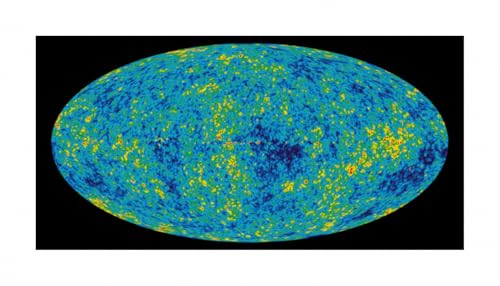
Cosmic Microwave Background Radiation Full Sky Space CMB – Black Background – Space Poster Print – Various Sizes (12 x 24 in)
High-quality printing
As an affiliate, we earn on qualifying purchases.
As an affiliate, we earn on qualifying purchases.
Conclusion
Just as Galileo first peered through his telescope, these new space observatories open your eyes to the universe’s deepest secrets. With clearer images and broader views, you’re invited to ask bolder questions—about distant galaxies, dark matter, and the origins of life itself. Like explorers of old gazing at uncharted lands, you stand on the brink of discovery, ready to uncover cosmic truths that will forever change your understanding of the universe’s grand story.

Infinite Cosmos: Visions From the James Webb Space Telescope
As an affiliate, we earn on qualifying purchases.
As an affiliate, we earn on qualifying purchases.

Concise Catalog of Deep-Sky Objects: Astrophysical Information for 550 Galaxies, Clusters and Nebulae
As an affiliate, we earn on qualifying purchases.
As an affiliate, we earn on qualifying purchases.