For families looking for patriotic geography board games, the best choice depends on how players like to learn: racing, matching, answering trivia, or exploring a map. I rank The 50 States Game first for its broad state coverage and many reusable facts, while Game Zone Great States adds a lively timed challenge and eeBoo United States Geography Bingo is the gentlest entry point for younger players.

Prime made for students and young adults
- Fast, free delivery for dorm and study essentials
- Prime Video and Amazon Music included
- Member-only deals
All five options focus on the United States, but they offer different ways to practice geography. Some emphasize capitals and state facts; others add landmarks, wildlife, industries, or grade-matched questions. The main tradeoffs are learning depth versus simplicity, a full board-game setup versus portable cards, and timed competition versus relaxed matching. I’ve ranked them by how well each combines U.S. geography learning, playability, and a distinct fit for a particular household or classroom.
Key Takeaways
- The 50 States Game is my broadest learning pick, with more than 500 facts plus state cards, sheets, and a map board.
- Game Zone Great States suits groups that enjoy fast, timed turns and multiple kinds of state-geography challenges.
- eeBoo Geography Bingo is the youngest-player-friendly option, using state-themed tiles, regional boards, wildlife, and industry details.
- Scholastic USA Travel Card Game is the easiest format to pack, but its 50-card set and 2–4 player limit make it less suited to large groups.
- Race Across the USA offers grade-matched questions and a clear travel-race objective, though progress depends on answering geography questions.
| The 50 States Game: U.S. Geography Board Game |  | Best Overall for Broad State-Fact Learning | Players: 2–5 | Recommended age: 7 years and up | Playing time: About 20 minutes | VIEW LATEST PRICE | See Our Full Breakdown |
| Game Zone Great States Geography Board Game |  | Best for Energetic, Timed Family Play | Brand: Game Zone | Players: 2–6 | Recommended age: 7+ years | VIEW LATEST PRICE | See Our Full Breakdown |
| eeBoo United States Geography Bingo Game |  | Best for Younger Geography Learners | Players: 2–6 | Recommended age: 5 years and up | Included components: 6 game boards, 84 tiles, cloth bag | VIEW LATEST PRICE | See Our Full Breakdown |
| Scholastic Race Across the USA Geography Board Game for Kids, Ages 8+ |  | Best for Mixed-Grade Question Play | Brand: University Games | Players: 2–4 | Recommended age: 8+ | VIEW LATEST PRICE | See Our Full Breakdown |
| Scholastic USA Travel Card Game: State Capitals and Geography |  | Best Compact Pick for Travel | Recommended age: 6 and up | Players: 2–4 | Included components: 50 cards, instructions | VIEW LATEST PRICE | See Our Full Breakdown |
| patriotic geography board game | Players | Recommended age | Included components | Language |
|---|---|---|---|---|
| The 50 States Game: U.S. Geogr | 2–5 | 7 years and up | 50 state cards, 10 state sheets, USA map game board, dice, instructions | English |
| Game Zone Great States Geograp | 2–6 | 7+ years | Game board, 400 cards, spinner, mechanical timer, instructions | English |
| eeBoo United States Geography | 2–6 | 5 years and up | 6 game boards, 84 tiles, cloth bag | English |
| Scholastic Race Across the USA | 2–4 | 8+ | Game board, cards, airplane pawns | English |
| Scholastic USA Travel Card Gam | 2–4 | 6 and up | 50 cards, instructions | — |
More Details on Our Top Picks
The 50 States Game: U.S. Geography Board Game
I put The 50 States Game at the top because it gives players several ways to revisit U.S. geography rather than relying on a single question format. Its map board is paired with state cards and state sheets, and the game covers more than 500 facts about flags, capitals, locations, nicknames, and postal codes. That combination makes the subject feel connected: players can see state locations while also practicing details that are easy to mix up.
Compared with Game Zone Great States, this pick offers a more reference-rich kit and does not depend on a mechanical timer for its challenge. Compared with eeBoo Geography Bingo, it asks for more active recall and serves older children and adults better. The listed playing time of about 20 minutes is a useful fit for a short family session, and cards can also be used for flash-card or trivia practice beyond the main game.
The tradeoff is that the broad fact set does not make this an all-purpose geography game: it remains focused on the United States, and the player count stops at five. It may also feel like more material than a younger child needs at the start. I would pick it when the goal is repeated practice across many state facts, not when the priority is the simplest rules or a compact travel pack.
Pros:- Covers all 50 states with more than 500 facts.
- Includes a map board, state cards, and state sheets for varied practice.
- Cards can be used for flash-card review or trivia outside the main game.
- About 20 minutes of play suits a short family game session.
Cons:- The subject remains limited to U.S. geography.
- The 2–5 player range excludes larger groups.
- Its volume of facts may be more demanding than a simple bingo format for younger learners.
Best for: Families with players ages 7 and up who want one U.S. geography game with broad state facts and extra card-based practice.
Not ideal for: Large groups, solo learners, or families seeking world geography or a very simple matching game for preschool-age children.
- Players:2–5
- Recommended age:7 years and up
- Playing time:About 20 minutes
- Geography coverage:All 50 U.S. states
- Fact count:More than 500
- Included components:50 state cards, 10 state sheets, USA map game board, dice, instructions
- Language:English
- Dimensions:10.94 × 10.94 × 2.44 inches
Our verdict“I recommend it as the strongest all-around pick when a family wants broad, repeatable practice with U.S. state facts.”
Game Zone Great States Geography Board Game
Great States is my pick for groups that want geography to feel active rather than like a quiet quiz. Players spin, draw cards, and complete challenges against a timer, with four card categories—fact, find, figure, and fun—bringing variety to the turns. Its illustrated board adds visual state landmarks and details, so the game can prompt map recognition as well as recall.
Against The 50 States Game, Great States is more about pace and changing challenge types than building a large reference set; the latter lists more than 500 facts and is better suited to deliberate review. Great States also supports up to six players, one more than The 50 States Game, which can help a family or classroom include another participant. Its 400 cards give groups plenty of prompts, though the timed turns will not suit every learner.
The central drawback is exactly what gives it energy: the timer can make turns feel rushed. Children who need extra processing time may enjoy a calmer game such as eeBoo Bingo, while players seeking compact travel play should look at the Scholastic card game. This is a good fit when the group likes lively competition and accepts that the focus stays on U.S. state geography.
Pros:- Four card categories vary the kinds of state-geography challenges.
- 400 cards provide a substantial pool of prompts.
- The illustrated map includes state landmarks and details.
- Supports 2–6 players for family or classroom groups.
Cons:- Timed turns may feel rushed for some players.
- The subject is limited to U.S. state geography.
- The timer-based pace is less suited to relaxed, self-paced practice.
Best for: Families or classrooms with players age 7 and up who enjoy quick turns, varied challenges, and a larger group size.
Not ideal for: Players who dislike timed pressure, need a relaxed pace, or want geography beyond U.S. states.
- Brand:Game Zone
- Players:2–6
- Recommended age:7+ years
- Genre:Educational
- Included components:Game board, 400 cards, spinner, mechanical timer, instructions
- Card categories:100 each of fact, find, figure, and fun
- Edition:Standard Edition
- Language:English
Our verdict“I’d choose Great States over a calmer fact game when the group wants varied U.S. geography challenges with a competitive pace.”
eeBoo United States Geography Bingo Game
eeBoo United States Geography Bingo is the most approachable entry point in this lineup for children starting to recognize state names and regional details. Instead of asking players to race or answer a stream of trivia questions, it has them match state-themed tiles to game boards. Its subject matter includes state industries and wildlife, giving the matching activity more texture than a basic state-name exercise.
Compared with Race Across the USA, Bingo puts less emphasis on answering questions to move a pawn and more on spotting and matching information. It is also recommended for ages five and up, younger than the other board-game picks here. The set includes six boards and 84 tiles, and it supports up to six players—useful for a family or small group that wants a shared activity rather than a turn-by-turn race.
That gentler format has limits. Players need to read and match information across boards and tiles, so it is not a no-reading game for every young child, and it cannot be played solo. For older players wanting capitals, postal codes, and a deep fact pool, The 50 States Game is the more demanding choice. I’d choose eeBoo for early, visual exposure, particularly when materials and production choices matter: the game uses 90% recycled materials and vegetable-based inks.
Pros:- Introduces U.S. geography through state and regional matching.
- Includes state information, industry details, and wildlife imagery.
- Supports 2–6 players with six boards and 84 tiles.
- Made with 90% recycled materials and vegetable-based inks.
Cons:- Cannot be played solo.
- Matching information across boards and tiles requires reading.
- Its gentler format offers less detailed fact practice than The 50 States Game.
Best for: Children ages 5 and up and families seeking a visual, matching-based introduction to U.S. states, wildlife, and industries.
Not ideal for: Solo play, players wanting extensive capital-and-state quizzes, or children who are not ready to read and match board information.
- Players:2–6
- Recommended age:5 years and up
- Included components:6 game boards, 84 tiles, cloth bag
- Geography focus:U.S. states and regional information
- Learning details:State industries and wildlife
- Materials:90% recycled materials; vegetable-based inks
- Language:English
- Illustrator:Saxton Freymann
Our verdict“I recommend eeBoo when younger players need an approachable visual start rather than a fast quiz or deep state-fact challenge.”
Scholastic Race Across the USA Geography Board Game for Kids, Ages 8+
Race Across the USA gives U.S. geography a clear goal: visit six states, answer questions, and return to your home state before the other players. That route-based objective can help children connect facts with movement across the country, rather than treating every question as a detached prompt. Its strongest distinction is grade-level-matched questions, which can make a shared game more workable when players have different school experience.
Compared with Great States, this game has a more defined race structure and does not list a mechanical timer. Compared with The 50 States Game, it offers a narrower experience built around travel and answering questions rather than a large set of reusable state facts. The board also provides clues, so players have some support as they progress. A listed play time of about 20 minutes keeps the route from taking over an entire evening.
Its question-driven movement is also its main limitation: players have to answer geography questions to advance, so a child who finds quizzes stressful may prefer eeBoo Bingo. The game supports only two to four players, fewer than Great States or Bingo, and it is aimed at ages eight and up. I’d pick it for a family or classroom with mixed-grade children who like a visible destination and can enjoy answering questions as part of the race.
Pros:- Race objective links geography questions to a route across the United States.
- Grade-level question matching supports mixed-grade play.
- Board clues offer help as players move through the game.
- About 20 minutes of play suits a short group session.
Cons:- Limited to 2–4 players.
- Progress depends on answering geography questions.
- Offers a narrower question-and-race format than the fact variety in The 50 States Game.
Best for: Families and classrooms with players ages 8 and up, especially mixed-grade groups that want a geography race with grade-matched questions.
Not ideal for: Groups larger than four, children who dislike quiz-based progress, or families wanting a large stand-alone state-fact reference set.
- Brand:University Games
- Players:2–4
- Recommended age:8+
- Estimated playing time:About 20 minutes
- Game objective:Visit six states and return to your home state
- Included components:Game board, cards, airplane pawns
- Genre:Educational geography board game
- Language:English
Our verdict“I’d choose Race Across the USA for a mixed-grade group that wants a focused state-geography race rather than open-ended fact practice.”
Scholastic USA Travel Card Game: State Capitals and Geography
Scholastic USA Travel Card Game is the most portable option here: its 50 cards and instructions fit in a travel tuck box, and the rules combine matching with trivia. Players collect matches while learning about states, capitals, landmarks, and history. That makes it a practical way to bring U.S. geography practice to a car ride, a classroom table, or a small space where a board game would be awkward.
Compared with Great States, this card game is simpler to set up and has no listed mechanical timer, though Great States offers a larger card pool and more challenge categories. Compared with The 50 States Game, the travel set is less substantial as a home reference or repeat-play fact collection. Its appeal is convenience: 2–4 players can get into a compact matching-and-trivia activity without spreading out a map board and multiple components.
The limits are clear. The player cap is lower than the six-player options, and 50 cards provide a smaller pool than the larger sets in this roundup. The title’s emphasis on U.S. geography also means it will not fill a need for world geography. I’d select it when storage and portability matter more than broad content or a full board-game experience; for a main family game at home, I would compare it with The 50 States Game or Race Across the USA first.
Pros:- Compact tuck box is suited to travel and small play spaces.
- Combines card matching with trivia.
- Covers state geography, capitals, landmarks, and history.
- Simple rules support quick setup at home or in a classroom.
Cons:- Limited to 2–4 players.
- The 50-card set offers less content than the larger card collections.
- Focused on U.S. geography rather than broader world geography.
Best for: Families with children ages 6 and up who want a compact U.S. geography game for travel, classroom breaks, or quick sessions.
Not ideal for: Groups larger than four, buyers seeking a full board-and-map experience, or players who want a broad fact pool for repeated study.
- Recommended age:6 and up
- Players:2–4
- Included components:50 cards, instructions
- Game format:Matching and trivia card game
- Packaging:Travel tuck box
- Geography topics:States, capitals, landmarks, and history
- Manufacturer:University Games
- Model number:00711
Our verdict“I recommend this card game when portability and quick setup matter more than the breadth of a full board-game set.”
How We Picked
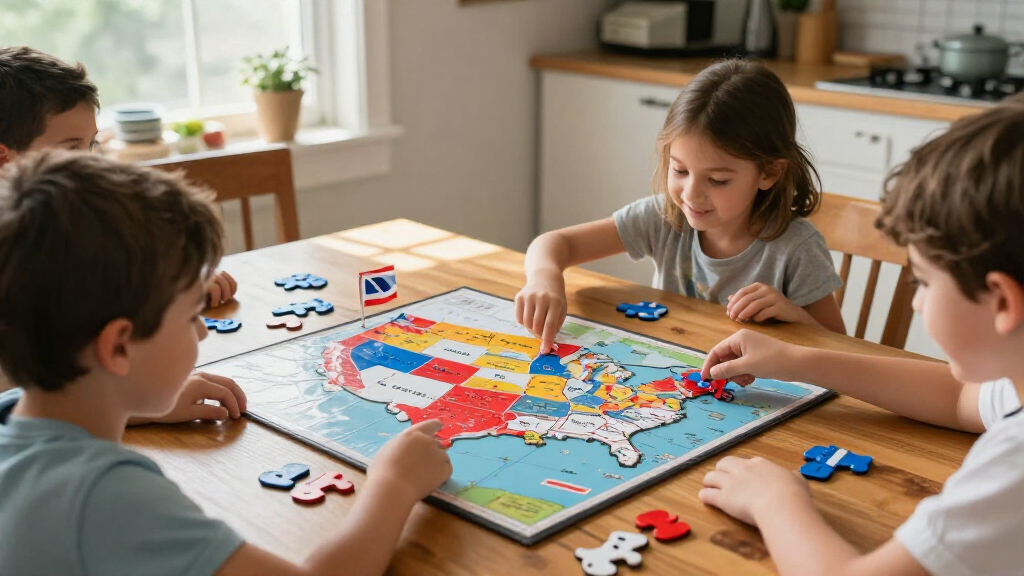
I ranked these games for their fit with the specific promise of patriotic geography: learning about U.S. states, locations, capitals, landmarks, flags, wildlife, or related state facts through play. I did not treat every educational game as interchangeable. A state-fact card game, a regional bingo game, and a race across the map support different kinds of learners and work best in different settings.
My comparison weighs geography coverage, the way the rules make players use that information, age and group fit, and practical format. A larger fact set can reward repeat play, while a simple matching system may be a better first step for younger children. I also gave weight to options with a distinctive advantage: portable cards for travel, a grade-level question system for mixed-age groups, or additional learning details such as state wildlife and industries.
The order reflects overall usefulness rather than a claim that one game suits every family. The 50 States Game takes the lead because it combines a map board with state cards and a substantial fact pool. Great States follows for energetic, varied play; Bingo earns a strong place for younger learners and visual matching. Race Across the USA and the Scholastic travel card game round out the list for families who want, respectively, a structured race or a compact card format. I also note limits such as player caps, U.S.-only subject matter, and pressure from timed or quiz-based turns.
Factors to Consider When Choosing Patriotic Geography Board Games
I’d choose among these games by matching the play style to the geography goal. The shared theme is U.S. states, but the learning experience changes quite a bit from one format to another.Decide what state knowledge you want to practice
If the goal is broad recall across capitals, flags, locations, nicknames, and postal codes, The 50 States Game offers the widest stated fact pool, with more than 500 facts. Great States also teaches state information, but its four card categories and timer make play feel more like a series of lively challenges. For a more focused introduction, eeBoo adds regional matching, industries, and wildlife instead of prioritizing a long list of quiz facts.
I would not treat these games as interchangeable study tools. A child who needs to locate states on a map may benefit from a board-centered game, while someone who enjoys recall questions may get more from a card or race format. Check which topics appear in the description and match those to what your family wants to learn.
Match the rules to the youngest or least confident player
Age guidance is a starting point, not a measure of readiness. eeBoo is recommended for ages five and up and uses matching, while the Scholastic travel card game begins at age six. The 50 States Game and Great States list ages seven and up; Race Across the USA lists ages eight and up and asks players to answer questions to progress.
For children who are still gaining confidence, matching can feel more approachable than being put on the spot to answer. If a child enjoys a challenge but benefits from help, Race Across the USA includes board clues and grade-level question matching. Great States’ timer is a less suitable fit for anyone who needs extra time to process an answer.
Choose for your usual group size
The player limits make a practical difference. Great States and eeBoo support up to six players, while The 50 States Game accommodates up to five. Race Across the USA and the Scholastic travel card game are limited to four. If you often play with several children, siblings, or a classroom group, the maximum count should influence the shortlist before you compare smaller details.
None of the listed options is described as a solo game. For one child studying independently, The 50 States Game’s cards may be usable for flash-card or trivia practice, but that is separate from its multiplayer game format. For a group, think about whether every player will stay engaged through the chosen format: simultaneous matching can feel different from waiting for a turn in a race.
Choose between a complete board setup and portable cards
Scholastic USA Travel is the obvious pick when bag space matters: its cards come in a travel tuck box. That convenience comes with a smaller 50-card set and a four-player cap. The 50 States Game, Great States, and Race Across the USA offer board-based play, while eeBoo’s boards and tiles create a matching layout rather than a travel-card format.
At home or in a classroom, a map or board can help players connect facts with places. On a trip, a compact deck is simpler to store and set out. I’d choose based on where the game will actually be played, not just on which format sounds most engaging.
Consider pace, pressure, and replay style
Great States uses a mechanical timer, which can energize players who like quick decisions but may frustrate children who prefer time to think. Race Across the USA builds progress around geography questions, so it suits players who enjoy a goal-driven quiz. The Scholastic travel game mixes matching and trivia, while eeBoo uses tile-to-board matching for a gentler feel.
For repeat practice, the type of material matters. A large fact pool can offer varied recall, and cards that can be used as flash cards add another way to revisit information. A simpler matching game may be more inviting for young players even if it covers fewer kinds of facts. Decide whether you want a game that tests existing knowledge, supports discovery, or does a little of both.
Set expectations about the geography scope
Every game in this roundup focuses on U.S. geography. That makes them relevant to learning state names and details, but none is a world geography game. If your priority is a patriotic theme centered on the United States, that focus is a strength. If you want countries, continents, or international landmarks, these products will not meet that need on their own.
Also compare the details each title highlights. Some concentrate on capitals and state facts; eeBoo includes wildlife and industries; Race Across the USA makes travel through states central to the objective. A close match between the game’s content and the learner’s interests can matter more than choosing the game with the largest stated number of facts.
Frequently Asked Questions
Which game is the strongest all-around choice for learning U.S. state facts?
I recommend The 50 States Game for broad state-fact practice. It covers all 50 states and includes more than 500 facts, along with a map board, state cards, and state sheets. Great States is a better fit if your group prefers timed challenges, while eeBoo is more approachable for younger learners who benefit from matching.
Which option is best for younger children?
eeBoo United States Geography Bingo has the youngest listed recommended age, five and up, and uses boards and tiles to match state-themed information. It includes wildlife and industry details, which can make the material feel visual and concrete. It still requires players to read and match information, so an adult may need to help a child who is just beginning to read.
Which game is easiest to take on a trip?
Scholastic USA Travel Card Game is the most travel-oriented choice because it comes as a 50-card set in a tuck box rather than a full board-and-piece setup. It supports two to four players and combines matching with trivia. The smaller set is less substantial than The 50 States Game or Great States, so I’d choose it for portability rather than maximum content.
Are these games suitable for a classroom or a mixed-age family?
Several can work in those settings, but the best fit depends on group size and learning levels. Great States and eeBoo support up to six players, and Race Across the USA uses grade-level-matched questions that may help mixed-grade groups play together. For a classroom with more than six children, players will likely need to rotate or play in smaller groups.
Do any of these games cover geography beyond the United States?
No. The five options here are centered on U.S. states and related details such as capitals, landmarks, wildlife, industries, or state facts. That makes them suitable for a patriotic U.S. geography theme, but not for learning world regions, other countries, or international capitals. I’d look for a separate world geography game if that broader scope is the main goal.
Conclusion
For the broadest U.S. state-fact practice, I’d start with The 50 States Game. Choose Great States if your family wants fast, varied challenges and is comfortable with a timer; pick eeBoo Geography Bingo for a younger child who is ready for visual matching and state details. For mixed-grade groups that like a route and quiz objective, Race Across the USA has the clearest race structure, while Scholastic USA Travel is my choice when compact storage and quick setup matter most.
All five are specifically U.S.-focused, so the final decision is less about finding a general geography game and more about choosing how players will engage with state knowledge. I’d match the game to the youngest participant, the number of players, and whether the group prefers matching, timed turns, trivia, or map-based travel.