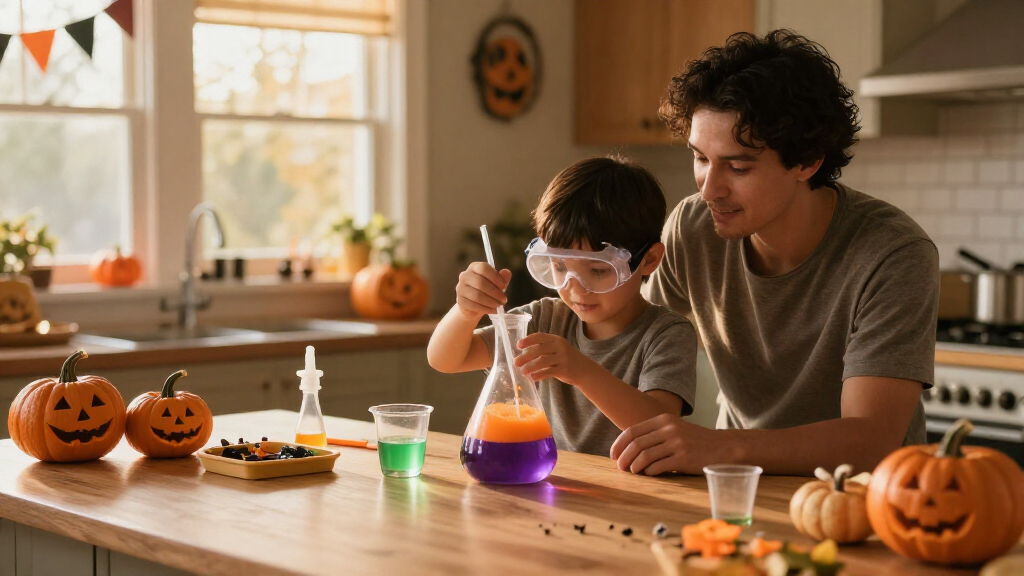

For Halloween-themed science that goes beyond decorations, I’d start with the Tasty Labs Wizard Potion Science Kit for edible potion-making and clear chemistry topics, or the Alritz Science Potion Kit for a larger assortment of colorful mixing activities. The MindWare Magic Potion Science Chemistry Set is the standout for younger beginners, while the Discovery Mini Science Kit 8-Pack offers the broadest range if you want science activities that last beyond one spooky-season session.

Prime made for students and young adults
- Fast, free delivery for dorm and study essentials
- Prime Video and Amazon Music included
- Member-only deals
These kits take different routes to Halloween chemistry. Some focus on storybook potions, some introduce recognizable reactions and materials, and one spreads its activities across several science themes rather than making every experiment spooky. I’ve ranked them by how well their format, age guidance, and included activities fit a Halloween chemistry session—not by how many bottles or experiments appear on the box. The tradeoff is straightforward: a narrow potion theme can feel more festive, while a broader kit can offer more variety after Halloween.
Key Takeaways
- The Tasty Labs Wizard Potion kit is the most direct pick for drinkable, story-led potion activities that introduce reactions, polymers, solutions, indicators, and density.
- Alritz provides the largest stated potion count—more than 20—but its appeal is primarily variety and visual mixing rather than a clearly itemized list of chemistry concepts.
- MindWare is the age-fit choice for preschool and early elementary children, though its four-and-up guidance does not remove the need for adult help.
- Discovery includes 32 experiments across seven themes, making it the most varied option but a less exclusively Halloween-focused choice than the potion sets.
- For a Halloween gathering, choose a kit by supervision needs and activity style: edible mixtures, colorful bottle experiments, guided beginner activities, or broader STEM projects.
| Tasty Labs Wizard Potion Science Kit |  | Best Overall for Halloween Potion Chemistry | Brand: Thames & Kosmos | Recommended age: 8 years and up | Potion experiments: 5 | VIEW LATEST PRICE | See Our Full Breakdown |
| Alritz Science Potion Kit with Cauldron for Kids Ages 8+ |  | Best for Potion Variety and Group Play | Brand: Alritz | Recommended age: 8 years and up | Potion activities: More than 20 | VIEW LATEST PRICE | See Our Full Breakdown |
| MindWare Magic Potion Science Chemistry Set for Kids |  | Best for Younger Beginners | Brand: MindWare | Recommended age: 4 years and up | Experiments: 5 | VIEW LATEST PRICE | See Our Full Breakdown |
| Discovery Mini Science Kit 8-Pack, 32 STEM Experiments for Kids Ages 8–12 |  | Best for Year-Round Science Variety | Brand: Discovery | Recommended age: 8–12 years | Number of kits: 8 individually packaged kits | VIEW LATEST PRICE | See Our Full Breakdown |
| Halloween chemistry experiment kit | Brand | Recommended age | Model number | Instructions |
|---|---|---|---|---|
| Tasty Labs Wizard Potion Scien | Thames & Kosmos | 8 years and up | 550050 | Illustrated experiment manual |
| Alritz Science Potion Kit with | Alritz | 8 years and up | Science-potions-001 | — |
| MindWare Magic Potion Science | MindWare | 4 years and up | — | Illustrated guidebook with step-by-step instructions and science lessons |
| Discovery Mini Science Kit 8-P | Discovery | 8–12 years | 1020078 | — |
More Details on Our Top Picks
Tasty Labs Wizard Potion Science Kit
Tasty Labs Wizard Potion Science Kit takes the top spot because it combines a clear wizard-potion theme with chemistry topics buyers can explain as children mix. Its five drinkable potion experiments are linked to chemical reactions, polymers, solutions, indicators, and density, giving the activity more structure than a set that simply promises lots of colorful mixtures. The cauldron, three flasks, beaker, and wand-shaped mixing tool reinforce the seasonal play without making the kit feel like a costume prop alone.
Compared with the Alritz set, Tasty Labs has fewer stated potion activities but a more explicit account of what children explore. That makes it a better match for a parent or educator who wants the activity to connect to science discussion, not just potion-making. Its edible ingredients are also a distinctive format: the product is designed for drinkable experiments, while the other kits are better described as hands-on mixing or broader science activities. Follow the supplied directions rather than treating “edible” as permission to substitute ingredients or improvise.
The tradeoff is age and scope. It is recommended for children eight and up, so it is not the easiest choice for preschoolers; MindWare is the clearer fit for younger children with adult guidance. Five potions may also feel limited to a family seeking an extended menu of activities, where Alritz’s more-than-20 count is more appealing. I rank Tasty Labs first because it balances Halloween-ready presentation and named chemistry concepts better than the alternatives, not because it has the most experiments.
Pros:- Five drinkable potion experiments give the kit a clear Halloween activity format.
- Names five chemistry topics, helping adults connect mixing with science discussion.
- Includes a cauldron, flasks, beaker, wand, edible ingredients, and an illustrated manual.
- More explicitly educational than a potion kit focused mainly on activity count.
Cons:- The age guidance starts at eight, excluding younger beginners as the intended audience.
- Five activities offer less stated variety than Alritz’s 20-plus potion count.
- The edible-ingredient format may not suit families who prefer non-consumable experiments.
Best for: Families with children ages 8 and up who want a guided, wizard-themed activity with drinkable potion experiments and named chemistry topics.
Not ideal for: Buyers shopping for children under eight, a long list of potion recipes, or experiments that do not involve edible ingredients.
- Brand:Thames & Kosmos
- Recommended age:8 years and up
- Potion experiments:5
- Educational topics:Chemical reactions, polymers, solutions, indicators, and density
- Included vessels and tools:Plastic cauldron, plastic wand, 3 clear plastic flasks, and plastic beaker
- Ingredients:8 packets of edible ingredients
- Instructions:Illustrated experiment manual
- Model number:550050
Our verdict“I’d choose Tasty Labs when a Halloween potion activity should feel playful while still giving adults clear chemistry concepts to talk through.”
Alritz Science Potion Kit with Cauldron for Kids Ages 8+
If the main goal is to give children lots of potion-style combinations to choose from, Alritz Science Potion Kit is the broadest option in this lineup. It includes 23 magic mix bottles and materials for more than 20 potions, with activities described as bubbling, solidifying, layering, and glowing. That makes it an easy fit for a Halloween table where children can rotate through colorful experiments or pick a recipe that appeals to them.
Its strength is range, not the same level of named science detail found in Tasty Labs. Tasty Labs lists concepts such as density and indicators alongside five drinkable experiments; Alritz emphasizes visual outcomes and a recipe guide. Buyers who want a large menu of activities may prefer Alritz, while those looking for a more clearly explained chemistry lesson may find the Tasty Labs descriptions easier to evaluate. The supplied information does not identify every ingredient or spell out the chemistry behind each effect, so I would not choose it solely on the promise of a particular educational topic.
The set is intended for ages eight and up, and adult supervision may be needed. Its bottles and caps are described as drop-resistant and spill-resistant, a practical feature for active group play, but those claims do not make the activities mess-proof. The product details also leave some bottle-material information unclear. Compared with MindWare, Alritz is aimed at older children and more expansive potion play; compared with Discovery, it keeps a much tighter Halloween-style theme. I place it second because it offers the most stated potion variety, with less detail about individual experiments than my overall pick.
Pros:- Lists more than 20 potion activities, the highest stated potion count in this comparison.
- Includes 23 mix bottles, a cauldron, measuring items, experiment materials, and a recipe guide.
- Activities include varied visual effects such as bubbling, layering, and solidifying.
- Bottle and cap design is described as drop-resistant and spill-resistant.
Cons:- The supplied details identify fewer specific chemistry concepts than Tasty Labs.
- Some listed bottle-material information is unclear.
- The age guidance starts at eight, and adult supervision may still be needed.
Best for: Families or small groups with children ages 8 and up who value a broad selection of colorful potion activities and a dedicated cauldron setup.
Not ideal for: Buyers who need a clearly itemized lesson for each experiment, prefer edible potion activities, or want a kit specifically designed for preschool-age children.
- Brand:Alritz
- Recommended age:8 years and up
- Potion activities:More than 20
- Magic mix bottles:23
- Included equipment:Bottles, plates, measuring cups, stirring sticks, and cauldron
- Other included items:Instruction manual, stickers, experiment materials, colorants, and decorations
- Described activity effects:Bubbling, solidifying, layering, and glowing
- Safety information:US CPC toy safety testing listed
- Model number:Science-potions-001
Our verdict“I’d pick Alritz for a lively, choice-rich potion session, but choose Tasty Labs instead when named chemistry topics matter more than the activity count.”
MindWare Magic Potion Science Chemistry Set for Kids
MindWare Magic Potion Science Chemistry Set is the clear age-range choice for younger children: it is listed for ages four and up, while the other three kits begin at age eight. Its five potion-themed activities include growing a crystal wand and inflating a balloon, so the set offers more than a pretend potion routine. A step-by-step illustrated guide supplies instructions and science lessons, giving an adult a structure for turning the activity into a short, guided introduction to chemistry.
That younger starting age is the reason to choose MindWare over Tasty Labs or Alritz, not a reason to expect independent use. The product information specifically notes that young children need adult guidance. Its activity count matches Tasty Labs at five, but the styles differ: MindWare includes a crystal-growing project and balloon activity, while Tasty Labs emphasizes drinkable mixtures and lists more chemistry concepts. For a child who enjoys wizard props and simple demonstrations, MindWare feels more beginner-oriented; for an older child who wants a broader potion menu, Alritz has the stronger stated variety.
The kit includes a long list of materials and tools, including citric acid, sodium bicarbonate, a beaker, test tube, flask, balloons, wand, workstation, and guidebook. That gives the activities a tangible science-kit feel, though the set is small and its five-experiment count is modest beside Discovery’s 32 activities. It also does not present as many clearly named learning topics as Tasty Labs. I rank it third because it serves a specific younger audience well, but its limited count and need for adult involvement make it less flexible for older children or self-directed group activities.
Pros:- Age guidance begins at four, younger than the other kits in this roundup.
- Includes five hands-on activities, including a crystal wand and balloon experiment.
- Provides experiment materials, tools, and an illustrated guide with science lessons.
- Includes familiar lab-style pieces such as a beaker, test tube, and flask.
Cons:- Young children need adult guidance, so it is not a hands-off activity.
- Five experiments offer less stated breadth than Alritz or Discovery.
- The supplied details name fewer chemistry topics than the Tasty Labs kit.
Best for: Parents seeking a potion-themed first science kit for a child ages four and up who will take part with adult guidance.
Not ideal for: Older children seeking many independent experiments, buyers who want edible potion-making, or households looking for the broadest activity selection.
- Brand:MindWare
- Recommended age:4 years and up
- Experiments:5
- Educational objective:STEM
- Included science materials:Aluminum potassium sulfate, plaster of Paris, sodium bicarbonate, citric acid, sand, coloring, wash base, and baby oil
- Included tools:Scoop, spoon, beaker, test tube, flask, round beaker, balloons, wand, wand holder, and workstation
- Instructions:Illustrated guidebook with step-by-step instructions and science lessons
- Batteries:Not required
- Item weight:13.6 ounces
Our verdict“I’d choose MindWare for an adult-led first potion science activity with a younger child, not for the largest or most self-directed Halloween experiment set.”
Discovery Mini Science Kit 8-Pack, 32 STEM Experiments for Kids Ages 8–12
The Discovery Mini Science Kit 8-Pack is the broadest science collection here, but it is not the most Halloween-specific. It contains eight individually packaged kits and 32 experiments across seven themes, including chemistry, slime, crystal growing, frozen science, and space. That variety makes it a practical choice when a family wants a seasonal activity plus projects to revisit later. Crystal growing and slime can suit a spooky-season table, while the additional themes keep the set from being limited to potion play.
Compared with Alritz’s more-than-20 potion activities, Discovery spreads its experiments across several branches of science rather than keeping them all in a cauldron-and-bottle format. Compared with Tasty Labs, it does not list the same focused set of chemistry concepts or drinkable activities. Its main advantage is the larger range of projects and the eight separate kits, which may help an adult divide activities across different occasions. For a buyer searching specifically for Halloween potion chemistry, however, its broad STEM scope is a compromise rather than an advantage.
The kit is recommended for ages eight to twelve, and some experiments may need adult supervision. That makes it a weaker fit than MindWare for younger children, even though MindWare offers far fewer activities. Illustrated instructions and included experiment materials help families get started, but a 32-experiment count does not mean every activity is a potion or chemistry project. I rank Discovery fourth for this particular roundup because its best role is year-round variety. Choose it if Halloween is one use among many; choose a dedicated potion set if the seasonal theme is the deciding factor.
Pros:- Includes 32 experiments across seven science themes.
- Eight individually packaged kits can support activities across multiple occasions.
- Covers chemistry, slime, crystal growing, frozen science, and other themes.
- Includes experiment materials and illustrated instruction guides.
Cons:- Its broad STEM focus makes it less specifically Halloween-themed than the potion kits.
- Not all 32 experiments are chemistry activities or potion experiments.
- Recommended for ages 8–12, with adult supervision needed for some activities.
Best for: Families with children ages 8–12 who want a substantial, varied STEM collection with some chemistry, slime, and crystal activities for Halloween and beyond.
Not ideal for: Buyers seeking a dedicated potion kit, edible experiments, or a set aimed at children younger than eight.
- Brand:Discovery
- Recommended age:8–12 years
- Number of kits:8 individually packaged kits
- Number of experiments:32
- Science themes:7
- Named themes:Chemistry, space, frozen science, slime, and crystal growing
- Included components:Experiment materials, specialty ingredients, crystal materials, slime ingredients, chemistry supplies, tools, accessories, and illustrated guides
- Model number:1020078
- UPC:840397519736
Our verdict“I’d choose Discovery when broad, reusable science variety matters more than a concentrated Halloween potion experience.”
How We Picked
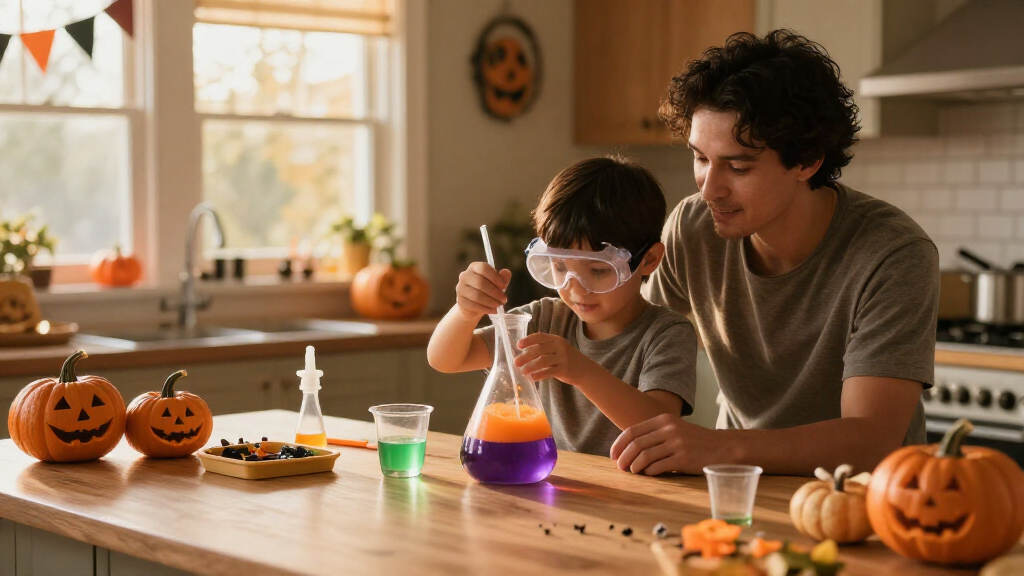
I compared these four kits against the specific job implied by Halloween chemistry experiment kits: helping families create a hands-on, potion-like science activity that feels at home during spooky season. I gave weight to the theme, the chemistry or experiment content stated in the product information, the age range, and whether the kit includes materials and directions for getting started. A Halloween label alone would not be enough; I looked for a clear reason the activities could suit a seasonal science session.
The ranking also reflects differences buyers may care about more than raw activity counts. Tasty Labs earns the strongest all-around placement because its five potion experiments are paired with named learning topics and edible ingredients. Alritz ranks next for breadth of potion-style play, while its listed materials and educational details are less specific. MindWare serves a younger age group with a guided beginner format, and Discovery comes last for this exact theme despite its many activities: its science mix is broader than Halloween potions. That wider scope may be a benefit for families seeking year-round use.
I have not treated claims such as “glowing” or “drinkable” as proof of a particular effect, safety outcome, or learning result beyond what the supplied descriptions state. The age labels are starting points, not replacements for checking instructions and supervising children. I also considered tradeoffs: fewer, more clearly defined activities can suit a planned family experiment, while a larger activity collection may offer more choice but less thematic focus. This is an editorial comparison based on the supplied product details, not a claim of hands-on testing.
| Halloween chemistry experiment kit | Brand | Instructions |
|---|---|---|
| Tasty Labs Wizard Potion Scien | Thames & Kosmos | Illustrated experiment manual |
| Alritz Science Potion Kit with | Alritz | — |
| MindWare Magic Potion Science | MindWare | Illustrated guidebook with step-by-step instructions and science lessons |
| Discovery Mini Science Kit 8-P | Discovery | — |
Factors to Consider When Choosing Halloween Chemistry Experiment Kits
I’d choose a Halloween science kit by deciding what kind of activity I actually want: an edible potion, an assortment of colorful mixes, a first guided experiment, or a wider STEM collection. The biggest number on a package is not automatically the best match. Age suitability, the type of science named, and how much adult participation the activity calls for can matter more than the headline experiment count.
Choose the seasonal style before counting activities
For a kit that immediately reads as Halloween potion play, I’d start with Tasty Labs or Alritz. Tasty Labs uses a wizard theme and a cauldron, while Alritz adds many bottles and a broader set of potion recipes. MindWare also has potion framing, but its beginner activities include crystal growing and balloon inflation. Discovery is the outlier: slime and crystals can fit a spooky-season activity, yet the collection is built around several science themes rather than Halloween alone. A narrow theme can make it easier to plan one festive activity; a broad theme can provide more ways to use the kit later.
Match the age label to the child and the adult’s role
The stated age ranges divide this group clearly. MindWare starts at four, while Tasty Labs and Alritz start at eight, and Discovery is listed for ages eight to twelve. Younger age guidance does not mean a child can complete every step alone: the MindWare details call for adult guidance, and the Discovery and Alritz descriptions also mention supervision needs. Before starting, an adult should read the instructions, prepare the work area, and decide which steps the child can handle. If you are buying for children of different ages, choose based on the youngest child who will take part, not simply the most advanced child in the group.
Compare named learning topics with visual variety
Some families want an activity that prompts a science conversation; others mainly want engaging mixing and visible changes. Tasty Labs names reactions, polymers, solutions, indicators, and density, so it is the easiest kit here to evaluate for explicit chemistry topics. Alritz lists effects such as bubbling, layering, solidifying, and glowing, but the supplied details do not identify each activity’s chemistry. MindWare includes a guide with science lessons, while Discovery offers chemistry among a wider list of themes. I would choose by the explanation the product provides, not assume every colorful effect teaches the same concepts.
Treat activity counts as different kinds of value
The stated totals do not measure the same thing. Alritz lists more than 20 potions, Discovery lists 32 experiments across seven themes, and MindWare and Tasty Labs each list five activities or potions. If the goal is a broad choice of potion recipes, Alritz has the largest stated selection. If you want varied projects beyond Halloween, Discovery’s eight kits and multiple themes may make better sense. Tasty Labs and MindWare have smaller counts but clearer, more focused formats. Check whether the number refers to potion recipes, all experiments, or an entire mixed-theme collection before comparing the kits.
Think through ingredients, cleanup, and group setup
Tasty Labs stands apart because its experiments use edible ingredients and are described as drinkable; families should follow the manual and avoid improvising with ingredients. Alritz supplies multiple bottles and describes spill-resistant caps, but that does not guarantee a mess-free session. MindWare’s listed materials and tools are suited to guided projects, and Discovery’s separate kits may make it easier to spread activities across days. For Halloween gatherings, I’d plan a stable surface, adult-led setup, and enough room for each participant’s materials. The product descriptions do not promise that all activities are quick, self-contained, or suitable for unsupervised group use.
Decide whether this is a one-night activity or a reusable kit
If the kit is mainly for one Halloween gathering, a focused potion set can make the event feel coherent. Tasty Labs gives adults clear chemistry topics to introduce, and Alritz offers more stated potion choices. If you want activities for other seasons too, Discovery has the strongest case because its themes include space, frozen science, slime, and crystal growing. MindWare can work as an introductory kit beyond Halloween as well, though its five experiments make it a more compact activity plan. I’d pay attention to the actual themes and included materials rather than assuming that a festive package will suit repeated use.
Frequently Asked Questions
Which kit is the strongest match for a Halloween chemistry activity?
I’d choose the Tasty Labs Wizard Potion Science Kit for the closest balance of seasonal presentation and named chemistry concepts. Its wizard-potion format includes five drinkable activities and lists reactions, polymers, solutions, indicators, and density. Alritz is a better alternative if the main goal is a larger stated choice of potion activities, while MindWare is the more age-appropriate option for younger beginners with adult help.
Which of these kits is suitable for a younger child?
MindWare is the only option here with age guidance starting at four, so it is the clearest choice for a younger child. Its product details still call for adult guidance, and the age label should not be read as a promise of independent use. The other kits are listed for ages eight and up or ages eight to twelve, making them less directly suited to preschool-age children.
Does the largest experiment count mean the best value for Halloween?
Not necessarily, because the counts describe different kinds of activities. Discovery lists 32 experiments across seven science themes, not 32 Halloween potions, while Alritz lists more than 20 potion activities. If you want seasonal potion variety, Alritz’s count is more directly relevant; if you want several types of science to reuse after Halloween, Discovery may be the better fit.
Are these kits designed for children to use without adult supervision?
The supplied product details do not support treating any of these kits as universally unsupervised. MindWare specifies adult guidance for young children, while Alritz and Discovery note that some activities may need adult supervision. I’d have an adult read the instructions, prepare materials, and supervise the steps according to the manual and the child’s age and abilities.
Which kit is best if I want science learning as well as potion play?
Tasty Labs is the clearest choice for named chemistry learning because it lists five topics alongside its potion activities. MindWare also includes a guide with science lessons and offers beginner-oriented projects, including crystal growing and balloon inflation. Alritz emphasizes a larger number of visual potion activities, and Discovery offers broader STEM variety, so those two may suit play or range better than a focused chemistry discussion.
Conclusion
For the best balance of Halloween potion play and explicit chemistry topics, I recommend Tasty Labs. Choose Alritz if your priority is a larger menu of colorful potion activities, and select MindWare when you are shopping for a younger beginner who will participate with an adult. If you want a kit that can serve as a wider science collection well beyond October, Discovery is the most varied option—but it is the least focused on Halloween potions. The right pick depends on whether your household values guided chemistry, potion variety, younger-child accessibility, or year-round STEM breadth.
Halloween Picks
halloween
As an affiliate, we earn on qualifying purchases.