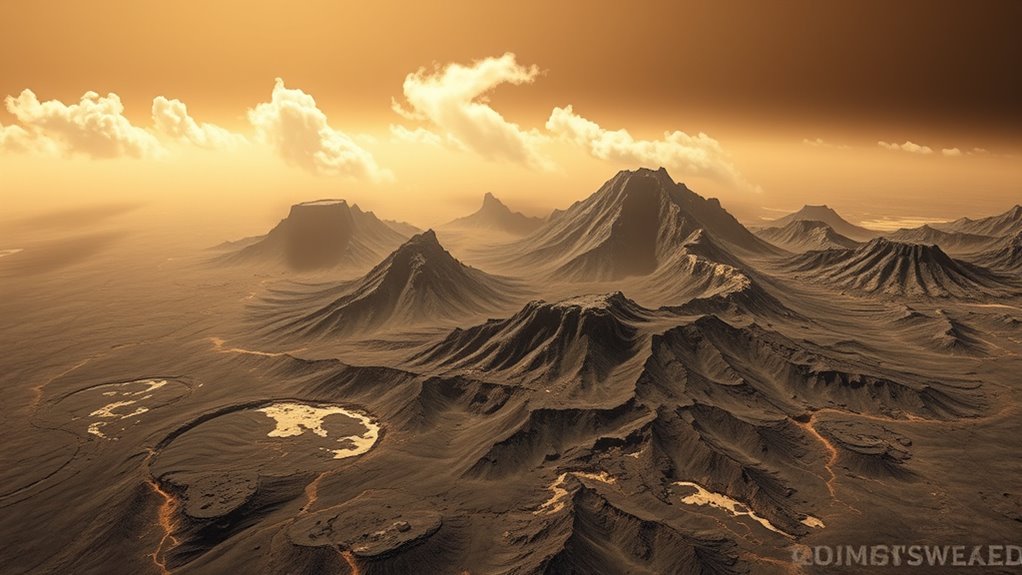

New radar maps from NASA’s Magellan reveal that Venus is anything but geologically dormant. You’ll find evidence of mysterious volcanic activity reshaping the planet’s surface, with extensive lava flows and unique structures indicating ongoing eruptions. These findings challenge earlier beliefs about Venus’s inactivity. It’s clear that the intense conditions influence how these eruptions manifest. If you’re curious about what these discoveries mean for our understanding of Venus, there’s much more to uncover.
Key Takeaways
- Recent radar maps from NASA’s Magellan show detailed surface features of Venus, indicating potential volcanic activity.
- The maps reveal young lava flows, suggesting that Venus may not be volcanically dormant as previously believed.
- Large volcanic domes and extensive lava plains indicate ongoing geological processes on the planet’s surface.
- Venus’s volcanic activity is characterized as more effusive compared to Earth’s explosive volcanoes, offering insights into its internal mechanisms.
- The planet’s thick atmosphere preserves signs of eruptions, hinting at possible current volcanic activity and fueling scientific interest.

Have you ever wondered what lies beneath the thick, swirling clouds of Venus? The planet’s surface reveals a landscape shaped by intense volcanic activity, making it a fascinating subject for exploration. Scientists have long speculated about volcano formation on Venus, and recent radar maps from missions like NASA’s Magellan have brought new insights into this enigmatic world. These maps help you visualize the geological features that hint at ongoing volcanic processes, suggesting that Venus is far from a dormant planet.
Explore the intriguing volcanic landscape of Venus, where radar maps reveal signs of ongoing geological activity beneath swirling clouds.
As you dig deeper into Venus’ surface, you’ll notice vast plains dotted with unique volcanic structures. These formations indicate that volcanic lava has flowed across the landscape, reshaping the terrain over millions of years. The radar images reveal vast lava flows, some of which are relatively young, hinting that Venus might still be active. This contradicts earlier beliefs that the planet’s volcanic activity had long ceased. The idea of active volcanoes challenges your perception of Venus as an inhospitable and lifeless environment.
The presence of large volcanic domes and extensive lava plains suggests that the planet has undergone significant geological changes. You might find it fascinating that these features are similar to those found on Earth, yet they differ in scale and formation processes. For instance, the volcanic activity on Venus is thought to be more effusive, meaning that the lava flows more freely, creating broad plains rather than the steep, explosive volcanoes common on Earth. This distinction provides vital clues about the internal processes shaping Venus.
Additionally, the thick atmosphere of Venus plays a role in how volcanic eruptions would manifest. The high pressure and temperature create an environment where volcanic lava could behave differently than on Earth. You can picture how the dense clouds and extreme conditions might preserve signs of past eruptions, giving scientists valuable insights into the planet’s geological history. Recent studies even suggest that some of these volcanoes may be capable of erupting today, further igniting curiosity about Venus’ current state.
Frequently Asked Questions
How Do Venus’ Volcanoes Compare to Earth’s Volcanoes?
Venus’ volcanoes and Earth’s differ markedly in formation and eruption styles. You’d find that Venusian volcanoes are mostly shield volcanoes, forming from less viscous lava that flows easily, creating broad, gently sloping structures. In contrast, Earth’s volcanoes exhibit a variety of eruption styles, ranging from explosive stratovolcanoes to gentle effusive eruptions. The lack of plate tectonics on Venus likely contributes to its unique volcanic activity, leading to fewer explosive eruptions compared to Earth.
What Is the Significance of Studying Volcanic Activity on Venus?
Studying volcanic activity on Venus helps you understand planetary evolution and the potential volcanic hazards that could arise. Isn’t it fascinating to think that by exploring another planet’s geology, you might uncover clues about Earth’s past? Analyzing Venus’ volcanoes reveals how similar or different their processes are compared to ours, shedding light on the dynamics of planetary development and the role of volcanism in shaping terrestrial worlds.
Are There Signs of Recent Volcanic Eruptions on Venus?
Yes, there are signs of recent volcanic eruptions on Venus. Scientists have noticed changes in the planet’s surface that suggest active geological activity, including potential lava flow and altered landforms. These observations indicate that the volcanoes might not be as dormant as previously thought. By studying these eruptions, you can gain valuable insights into Venus’ geological history and its similarities to Earth, enhancing our understanding of planetary evolution.
How Do Scientists Use Radar Maps to Study Venus?
Scientists use radar imaging to penetrate Venus’ thick atmosphere, juxtaposing its harsh clouds with detailed surface mapping. You’ll see how these maps reveal topographical features, showing potential volcanic activity beneath the surface. By bouncing radar waves off the planet, they create high-resolution images, highlighting changes over time. This technique helps you understand Venus’ geological processes, offering insights into its volcanic history and how it compares to Earth’s dynamic landscape.
What Tools and Missions Have Contributed to Understanding Venus’ Geology?
To understand Venus’ geology, you’ll find that tools like orbital spectrometry and missions such as Magellan have been essential. These instruments conduct detailed geological surveys, mapping surface features and analyzing the composition of Venus’ atmosphere. They reveal insights into volcanic activity and tectonic processes. By combining data from various missions, scientists piece together a clearer picture of Venus, enhancing your understanding of this intriguing planet’s geological history.
Conclusion
As you explore Venus’ enigmatic landscape, you can’t help but marvel at the juxtaposition of beauty and destruction. Beneath the planet’s thick, toxic atmosphere lies a world shaped by relentless volcanic activity, hidden yet alive. These new radar maps reveal not just ancient scars, but hints of ongoing eruptions, challenging our perceptions of planetary stillness. In this dance between fire and ice, Venus reminds us that even in the most hostile environments, life—of a sort—can thrive.