The first photographs of quantum entanglement give you visual proof of a phenomenon once thought unseeable. Using advanced imaging, scientists captured photons with correlated phases, confirming entanglement beyond theoretical predictions. These images show interference patterns that reveal instantaneous connections, supporting Einstein’s “spooky action.” This breakthrough transforms a puzzling quantum idea into an observable effect, opening new doors in science. If you keep exploring, you’ll uncover even more fascinating details behind these remarkable images.
Key Takeaways
- First visual confirmation of Bell entanglement through direct photographic images of entangled photons.
- Photographs show interference patterns indicating nonlocal quantum correlations.
- The experiment used laser-generated entangled photon pairs and sensitive cameras to capture their phases.
- Visual evidence supports quantum mechanics predictions and demonstrates entanglement as an observable phenomenon.
- This breakthrough enhances understanding and visualization of quantum phenomena, opening new research and educational opportunities.
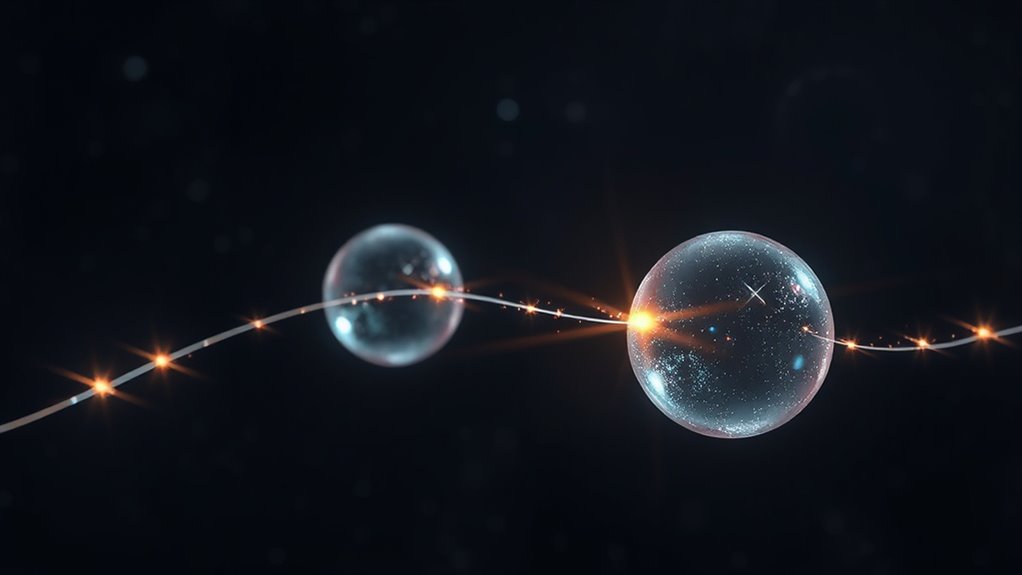
Quantum entanglement, long a concept confined to abstract theory and indirect experiments, has now been captured in striking photographic images. This breakthrough marks a pivotal moment in quantum physics, transforming intangible phenomena into visual evidence. Before 2019, the best evidence for entanglement came from experimental data that confirmed correlations predicted by quantum mechanics, but no one had ever produced a direct photograph showing the phenomenon itself. Researchers at the University of Glasgow made history by capturing the first images that visually demonstrate Bell entanglement, a particularly strong and nonlocal form of quantum connection.
First photographic images visually confirming Bell entanglement mark a milestone in quantum physics.
The methodology behind this achievement involved generating pairs of entangled photons using an ultraviolet laser beam passed through a nonlinear crystal. This process caused the photons’ phases to become intertwined. These photon pairs were then separated by a beam splitter, which directed each photon into different paths—these are the two arms of the experiment. One photon in each pair passed through a phase filter, which restricted its state to one of four possible phases. Because of the entanglement, when the phase of one photon was altered, its partner’s phase instantaneously changed, no matter how far apart they were. Sensitive cameras positioned to detect the photons recorded their arrival times and phases. The cameras only triggered when both photons from each pair arrived simultaneously, allowing the system to build up an image over many events. This process demonstrated the importance of advanced imaging techniques in quantum research.
The resulting photograph displayed distinctive “four eye-like” interference patterns. These patterns corresponded directly to the four phase states imposed on the photons, visually confirming the nonlocal correlations expected from quantum mechanics and Bell’s theorem. The images vividly illustrated the instantaneous phase correlations between spatially separated photons, providing a tangible example of what Einstein famously called “spooky action at a distance.” This visual evidence not only counters classical intuition but also aligns with quantum theory’s predictions, transforming the abstract concept of entanglement into a perceptible form. The experiment’s success in capturing these images confirms that entanglement is a measurable phenomenon rather than merely a theoretical construct. This photographic breakthrough is significant because it offers the first direct visual confirmation of Bell entanglement, supporting decades of indirect evidence. It demonstrates that entanglement is an observable, real phenomenon at the single-photon level, affirming that particles can share states regardless of their physical separation. This new capability paves the way for future research using advanced imaging techniques to explore quantum phenomena more deeply. It also enhances educational efforts by providing a visual demonstration that makes complex quantum concepts more accessible and compelling. Overcoming technical challenges—such as precise synchronization, noise reduction, and the need for highly sensitive cameras—was fundamental to this success. The achievement not only confirms foundational theories but also opens exciting possibilities for visualizing and manipulating quantum states directly.
Frequently Asked Questions
How Long Did It Take to Capture the First Entanglement Photographs?
You’re curious about how long it took to capture the first photographs of entanglement. It actually happened in 2019, but the process leading up to it spanned decades of research. Researchers had to develop advanced techniques, like creating entangled photons with beam splitters, to visualize the phenomenon. So, from early experiments to that breakthrough image, it’s been roughly 50 years of scientific progress to finally capture entanglement visually.
What Equipment Was Essential for Photographing Quantum Entanglement?
You need specialized equipment to photograph quantum entanglement. A UV laser source creates high-energy photons, which a nonlinear crystal converts into entangled pairs. A beam splitter divides these photons, while phase filters control their states. A single-photon sensitive camera with nanosecond timing detects coincident photon pairs, synchronized with electronic triggers and optical components like mirrors and lenses. This setup captures and reconstructs the entanglement image accurately.
Can These Photographs Be Used for Practical Quantum Computing Applications?
You might wonder if these photographs can be used practically in quantum computing. They visually confirm entanglement, which is vital for quantum processors. With super-sensitive cameras capturing correlated photons, you gain a direct way to study and manipulate entangled states. This visual validation helps refine quantum algorithms and hardware, speeding up development. Ultimately, these images serve as a pivotal step toward integrating entanglement into scalable, real-world quantum computing systems.
How Do These Images Compare to Previous Indirect Measurements of Entanglement?
You see, these images give you a direct visual of entanglement, unlike previous measurements that only showed statistical correlations. With direct images, you can observe how particles relate spatially in real time, providing clearer confirmation of quantum phenomena. This visual proof enhances your understanding and opens new possibilities for quantum research, making it easier to develop applications like quantum computing and secure communication technologies.
What Challenges Did Scientists Face in Capturing Quantum Entanglement Visually?
You face several challenges when capturing quantum entanglement visually. You need highly sensitive, synchronized detectors to identify correlated photon pairs amid background noise. Precise calibration is essential to account for arbitrary coordinate rotations. You also rely on complex setups like nonlinear crystals and laser sources, and you must gather extensive data to distinguish genuine entanglement from statistical fluctuations. Overcoming these obstacles is vital for producing clear, reliable images of quantum entanglement.
Conclusion
As you gaze at these pioneering images, remember they’re just the beginning of a journey into the unseen. While today’s photographs hint at endless possibilities, there’s still much to discover beneath the surface. These delicate glimpses remind us that even the most intricate mysteries can be gently unfolded with patience and curiosity. In time, what now seems elusive may become a familiar part of your understanding, inviting you to explore the subtle beauty of the quantum world.