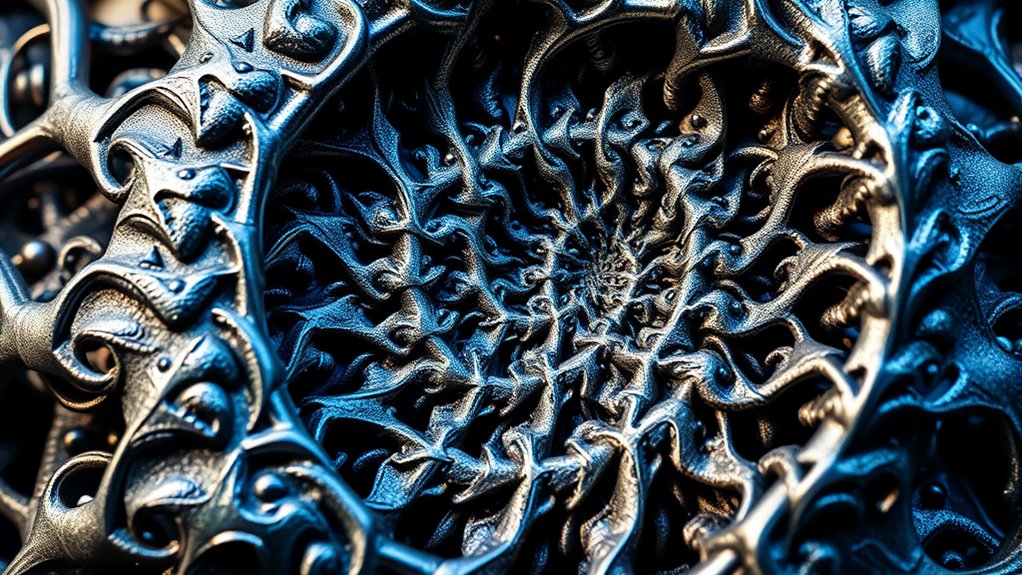

Fractal materials use complex mathematical principles to create structures that seem chaotic but provide remarkable strength and resilience. Their unique properties arise from their fractal dimension, which enhances structural complexity and allows effective energy distribution. This self-similar design contributes to improved performance, making them ideal for applications in aerospace, medicine, and beyond. You’ll discover how these innovative materials redefine engineering and open up new possibilities as you explore further into this fascinating subject.
Key Takeaways
- Fractal materials utilize complex mathematical principles, resulting in enhanced strength and resilience through intricate, self-similar structures.
- The fractal dimension quantifies how these materials occupy space, revealing their superior structural complexity compared to traditional materials.
- Self-similarity in fractal structures allows for effective energy absorption and even stress distribution, improving mechanical performance.
- Practical applications of fractal geometry in engineering include lightweight components for aerospace and innovative designs in medical implants.
- Ongoing research in fractal materials combines mathematics and material science, driving advancements in efficient and robust engineering solutions.

When you explore the fascinating world of fractal materials, you’ll discover that their unique properties stem from complex mathematical principles. These materials exhibit incredible strength and resilience, thanks in large part to the underlying mathematics that governs their structure. One of the key concepts in understanding fractal materials is the fractal dimension, which describes how a fractal pattern fills space. Unlike traditional geometric shapes, fractals have non-integer dimensions, revealing a depth that defies simple classification. This characteristic allows them to maintain self-similarity across various scales, meaning that you can zoom in on a fractal pattern and see smaller copies of the same structure.
Discover the incredible strength of fractal materials, shaped by complex mathematics and self-similar structures across various scales.
As you explore further into the mathematics of fractal materials, you’ll start to appreciate the way self-similarity plays an essential role in their properties. Self-similarity means that the structure remains consistent, regardless of the scale at which you observe it. This consistency results in a distribution of materials that can absorb and dissipate energy effectively. In practical terms, when you apply force to a fractal material, its unique structure allows it to distribute the stress more evenly, enhancing its strength compared to traditional materials.
Understanding the fractal dimension helps to quantify the complexity of these materials. For instance, a fractal dimension greater than two indicates a structure that occupies more space than a standard surface, leading to enhanced mechanical properties. You might imagine this as having a network of tiny, interconnected features that work together, creating a robust material that can withstand various forces without failing. This complexity is what makes fractal materials so appealing to engineers and designers looking to create stronger, lightweight structures.
In real-world applications, the principles of fractal geometry find their way into fields like aerospace engineering, architecture, and even medicine. By harnessing the mathematical properties of fractal materials, you can develop components that are not only strong but also more efficient. Whether it’s in the design of aircraft wings or the creation of flexible medical implants, the potential of fractal materials seems limitless. Additionally, understanding market trends related to material science can help drive innovations in the development of these advanced structures.
Ultimately, the fascinating interplay between mathematics and material science leads you to a better understanding of how to engineer strength from chaos. As you explore this domain, you’ll find that embracing the complexities of fractal structures opens up exciting possibilities for innovation and advancement. With each new discovery, you’re not just learning about materials; you’re also uncovering new ways to redefine strength and resilience in the engineering world.
Frequently Asked Questions
How Do Fractal Materials Compare to Traditional Materials in Cost?
Fractal materials often present a more complex cost comparison than traditional materials. While they can lead to reduced manufacturing costs due to their unique properties, the initial investment in research and development can be high. However, once optimized, you might find that their enhanced strength and durability justify the expenses. In the long run, you could save money on repairs and replacements, making them a potentially cost-effective choice for various applications.
What Industries Are Most Impacted by Fractal Material Advancements?
Fractal material advancements are shaking up industries like aerospace and medicine. In aerospace innovation, these materials enhance performance and reduce weight, leading to more efficient aircraft. In the medical field, they’re driving breakthroughs in prosthetics and implants, offering stronger yet lighter solutions that improve patient outcomes. As you explore these advancements, you’ll see how they’re reshaping the future of these critical sectors, ultimately pushing the boundaries of what’s possible.
Can Fractal Materials Be Recycled Effectively?
When it comes to recycling fractal materials, you might find it’s not all smooth sailing. Recycling challenges arise due to the complex structure of these materials, which can lead to material degradation during processing. However, with innovative techniques, you can overcome these hurdles. Developing efficient recycling methods can help you reclaim valuable resources and reduce waste, turning a potential headache into a sustainable opportunity for the future.
How Does Temperature Affect the Properties of Fractal Materials?
Temperature critically affects the properties of fractal materials. As temperatures rise, you’ll notice thermal expansion, which can alter their dimensions and stability. High temperatures may disrupt fractal stability, leading to potential structural weaknesses. Conversely, lower temperatures can enhance stability but might make the material more brittle. Understanding these temperature effects is essential for optimizing the performance and longevity of fractal materials in various applications, ensuring they maintain their unique properties under changing conditions.
What Are the Environmental Impacts of Producing Fractal Materials?
You might think producing fractal materials is too harmful to the environment, but sustainable manufacturing practices can minimize their ecological footprint. By using renewable resources and energy-efficient processes, you can create these materials with less waste and lower emissions. Additionally, recycling and repurposing waste materials can further reduce the environmental impact. It’s vital to balance innovation with responsibility, ensuring that the benefits of these materials don’t come at the expense of our planet.
Conclusion
In the world of fractal materials, you harness chaos to create strength, you embrace complexity to enhance resilience, and you explore patterns to *discover* new possibilities. Just as nature crafts beauty from disorder, you can engineer remarkable structures that defy conventional limits. By understanding the mathematics behind these materials, you’re not just shaping the future of engineering; you’re transforming the way we perceive strength and innovation. Embrace the chaos, and let it guide your creativity.