
Scientists are making headway in solving the fast radio burst mystery by studying their brief, powerful signals and potential cosmic origins. Evidence suggests these bursts come from distant, energetic events involving highly magnetic neutron stars called magnetars, possibly from collisions or mergers. Ongoing efforts to localize and analyze these signals are bringing new insights. If you explore further, you’ll uncover how ongoing research continues to shed light on this fascinating cosmic puzzle.
Key Takeaways
- Recent detections of repeating FRBs suggest diverse origins, providing new clues to their mechanisms.
- Improved localization techniques are narrowing down potential astrophysical sources, advancing understanding.
- Ongoing observations link some FRBs to magnetar activity, supporting magnetic turbulence theories.
- Multi-wavelength studies are uncovering host galaxy environments, aiding in identifying FRB progenitors.
- Advances in telescope technology are increasing detection rates, bringing scientists closer to solving the FRB mystery.
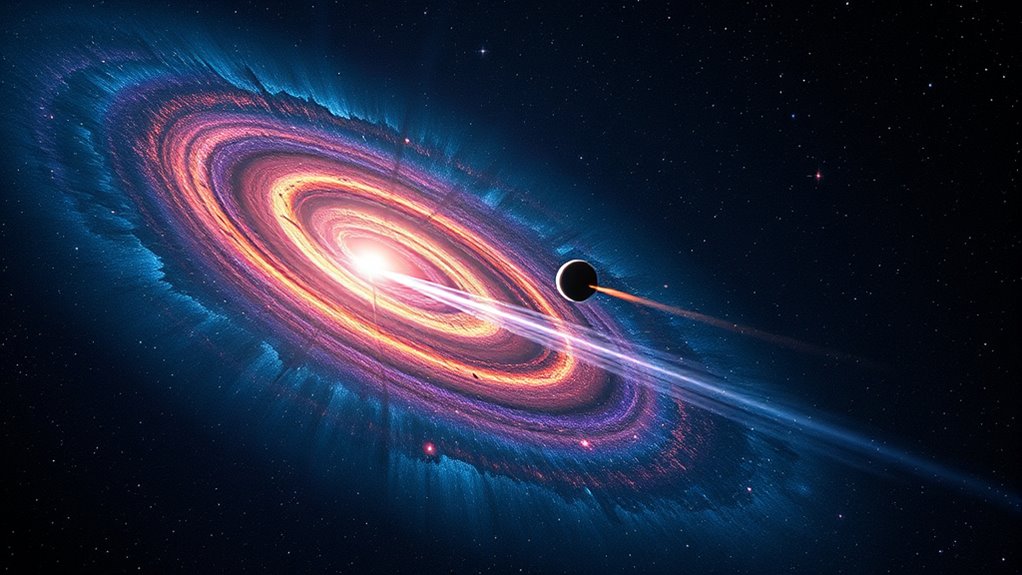
Have you ever wondered about the mysterious flashes of energy that blink across our universe in milliseconds? Fast radio bursts (FRBs) are brief yet incredibly bright pulses of radio waves detected mainly around 1,400 MHz, though some occur at lower frequencies. These signals last only a few milliseconds, but in that tiny window, they emit energy comparable to the sun’s output over several days. This immense power packed into such a short burst makes FRBs one of the most intriguing mysteries in astrophysics. Their fleeting nature and brightness challenge scientists to understand their origins and mechanisms.
Mysterious millisecond flashes of energy, the dazzling enigma of fast radio bursts illuminate the universe’s fleeting and powerful secrets.
One of the key clues pointing to their extragalactic origin is the dispersion measure, which indicates the signals have traveled through vast amounts of ionized material outside our galaxy. The higher the dispersion measure, the more distant the source likely is. FRBs are observed all over the sky, not concentrated along the Milky Way’s plane, further supporting the idea they come from outside our galaxy. Instruments like UTMOST have helped rule out terrestrial sources by establishing a minimum distance of 10,000 kilometers, confirming that these bursts are truly cosmic phenomena. Their enormous radio luminosities suggest they result from highly energetic events far beyond our local environment. Additionally, the study of their polarization properties provides insights into the magnetic environments near their sources, which can help narrow down potential origins.
Scientists have proposed several potential causes for FRBs, but no consensus exists yet. Some believe they originate from highly magnetic neutron stars, known as magnetars, which can release vast amounts of energy through magnetic turbulence. Others theorize that collisions between neutron stars could produce the bursts, given the enormous energy released during such mergers. Merging white dwarfs have also been suggested as possible sources, though evidence remains limited. Despite these hypotheses, the exact mechanism behind FRBs continues to elude researchers, making them one of the most elusive phenomena in modern astronomy.
Detection methods rely on large single-dish telescopes that can pick up these millisecond signals, but precise localization remains difficult. The brief duration and wide detection areas mean scientists often struggle to pinpoint the exact source. Observatories like the Parkes Radio Telescope and the Very Large Array are crucial for capturing and studying these bursts. Future advancements in telescope technology and surveys aim to improve localization, helping researchers identify host galaxies and environments more accurately. However, current technological limitations still hinder a detailed understanding of what causes FRBs and how they are produced. Improving our understanding of the astrophysical environments where these bursts originate could unlock vital clues about their nature.
The signal characteristics of FRBs, particularly their short duration and frequency dispersion, provide essential clues. Some FRBs repeat, but most are one-off events, making real-time study tricky. As scientists work to uncover their origins, each detection adds a piece to the puzzle, inching us closer to solving the mystery of these fleeting cosmic flashes.

Fundamentals of Radio Astronomy: Observational Methods (Series in Astronomy and Astrophysics)
As an affiliate, we earn on qualifying purchases.
As an affiliate, we earn on qualifying purchases.
Frequently Asked Questions
Could Fast Radio Bursts Be Linked to Extraterrestrial Intelligence?
You wonder if fast radio bursts could be linked to extraterrestrial intelligence. While some scientists suggest FRBs might be signals from advanced civilizations or leakage from their transmitters, there’s no definitive proof yet. You should keep an eye on ongoing research, like SETI’s monitoring efforts, as future discoveries might reveal patterns or signatures indicating an extraterrestrial origin. For now, FRBs remain one of the universe’s most intriguing mysteries.
What Are the Possible Implications if FRBS Originate From Black Holes?
If FRBs originate from black holes, you could gain insights into extreme energy releases and quantum gravity effects. You might also understand magnetosphere dynamics and the role of exotic matter in these environments. This discovery could reshape your understanding of cosmic processes, like accretion and jet activity, and offer clues about the universe’s early history. Technological advances and multi-messenger observations will be essential for exploring these profound implications.
How Do Scientists Differentiate Between Natural and Artificial FRB Sources?
Imagine sorting through a cosmic symphony, trying to distinguish the natural melodies from the artificial echoes. You look at signal traits—natural FRBs have broad frequency sweeps, high dispersion measures, and complex polarization, like a wild, untamed song. Artificial signals lack this complexity, often showing regular patterns or narrow frequencies. By analyzing these clues, you can tell whether the universe is playing a natural tune or sending a crafted message.
Are There Any Ongoing International Collaborations Studying FRBS?
You should know there are several ongoing international collaborations studying FRBs. For example, the SKA India Consortium partners with FTSky to build a strong FRB community in India. The global detector network combines upgraded LIGO/Virgo/KAGRA observatories to explore gravitational wave links. Conferences like FRB Taiwan 2025 and Montreal’s FRB2025 bring researchers together. These collaborations focus on understanding FRBs better through shared data, technological advances, and cross-disciplinary efforts.
What Technological Advancements Are Needed to Better Understand FRBS?
Picture trying to catch fireflies in a hurricane—you need sharper tools. To better understand FRBs, you should develop more precise localization tech like tens of milliarcsecond accuracy, upgrade real-time processing speeds, and refine polarization and scintillation analysis. Collaborating across global telescopes and improving signal strength are essential. These advancements will turn the cosmic fireworks into comprehensible signals, revealing the true nature of these mysterious bursts.
cosmic radio burst detection device
As an affiliate, we earn on qualifying purchases.
As an affiliate, we earn on qualifying purchases.
Conclusion
As scientists inch closer to solving the fast radio burst mystery, it’s clear that progress is happening faster than many expected. With each discovery, you get a step closer to understanding these cosmic signals. Keep an eye on the skies — the pieces are falling into place. Don’t count your chickens before they hatch, but it’s safe to say that the universe’s secrets are starting to come to light. The puzzle’s almost complete.

Small Astronomical Observatories: Amateur and Professional Designs and Constructions (The Patrick Moore Practical Astronomy Series)
Used Book in Good Condition
As an affiliate, we earn on qualifying purchases.
As an affiliate, we earn on qualifying purchases.

CelticBird Telescope Accessory Kit – 1.25" Telescope Eyepiece and Filter Set with a Sturdy Carry Case – Five Plossl Eyepieces, 2X Barlow Lens and Seven Filters
【13 Affordable Kit】This 1.25 inch telescope accessory kit include 5pcs Plossl eyepieces, 5pcs color filters, 1pcs polarizing filter,…
As an affiliate, we earn on qualifying purchases.
As an affiliate, we earn on qualifying purchases.