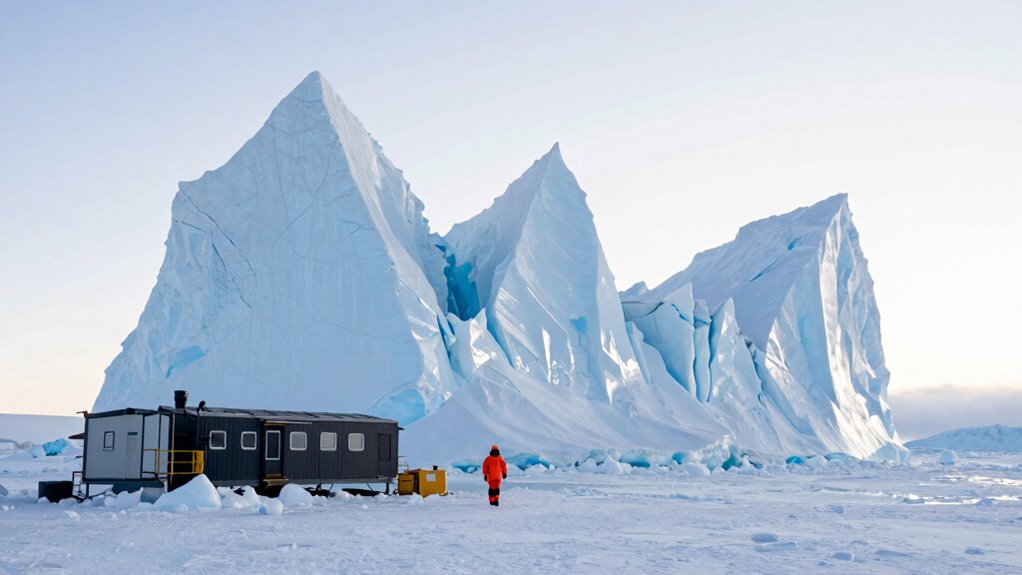

Extreme environments keep producing big surprises because they challenge what we think is possible for life. Microbes survive harsh conditions like extreme heat, pressure, and toxicity by developing unique adaptations. Geological phenomena, like hydrothermal vents, create ecosystems without sunlight, showing life’s incredible resilience. These discoveries push scientists to rethink the limits of life on Earth and beyond. If you explore further, you’ll uncover even more fascinating insights into how nature defies expectations.
Key Takeaways
- Microbes in extreme environments develop unique adaptations, revealing life’s unexpected resilience and expanding biological understanding.
- Geological phenomena like hydrothermal vents create energy-rich habitats that challenge traditional views of life’s requirements.
- Extreme conditions foster rapid microbial evolution, leading to surprising discoveries about life’s capabilities.
- These habitats serve as natural laboratories, uncovering novel biochemical processes and potential extraterrestrial life signs.
- Studying extreme environments continually reshapes scientific assumptions about the limits and diversity of life on Earth.

Extreme environments, from the scorching depths of hydrothermal vents to the icy expanse of Antarctica, challenge our understanding of life and the planet’s limits. These habitats push organisms to adapt in ways that often seem impossible, revealing surprises about microbial resilience and the power of geological phenomena. When you explore these regions, you quickly realize that life isn’t confined to the familiar; it thrives in conditions once considered uninhabitable. Microbes, in particular, demonstrate remarkable resilience, surviving high temperatures, crushing pressures, and toxic chemicals. Their ability to adapt and flourish in such hostile settings defies previous assumptions and opens new avenues for scientific discovery.
In these extreme environments, geological phenomena play a significant role in shaping ecosystems. Hydrothermal vents, for example, release mineral-rich fluids that support dense communities of life, often independent of sunlight. These vents are hotspots for microbial activity, where microbes harness chemical energy through chemosynthesis, creating a foundation for entire ecosystems. As you study these geological phenomena, you uncover how they influence microbial resilience. The extreme conditions that seem destructive to most life forms actually serve as a catalyst for unique biological adaptations. Microbes develop specialized enzymes and metabolic pathways that allow them to extract energy from chemicals like hydrogen sulfide, which would be toxic to other organisms. Understanding these metabolic processes highlights the importance of extreme environments as natural laboratories for discovering novel biochemical pathways. Additionally, the study of such environments enhances our understanding of microbial resilience, illustrating how life can endure and adapt in the harshest conditions. These environments also exemplify the significance of geological phenomena in supporting diverse ecosystems in extreme settings. Recognizing that these geological processes are central to ecosystem sustainability underscores their role in extreme environment research.
What makes these environments scientifically surprising is how they challenge conventional wisdom about the requirements for life. You might assume that sunlight and nutrient-rich conditions are essential, but these ecosystems thrive in their absence. The resilience of microbes in such settings highlights an incredible flexibility, forcing scientists to rethink the limits of life on Earth—and potentially beyond. The geological phenomena fueling these ecosystems often create dynamic, ever-changing conditions, prompting microbes to evolve rapid adaptation strategies. These adaptations not only deepen our understanding of microbial resilience but also shed light on the origins of life and the possibility of life elsewhere in the universe. The ongoing discovery of microbial life in these environments continually reshapes our understanding of life’s potential distribution across the cosmos.
As you explore the mysteries of these extreme environments, you realize that they are not just alien worlds but crucial keys to understanding life’s versatility. The interplay between microbial resilience and geological phenomena continually produces scientific surprises, pushing the boundaries of what we thought was possible. These environments remind us that life finds a way, thriving against all odds, and that exploring them can revolutionize our knowledge of biology, geology, and the universe itself.

Microbial Ecology of Extreme Environments
As an affiliate, we earn on qualifying purchases.
As an affiliate, we earn on qualifying purchases.
Frequently Asked Questions
How Do Researchers Prepare for Unexpected Discoveries in Extreme Environments?
You prepare for unexpected discoveries in extreme environments by developing adaptive strategies that allow quick responses to surprises. You also implement risk management plans to minimize potential dangers, ensuring safety and experiment integrity. Staying flexible in your approach helps you adapt as new information emerges. By combining thorough training, robust contingency plans, and real-time monitoring, you’re better equipped to handle surprises and capitalize on unexpected scientific breakthroughs.
What Technological Advances Have Been Driven by Exploring Extreme Environments?
Ever wonder how exploring extreme environments sparks technological innovation? You benefit from advances like improved robotic systems, enhanced life-support technologies, and miniaturized sensors, which are essential for astrobiology implications. These innovations allow scientists to operate in harsh conditions and gather critical data. By pushing boundaries, you help develop tools that can also be applied in medicine, industry, and space exploration, broadening our understanding of life and the universe.
How Do Extreme Environments Influence the Development of New Scientific Theories?
You see, extreme environments challenge existing scientific theories by revealing unique biosphere adaptations caused by environmental pressures. These conditions force you to rethink biological, chemical, and physical principles, leading to new hypotheses. As you study organisms thriving under harsh conditions, you recognize how environmental pressures shape life’s resilience. This ongoing process pushes scientific understanding forward, often surprising you with discoveries that reshape fundamental concepts about life and the universe.
Are There Ethical Concerns Associated With Exploring Extreme Environments?
Exploring extreme environments is like walking a tightrope over a chasm—exciting but fraught with ethical dilemmas. You must consider environmental ethics, ensuring your quest doesn’t harm fragile ecosystems. Conservation challenges arise when scientific curiosity risks disrupting untouched habitats or species. Balancing progress with responsibility is essential, so you can uncover nature’s secrets without leaving a destructive footprint. Respect for these extreme worlds safeguards their mysteries for future generations.
How Can Studying Extreme Environments Benefit Everyday Life?
Studying extreme environments through biosphere exploration helps you understand how organisms adapt, which can inspire new adaptation strategies for humans facing climate change or other challenges. These insights can lead to innovations in medicine, technology, and sustainability. By learning how life survives under harsh conditions, you gain practical knowledge that benefits daily life, making you better equipped to develop resilient systems and solutions for a changing world.
chemosynthesis microbial kit
As an affiliate, we earn on qualifying purchases.
As an affiliate, we earn on qualifying purchases.
Conclusion
Just like explorers venturing into uncharted waters, you’re drawn to extreme environments because they hold secrets waiting to be uncovered. These harsh landscapes are like mysterious islands, hiding treasures of knowledge beneath their surface. As you explore further, you realize that the most astonishing discoveries emerge where others fear to go. Embrace the challenge—because in these wild frontiers, every surprise is a new map, guiding you closer to the heart of nature’s most profound mysteries.

Extremophiles as Astrobiological Models (Astrobiology Perspectives on Life of the Universe)
As an affiliate, we earn on qualifying purchases.
As an affiliate, we earn on qualifying purchases.

Playz Extreme Chemistry Set – 52 Unique Experiments, Science Kits for Kids Age 8-12, Lab Gear, Volcano Project, Learning Tools, Fair Activity, Discovery Gift, STEM Toys for Boys and Girls
Explosive science kit – Features 52 chemistry experiments for kids, including a foaming volcano, self-inflating balloon, and colorful…
As an affiliate, we earn on qualifying purchases.
As an affiliate, we earn on qualifying purchases.