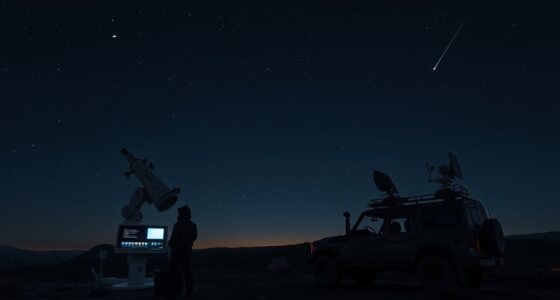

By hunting anomalies, you challenge existing assumptions and open doors to new knowledge. When you notice data irregularities, you ask why they happen, which can reveal hidden phenomena or gaps in current understanding. Investigating these quirks often leads to breakthroughs, as they push you to rethink theories and explore unknown mechanisms. Embracing anomalies fuels innovation and sparks major discoveries—so stay curious, because the next breakthrough might be just an anomaly away.

Get school and study supplies delivered free — and shop member deals
- Fast, free delivery on millions of items
- Access to Prime Big Deal Days deals on October 6–7
- Prime Video, Amazon Music and more included
Key Takeaways
- Anomaly hunting reveals unexpected data patterns that challenge existing theories, leading to new scientific insights.
- Investigating irregularities uncovers hidden variables or phenomena, expanding current understanding.
- Following anomalies sparks innovative ideas and alternative hypotheses, driving revolutionary discoveries.
- Historical breakthroughs often originate from unexplained anomalies, demonstrating their role in scientific progress.
- Embracing anomalies fosters a proactive, open-minded approach that keeps science adaptable and receptive to surprises.

When scientists chase anomalies, they often reveal new frontiers of knowledge. You might think of anomalies as mere glitches or errors, but they’re actually clues pointing to deeper truths. In your research, you’ll encounter data irregularities—unexpected deviations from expected results—that challenge your assumptions and push you to dig deeper. These irregularities aren’t failures; they’re signals that something unexplored is happening. When you notice unexpected patterns in your data, it’s tempting to dismiss them as noise. But often, these patterns hold the key to major breakthroughs. Instead of ignoring anomalies, you learn to investigate them thoroughly, asking why they occur and what they might reveal about your subject.
Your curiosity fuels the process. As you analyze data irregularities, you start to see connections that weren’t obvious before. Unexpected patterns might suggest new phenomena, hidden variables, or flaws in your existing models. This process demands a shift in mindset—rather than forcing data to fit your theories, you remain open to what the anomalies tell you. Sometimes, these irregularities expose gaps in current knowledge, prompting you to question established ideas. Other times, they uncover new mechanisms or interactions that open entirely new lines of inquiry. Recognizing the importance of scientific observation and the role of anomalies in data collection helps you appreciate their potential as gateways to new knowledge. In this way, anomalies serve as catalysts for innovation, pushing scientific understanding forward.
The thrill of anomaly hunting lies in the discovery process. You might initially feel frustrated when your data doesn’t conform to expectations, but perseverance pays off. When you follow these unexpected patterns, you often end up uncovering phenomena that challenge conventional wisdom. This process requires patience and meticulous investigation—repeating experiments, refining measurements, and scrutinizing your data. By doing so, you turn what seems like a problem into a breakthrough. History shows that many scientific advances began with an anomaly that defied explanation, leading researchers down new paths of discovery. Recognizing the significance of data irregularities in research helps you appreciate their potential as gateways to new knowledge. Developing an innovative mindset enables you to see these irregularities as opportunities rather than setbacks.
Ultimately, anomaly hunting transforms the way you approach science. Instead of viewing irregularities as nuisances, you see them as opportunities—signposts pointing toward unknown territory. Your willingness to explore unexpected patterns not only deepens your understanding but can revolutionize entire fields. This proactive pursuit of anomalies ensures that science remains dynamic and responsive to the universe’s surprises. When you embrace anomalies, you don’t just solve puzzles—you open doors to new knowledge, making your research a vital part of scientific progress.
Top picks for "anomaly hunt produc"
As an affiliate, we earn on qualifying purchases.
Frequently Asked Questions
How Do Scientists Decide Which Anomalies to Investigate Further?
You decide which anomalies to explore further by examining how they challenge or support existing theories. You form hypotheses based on initial observations, then validate your data to guarantee accuracy. If the anomaly persists after validation, you consider its potential significance, prioritizing anomalies that could lead to new insights or revisions in understanding. This process helps you focus on anomalies most likely to yield groundbreaking discoveries.
What Tools Are Essential for Effective Anomaly Hunting?
You need data visualization tools, pattern recognition skills, and statistical software for effective anomaly hunting. Data visualization helps you spot irregularities quickly, while pattern recognition allows you to identify unexpected trends. Combining these tools, you can analyze large datasets efficiently, detect anomalies more accurately, and generate hypotheses for further investigation. Mastering these tools empowers you to uncover hidden insights, pushing scientific discovery forward with precision and confidence.
Are There Risks Involved in Pursuing Anomalies?
Yes, pursuing anomalies carries risks. You need to conduct thorough risk assessment to identify potential scientific, safety, or ethical issues. Ignoring ethical considerations can lead to unintended harm or misinterpretation of results. Always weigh the potential benefits against risks, ensuring your approach respects ethical standards. Being cautious helps prevent false conclusions, maintains integrity, and supports responsible scientific progress through anomaly hunting.
How Long Does It Typically Take to Confirm an Anomaly as a Breakthrough?
Like a detective piecing together clues, you’ll often spend months validating data and mitigating bias before confirming an anomaly as a breakthrough. The timeline varies depending on the complexity, but thorough data validation and rigorous testing are essential to avoid false leads. Typically, it takes several months to years, as you carefully verify findings, ensuring they withstand scrutiny and truly represent a scientific breakthrough rather than a fleeting anomaly.
Can Anomaly Hunting Be Applied Outside Scientific Research?
Yes, anomaly hunting can be applied outside scientific research, like in history or business. You might look for unexpected patterns or deviations that challenge established beliefs, much like historical parallels where anomalies led to new interpretations. However, ethical considerations are essential—ensuring that your search respects privacy, avoids bias, and doesn’t cause harm. By responsibly exploring anomalies, you can uncover valuable insights and inspire innovative ideas across various fields.
Conclusion
So, next time you encounter an anomaly, don’t dismiss it. Instead, follow where it leads—you might just stumble upon the next big scientific breakthrough. Remember, history shows that some of the greatest discoveries began with a curious eye on the unexpected. Keep questioning, keep exploring, because in those anomalies lies the potential to uncover secrets we’ve yet to imagine. The next discovery could be just one anomaly away—are you ready to chase it?
Halloween Picks
halloween
As an affiliate, we earn on qualifying purchases.