
TL;DR

Prime made for students and young adults
- Fast, free delivery for dorm and study essentials
- Prime Video and Amazon Music included
- Member-only deals
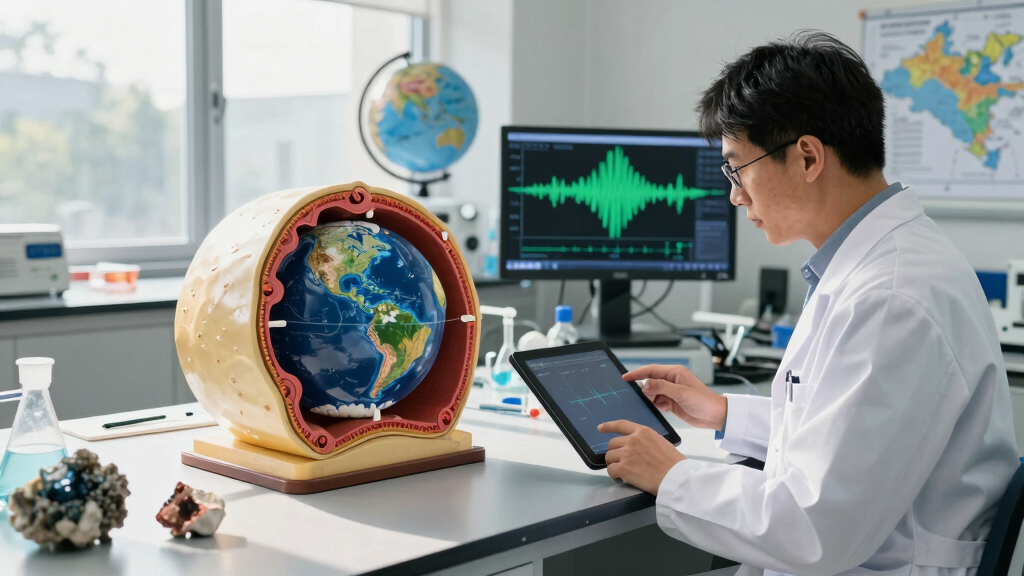
Researchers have confirmed that seismic waves from the 2011 Japan earthquake bounced off Earth’s core, causing measurable shifts in Japan’s position. This discovery sheds light on Earth’s internal dynamics and the impact of major quakes.
Scientists have confirmed that seismic waves generated by the 2011 Japan earthquake bounced off Earth’s core, leading to a measurable shift in Japan’s position. This discovery provides new insights into Earth’s internal processes and the long-term effects of massive seismic events.
Recent research analyzing decades of seismic data has demonstrated that waves traveling through Earth’s interior reflected off the core and returned to the surface, causing detectable movements in Japan’s landmass. The 2011 Tōhoku earthquake, one of the most powerful ever recorded, appears to have contributed to a subtle but measurable shift in Japan’s position, as evidenced by seismic and geodetic measurements.
Scientists involved in the study say that the bouncing of seismic waves off Earth’s core is consistent with models of wave propagation and confirms that Earth’s interior is dynamic and responsive to large seismic events. The findings were published in a peer-reviewed geophysics journal, with researchers noting that the shifts are tiny but significant enough to be detected with modern instrumentation.
Implications for Earth’s Interior and Seismic Monitoring
This discovery is significant because it enhances understanding of Earth’s internal structure and how seismic energy interacts with the core. It also demonstrates that major earthquakes can induce measurable shifts in Earth’s crust, which may influence future seismic risk assessments and geophysical models. For Japan, a country highly vulnerable to earthquakes, understanding these subtle shifts could improve long-term preparedness and hazard mitigation strategies.
seismic wave monitoring equipment
As an affiliate, we earn on qualifying purchases.
As an affiliate, we earn on qualifying purchases.
Background on Seismic Wave Research and the 2011 Earthquake
The 2011 Tōhoku earthquake, with a magnitude of 9.0, caused widespread destruction and was one of the most powerful recorded in history. Since then, scientists have extensively studied seismic waves generated by the event to understand Earth’s interior. Historically, seismic waves have been used to map Earth’s layers, but recent advances allow for detecting minute shifts caused by wave reflections off the core. Prior studies have suggested that Earth’s interior is not static but responds to large seismic forces over time.
This new research builds on those findings, utilizing high-precision seismic data collected over the past decade to analyze wave paths and their interactions with Earth’s core, revealing the impact of the 2011 quake on Earth’s structure.
“The findings demonstrate that the energy from large earthquakes can have long-lasting effects on Earth’s structure, which we can now detect with advanced seismic monitoring.”
— Lead researcher Dr. Maria Lopez, Earthquake Institute
earthquake detection and analysis tools
As an affiliate, we earn on qualifying purchases.
As an affiliate, we earn on qualifying purchases.
Unconfirmed Aspects of Core Shift Magnitude and Duration
While the seismic data confirms wave bouncing off Earth’s core and a resultant shift in Japan, the precise magnitude and long-term stability of this shift remain uncertain. Researchers have not yet determined whether this movement is temporary or part of a longer-term adjustment of Earth’s interior. Additionally, the influence of the 2011 earthquake on Earth’s core dynamics is still under investigation, and more data is needed to understand the full implications.
As an affiliate, we earn on qualifying purchases.
Further Research and Monitoring of Earth’s Structural Changes
Scientists plan to continue monitoring seismic activity and Earth’s structural responses to large earthquakes. Future studies aim to quantify the magnitude of these shifts more precisely and assess their potential impact on seismic risk and geophysical models. Advances in seismic instrumentation and data analysis techniques will support ongoing efforts to understand Earth’s interior dynamics better.
geophysical research instruments
As an affiliate, we earn on qualifying purchases.
As an affiliate, we earn on qualifying purchases.
Key Questions
How do seismic waves bounce off Earth’s core?
Seismic waves generated by earthquakes travel through Earth’s interior. When they encounter the boundary of Earth’s core, some waves reflect and bounce back toward the surface, allowing scientists to study the core’s properties and detect shifts in Earth’s structure.
What does this discovery tell us about Earth’s interior?
It confirms that Earth’s interior is dynamic and responds to large seismic events. The bouncing of seismic waves off the core indicates that the Earth’s structure can experience subtle shifts over time, influenced by major earthquakes.
Could this shift affect seismic hazard assessments in Japan?
Currently, the observed shifts are very small and unlikely to impact immediate hazard assessments. However, understanding these long-term structural changes can improve models used for seismic risk prediction in the future.
Is this phenomenon unique to Japan or the 2011 earthquake?
While the study focused on Japan and the 2011 quake, similar seismic interactions are possible elsewhere and after other large earthquakes. Ongoing research aims to determine how widespread and significant these effects are globally.
Source: google-trends
Fall Picks
fall essentials
As an affiliate, we earn on qualifying purchases.



![The Early History Of The Singular Value Decomposition (1993) [Pdf]](https://thegeniusfactory.net/wp-content/uploads/2026/07/the-early-history-of-the-singular-value-decomposition-1993-pdf-featured-560x300.jpg)