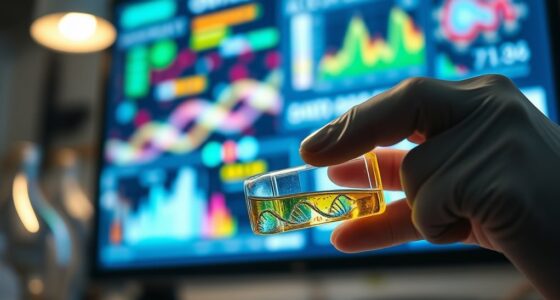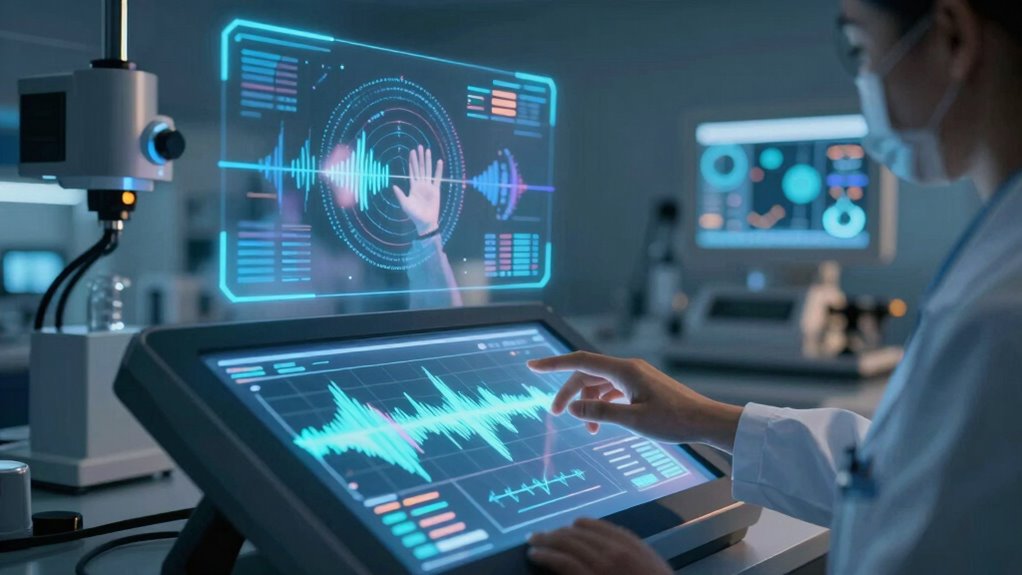

You can now use your voice, vision, and motion as powerful, non-invasive ways to detect health issues early. Changes in speech, eye movements, or body patterns reveal subtle clues about neurological and mental health. Technology improves how accurately these signals identify conditions like Parkinson’s or depression. By analyzing these cues, healthcare becomes more personalized and proactive. Keep exploring to discover how these signals are transforming health assessments and what it could mean for your well-being.
Key Takeaways
- They provide non-invasive, real-time insights into neurological and cognitive health through subtle behavioral cues.
- Advanced machine learning enhances accuracy in analyzing complex voice, vision, and motion data for diagnostics.
- Early detection of diseases like Parkinson’s and Alzheimer’s is possible through subtle signal changes before symptoms appear.
- Continuous monitoring enables personalized care and tracking disease progression effectively.
- Combining multiple signals creates comprehensive health profiles, improving diagnostic precision and treatment outcomes.
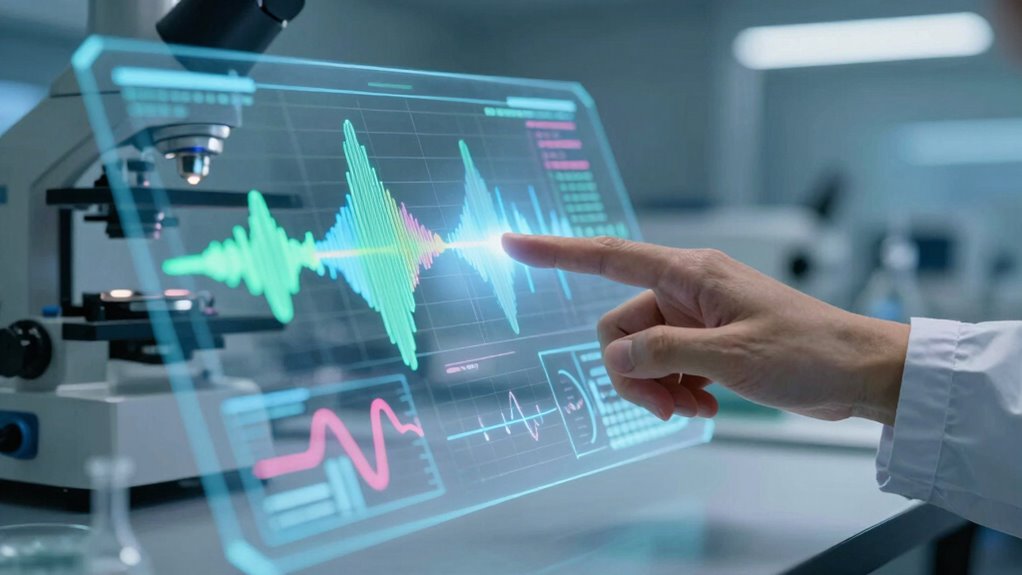
Advancements in technology have made it possible to analyze voice, vision, and motion as powerful diagnostic signals that reveal underlying health conditions. These methods are transforming traditional healthcare by offering non-invasive, real-time insights into your physical and mental well-being. When you speak, your voice carries subtle cues that can indicate cognitive assessment parameters. Changes in speech patterns—such as slurred words, hesitations, or altered pitch—can reveal neurological issues, cognitive decline, or even early signs of diseases like Parkinson’s or Alzheimer’s. By analyzing your voice, healthcare providers can detect these signals early, often before symptoms become obvious.
Similarly, vision plays an indispensable role in diagnosing health problems. Through advanced imaging and artificial intelligence, your visual responses and eye movements are scrutinized to identify issues ranging from neurological disorders to eye diseases. For example, tracking how your eyes move when following objects or reacting to light can provide essential clues about your brain’s health. These visual cues, when combined with other data, can help in early detection of conditions like multiple sclerosis or stroke risk. The ability to monitor your eye movements continuously and non-invasively allows clinicians to assess your health status more accurately and swiftly. Incorporating machine learning algorithms further enhances the precision of these visual assessments.
Motion analysis is another fundamental diagnostic tool that leverages your body’s movements. Whether through wearable sensors or camera-based systems, analyzing how you walk, stand, or perform specific tasks can reveal underlying problems. Impaired gait or reduced mobility can be early indicators of neurological conditions, muscular disorders, or the effects of aging. By examining your motion patterns, doctors can perform detailed assessments of your physical state, track disease progression, and tailor treatments accordingly. Additionally, motion analysis can be used to monitor recovery progress after injury or surgery.
Emotional analysis has also become a significant component of these diagnostic signals. Your emotional state influences your voice and facial expressions, which can be captured and analyzed to detect mental health issues such as depression or anxiety. For instance, changes in tone, speech pace, or facial cues can serve as indicators of emotional distress, prompting timely intervention. This kind of analysis makes mental health assessments more accessible and less stigmatized, providing continuous monitoring outside clinical settings. Recognizing these emotional cues helps in providing more holistic care and understanding patient well-being.
Furthermore, recent research highlights how speech analysis can be integrated with other diagnostic signals to create comprehensive health profiles, thus enhancing diagnostic accuracy and personalized care. In essence, your voice, vision, and motion are rich sources of health information that, when properly analyzed, can lead to earlier diagnoses, better treatment outcomes, and more personalized care. These diagnostic signals are revolutionizing healthcare by turning everyday functions into windows revealing your underlying health, all without invasive procedures.
As an affiliate, we earn on qualifying purchases.
Frequently Asked Questions
How Do These Sensors Integrate With Existing Healthcare Systems?
You integrate these sensors with existing healthcare systems by guaranteeing proper sensor calibration for accurate data collection. Then, you focus on data interoperability, enabling seamless communication between new sensors and current electronic health records. This integration allows real-time data sharing, improves diagnostics, and supports better patient outcomes. By maintaining calibration and interoperability, you optimize sensor performance and ensure that the new signals complement your healthcare system effectively.
What Are the Privacy Concerns Related to Capturing Voice, Vision, and Motion Data?
You face privacy risks when capturing voice, vision, and motion data, as sensitive information could be exposed or misused. Data security becomes vital to protect against breaches that threaten your personal health details. You need robust encryption and strict access controls to guarantee your data remains confidential. Being aware of these privacy concerns helps you advocate for safer, more transparent systems that prioritize your rights and safeguard your health information.
Are There Specific Conditions Better Diagnosed Through These Signals?
You’ll find that speech analysis and motor assessment excel at diagnosing neurological conditions like Parkinson’s disease, ALS, and stroke-related impairments. These signals reveal subtle changes in speech patterns, facial movements, and motor skills that might go unnoticed otherwise. By combining voice, vision, and motion data, healthcare providers can detect early signs of these conditions, enabling earlier intervention and personalized treatment plans that improve patient outcomes.
How Accurate Are These Diagnostic Methods Compared to Traditional Techniques?
Think of these methods as finely tuned instruments, more precise with proper sensor calibration and data standardization. They often surpass traditional techniques in accuracy, capturing subtle changes that might go unnoticed. While they may not replace all conventional tests, their ability to detect early signs makes them powerful allies. You can trust their diagnostics, provided the sensors are properly calibrated and data is standardized for consistent, reliable results.
What Are the Costs Involved in Implementing These Technologies?
Implementing voice, vision, and motion diagnostics involves costs that vary based on technology complexity and scale. You should conduct a thorough cost analysis to understand initial investments and ongoing expenses. Funding strategies like grants, partnerships, or government support can help offset costs. While upfront expenses may seem high, the long-term benefits of earlier detection and improved patient outcomes often justify the investment, making these technologies financially viable for your healthcare setup.
As an affiliate, we earn on qualifying purchases.
Conclusion
As you embrace the symphony of voice, vision, and motion, you’ll find these signals transforming into a lighthouse guiding healthcare through uncharted waters. They illuminate hidden patterns like stars in a night sky, revealing secrets buried deep within. By listening, seeing, and moving with purpose, you become a navigator in a vast ocean of data, steering towards precise diagnostics. Ultimately, these signals are the compass steering medicine into a future where clarity and connection lead the way.
wearable motion sensors for neurological health
As an affiliate, we earn on qualifying purchases.
As an affiliate, we earn on qualifying purchases.
mental health emotional detection device
As an affiliate, we earn on qualifying purchases.
As an affiliate, we earn on qualifying purchases.