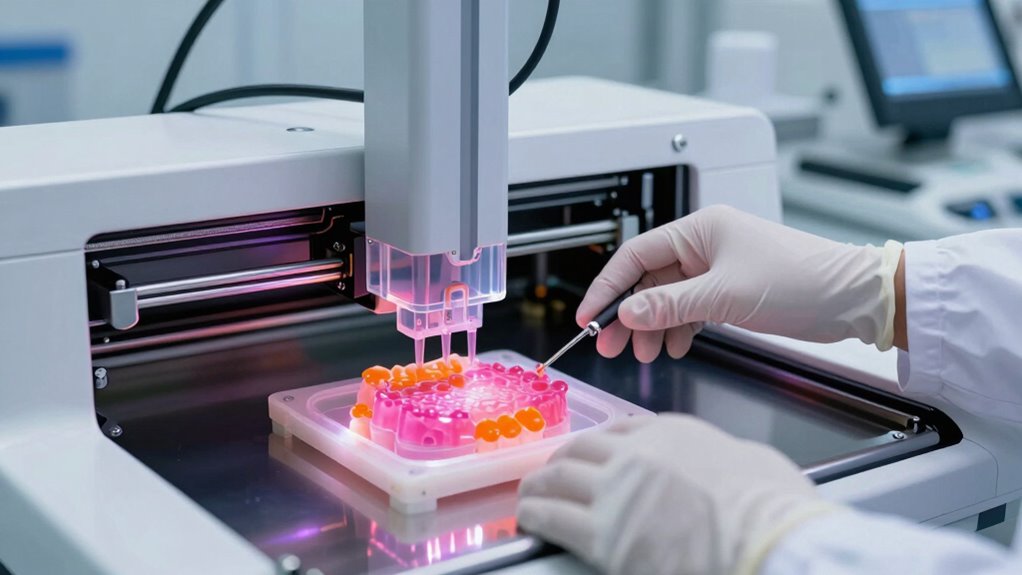

Bioprinting could transform your reconstructive care by giving you access to custom-made tissues and organs that fit perfectly and heal faster. It supports creating complex structures tailored to your unique needs, reducing rejection risks and improving functionality. You’ll benefit from more precise, natural-looking results that integrate seamlessly with your body. As you explore further, you’ll discover how these innovations are reshaping future treatment options and enhancing patient outcomes.

Prime made for students and young adults
- Fast, free delivery for dorm and study essentials
- Prime Video and Amazon Music included
- Member-only deals
Key Takeaways
- Enables creation of patient-specific, complex tissue and organ structures, reducing rejection risks and improving compatibility.
- Provides customizable scaffolds that support faster tissue integration and more natural healing processes.
- Allows precise control over tissue shape, size, and texture, enhancing aesthetic and functional outcomes.
- Accelerates tissue regeneration by advancing bioinks and vascularization techniques for better blood supply.
- Transforms reconstructive care from reactive procedures to proactive, personalized, and biologically integrated solutions.

Bioprinting is revolutionizing reconstructive care by enabling precise, custom-made tissue and organ solutions. With this technology, you can create complex 3D tissue structures tailored to individual patients, reducing rejection risks and improving healing outcomes. The ability to print living tissues means you’re no longer limited to traditional grafts or synthetic materials. Instead, you can develop biological substitutes that closely mimic natural tissue, offering a more effective and personalized approach to reconstruction.
One of the key advantages of bioprinting lies in its capacity to produce regenerative scaffolds. These scaffolds serve as the foundation for new tissue growth, providing the necessary support and structure for cells to grow and differentiate. When designed correctly, they can seamlessly integrate with existing tissues, restoring function and appearance more efficiently. By customizing these scaffolds to match the patient’s unique anatomy, you minimize complications and foster faster recovery.
Using bioprinting to generate 3D tissue brings a new level of precision to reconstructive procedures. Instead of relying on generic implants or donor tissue, you can print tissues that match the exact shape, size, and texture needed for each patient. This customization not only improves aesthetic results but also enhances functionality, especially in complex cases like facial reconstruction or organ repair. The ability to control cell placement and scaffold architecture means you can influence tissue development, encouraging better integration and long-term durability.
Furthermore, bioprinting accelerates the development of innovative treatments. As research advances, you’ll find new bioinks and materials that promote faster tissue regeneration and stronger repair. This means you could soon have access to tissues that not only replace damaged areas but also restore original functions more effectively. The technology also opens doors for creating vascular networks within printed tissues, ensuring proper blood supply and nutrient delivery, which are critical for tissue survival and growth.
In the broader scope, bioprinting shifts the paradigm from reactive to proactive treatment. Instead of managing injuries or defects with temporary fixes, you can aim for permanent, biologically integrated solutions. As this field evolves, you’ll see a move toward on-demand, patient-specific tissue fabrication—transforming reconstructive care from a challenge into a highly precise, personalized science. This progress promises a future where tissue engineering isn’t just an experimental concept but a standard part of medical practice, drastically improving outcomes and quality of life for patients requiring reconstructive procedures.
bioprinting tissue engineering kit
As an affiliate, we earn on qualifying purchases.
As an affiliate, we earn on qualifying purchases.
Frequently Asked Questions
What Are the Main Challenges in Bioprinting Complex Tissues?
The main challenges in bioprinting complex tissues include overcoming technical limitations like replicating intricate cellular structures and ensuring vascularization for nutrient flow. You also face ethical concerns about creating living tissues and regulatory hurdles for approval. These issues make it difficult to scale up production, but ongoing research aims to address these hurdles, bringing us closer to practical, life-changing reconstructive treatments.
How Long Does It Take to Produce a Bioprinted Organ?
Producing a bioprinted organ can take anywhere from several hours to weeks, depending on complexity. Ethical considerations and regulatory hurdles often extend this timeline, as approvals and safety assessments are necessary. You’ll find that advances in bioprinting speed help reduce production time, but guaranteeing ethical standards and gaining regulatory clearance remain critical steps. This careful process aims to ensure the safety and effectiveness of bioprinted organs before they reach patients.
Are Bioprinted Tissues Accepted by the Body’s Immune System?
Think of bioprinted tissues as carefully crafted puzzles designed to fit seamlessly into your body. They often evoke a minimal immune response because they’re made with your own cells, promoting better tissue integration. This compatibility reduces rejection risks, making acceptance by the immune system more likely. As scientists refine bioprinting, you can expect improved acceptance rates, leading to more successful reconstructive outcomes and fewer complications from immune reactions.
What Are the Costs Associated With Bioprinting for Reconstructive Surgery?
The costs associated with bioprinting for reconstructive surgery can be high, impacting cost feasibility. You’re likely to face expensive equipment, materials, and specialized expertise. Insurance coverage varies, and many policies currently don’t include bioprinting procedures, making affordability a challenge. While costs may decrease over time with technological advances, upfront expenses remain significant, and you’ll need to explore funding options or insurance adjustments to access this innovative treatment option.
How Soon Could Bioprinting Become Standard Practice in Clinics?
Bioprinting’s journey to becoming standard practice in clinics is like steering through a maze; it could take 5 to 10 years, depending on overcoming regulatory hurdles and addressing ethical considerations. You’ll see early applications in specialized centers first, but widespread adoption hinges on safety, approval, and ethical acceptance. As these hurdles clear, bioprinting will increasingly become a routine part of reconstructive care, transforming how you heal and recover.
custom 3D bioprinted organ models
As an affiliate, we earn on qualifying purchases.
As an affiliate, we earn on qualifying purchases.
Conclusion
You can see how bioprinting transforms reconstructive care, offering hope where there was once despair. It restores, rebuilds, and renews with precision and possibility. It heals wounds, replaces tissues, and redefines futures. As technology advances, your role in embracing this innovation becomes essential. You hold the power to shape a future where scars fade, lives change, and healing is reimagined through the incredible potential of bioprinting.
bioprinting bioinks for tissue regeneration
As an affiliate, we earn on qualifying purchases.
As an affiliate, we earn on qualifying purchases.
bioprinted scaffolds for reconstructive surgery
As an affiliate, we earn on qualifying purchases.
As an affiliate, we earn on qualifying purchases.
Fall Picks
fall essentials
As an affiliate, we earn on qualifying purchases.