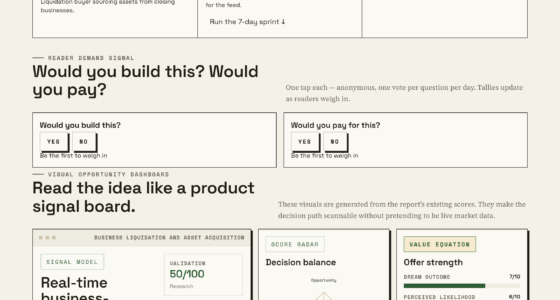

📊 Full opportunity report: Why Self-Directed Investors Need A Portfolio Cost Calculator on IdeaNavigator AI — validation score, market gap, and execution plan.

Prime made for students and young adults
- Fast, free delivery for dorm and study essentials
- Prime Video and Amazon Music included
- Member-only deals
TL;DR
A new web-based portfolio cost calculator is launching to help retail investors quantify the dollar cost of fees over their investment horizon. It aims to improve fee awareness among fee-conscious DIY investors and advisors, addressing a key gap in transparency.
A new online portfolio cost calculator has been introduced to help self-directed and fee-conscious investors quantify the long-term dollar impact of fees on their investments. Developed as a simple, accessible web tool, it aims to improve fee transparency and empower investors to make more informed decisions about their advisors and fund choices. This development comes amid rising fee awareness and changing regulatory landscapes that shift the burden of fee scrutiny back onto investors.
The calculator allows users to input their current investment balance, monthly contributions, investment horizon, expected annual return, and fee rates including expense ratios and advisory fees. It then outputs the total dollar amount lost to fees over the investment period, the difference in ending balances compared to a low-cost baseline, and the proportion of withdrawals that fees represent at retirement. The tool is designed as a single-page, no-login web app, making it accessible to a wide audience.
According to sources familiar with the project, the goal is to serve fee-conscious DIY investors, typically aged 35-60, who hold index funds or work with small advisory firms charging around 1% AUM. The calculator aims to illustrate how seemingly small percentage fees can compound into six-figure costs over decades, a figure often underestimated or misunderstood by investors. The tool is being tested as a first step in a broader effort to promote fee transparency and encourage investors to compare their current costs with lower-cost alternatives.
Why a Portfolio Cost Calculator Matters for Investors
This calculator addresses a critical gap in investor awareness: while many understand that fees reduce returns, few can quantify their actual dollar impact over time. By making the cost of fees tangible, it can influence investor behavior, encouraging them to question high-fee advisors or fund choices. As fee transparency becomes more important amid the rise of low-cost index funds and robo-advisors, this tool offers a practical way for retail investors to take control of their financial outcomes. It also responds to regulatory shifts, such as the vacating of the 2024 DOL fiduciary rule, which previously aimed to protect investors from conflicted advice but is now less enforceable, increasing the need for investor vigilance.
investment portfolio cost calculator
As an affiliate, we earn on qualifying purchases.
As an affiliate, we earn on qualifying purchases.
Growing Need for Fee Awareness in a Changing Regulatory Environment
Over recent years, fee transparency has gained prominence, driven by the rise of low-cost index funds, ETFs, and robo-advisors that often charge fees below 0.10%. Despite this, many retail investors still pay significantly higher fees, often without fully understanding their long-term impact. The 2024 Department of Labor (DOL) fiduciary rule, which aimed to enforce fee transparency and fiduciary standards, was vacated in 2026, allowing non-fiduciary advice and commissions to return legally. This shift increases the importance of investor-led fee scrutiny, making tools like this calculator timely and relevant.
Historically, investors tend to underestimate how small percentage fees accumulate over decades. For example, a 1% advisory fee on a $100,000 portfolio can cost approximately $30,000 over 30 years, not accounting for compounding effects. Many investors lack the means or motivation to quantify these costs manually, which underscores the need for accessible tools that can demonstrate the real dollar impact of fees in a straightforward manner.
As an affiliate, we earn on qualifying purchases.
Uncertainties About Adoption and Impact
It is not yet clear how widely the calculator will be adopted among retail investors or whether it will significantly influence investor behavior. The effectiveness of the tool depends on user engagement and whether it prompts meaningful fee comparisons and decisions. Additionally, the long-term impact on fee reduction or advisor switching remains to be seen, as behavioral factors and financial literacy levels vary among investors.
As an affiliate, we earn on qualifying purchases.
Next Steps for Deployment and Validation
The immediate next step is to release the calculator as a prototype to a test audience, including communities like r/personalfinance and r/Bogleheads, to gather usage data and feedback. The goal is to measure how many users complete the calculations and whether they follow through with recommended actions, such as switching to low-cost providers. Based on initial results, developers plan to refine the interface, add features like portfolio audits with CSV uploads, and explore monetization strategies through referrals and licensing agreements. Broader rollout and marketing efforts are expected to follow within the next six months.
DIY investor fee transparency tool
As an affiliate, we earn on qualifying purchases.
As an affiliate, we earn on qualifying purchases.
Key Questions
How accurate is the calculator’s estimate of fees?
The calculator provides estimates based on user-inputted data, including current balances, contributions, and fee rates. It assumes consistent returns and fees over the investment horizon, so actual results may vary. It is designed for illustrative purposes rather than precise forecasting.
Can I use the calculator for my specific portfolio?
Yes, the calculator is intended for individual use, allowing you to input your own balances, contributions, and fees. Future versions may include CSV upload features for more detailed portfolio analysis.
Will this tool recommend specific investments or advisors?
No, the calculator is purely a cost analysis tool. It aims to help you understand the dollar impact of fees and compare different fee scenarios but does not provide investment advice.
Is the calculator free to use?
Yes, the tool will be offered as a free resource, with potential revenue streams including referrals to low-cost advisors, premium features, and licensing to financial service providers.
What are the limitations of this calculator?
The calculator simplifies complex investment scenarios and assumes constant returns and fees. It does not account for tax implications, market volatility, or behavioral factors influencing investor decisions.
Source: IdeaNavigator AI
Fall Picks
fall essentials
As an affiliate, we earn on qualifying purchases.