
TL;DR
A study published in Science Advances reports that bleached fragments of a stony coral recovered when touching healthy fragments from the same genet. The laboratory result depended on tissue fusion and does not show that the method works across unrelated corals or in the wild.
Bleached coral fragments recovered after touching healthy fragments from the same genet in a laboratory experiment, according to research published in Science Advances on October 14. The researchers observed symbiotic algae moving into the bleached tissue through a fused tissue bridge, a result that suggests a possible way to restore some coral but does not establish that the technique can work at reef scale.

Prime made for students and young adults
- Fast, free delivery for dorm and study essentials
- Prime Video and Amazon Music included
- Member-only deals
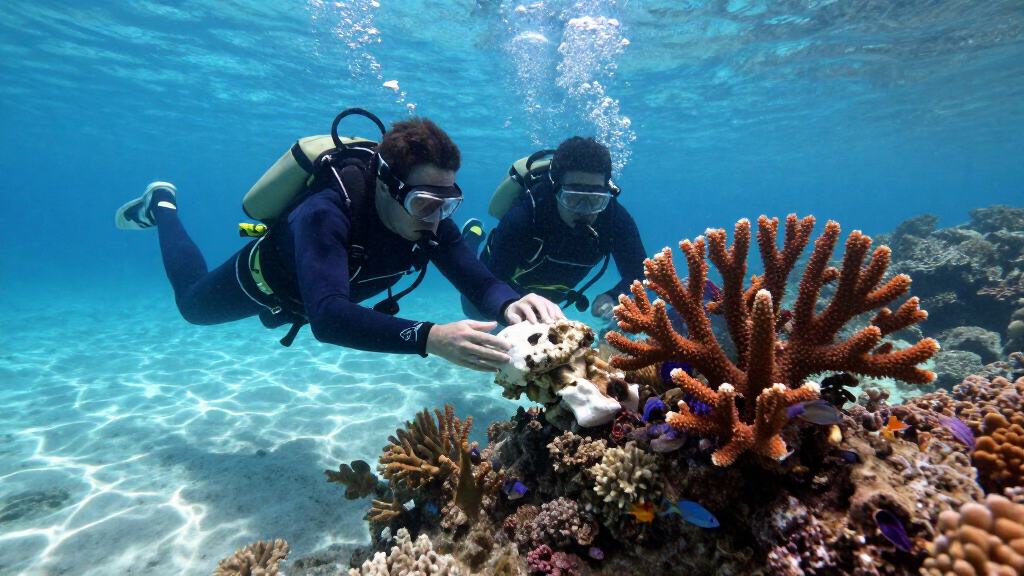
Study co-author Danny Collins and colleagues tested 10 pairs of fragments of the coral species Pocillopora damicornis. Each pair included one bleached and one healthy fragment taken from the same genet — genetically identical growth originating from one individual. In five pairs, the pieces touched; in the other five, they were separated by a few millimetres.
The bleached pieces that touched healthy ones recovered within eight weeks, the report says. After a week of contact, a bleached branch could continue recovering on its own when separated. The researchers also found that the symbiont population doubled every four days by the second week. In contrast, the fragments kept slightly apart died after 20 weeks.
Microscopy showed that touching fragments from the same genet formed a bridge of tissue, through which the algae could spread. The team did not observe fusion between fragments from different species or between different animals of the same species. Those pairings did not restore the bleached fragment, according to the study report.
A Possible Route to Coral Recovery
Coral bleaching occurs when heat stress prompts corals to lose the symbiotic algae living in their tissues. Those algae provide much of the coral’s nutrients, so their loss can leave the animal weakened and at risk of starvation and death. The reported experiment matters because it describes a rapid recovery mechanism under laboratory conditions: a healthy, genetically matched fragment may supply algae to a bleached neighbour through direct contact.
The result is a laboratory finding, not evidence that touching fragments can reverse bleaching across natural reefs. Any practical use would depend on whether suitable healthy fragments can be matched with bleached coral, whether tissue fusion occurs in natural settings, and whether recovered coral remains healthy. The study points to a possible restoration approach for further research; it does not change the underlying threat from rising sea temperatures.
Popular right now

TCL 65-Inch 4K UHD Smart LED TV (65S425)

Dyson V8 Cyclone Cordless Vacuum

Ninja Foodi DZ201 8-Quart DualZone 6-in-1 Air Fryer
As an affiliate, we earn on qualifying purchases.
How the Contact Experiment Began
The work followed an observation in early 2025 by study co-author Stephen Palumbi at Hopkins Marine Station in California. He noticed that a healthy and a bleached coral fragment in a laboratory tank were touching, and colour appeared to be spreading into the bleached piece. Collins, then studying how disease spreads through coral contact, investigated whether symbiotic algae could move between fragments as well.
The researchers compared fragments that touched with fragments held only a few millimetres apart. The distinction mattered: their findings link recovery to physical contact and tissue fusion, rather than simply being near a healthy coral. The reported trial used fragments from the same genet, and the researchers found no comparable recovery when fragments were genetically different.
“This incredible new result — that fast and full recovery is possible in bleached coral — can inspire solutions that eventually may be scalable.”
— Fiorenza Micheli, marine ecologist at Stanford University’s Center for Ocean Solutions and study co-author
Limits Beyond the Laboratory
The report does not establish whether this method can restore coral under reef conditions, how often naturally occurring fragments share the same genet, or whether recovered fragments would withstand renewed heat stress. The experiment was limited to one coral species and a small set of fragment pairs; the supplied account gives no evidence of tests across broader coral populations or at field scale.
It is also unclear how quickly the approach could be applied or whether it could be used without harming healthy donor coral. The result supports further investigation of contact-based recovery, but the authors’ observations should not be read as a general cure for coral bleaching.
Testing Recovery Outside the Tank
The reported next step is to determine whether the tissue-fusion and algae-transfer process can inform restoration approaches that are useful beyond laboratory tanks. Further work would need to test more coral species and genetic pairings, establish whether recovery persists, and assess the method under environmental conditions that cause bleaching. The available report does not specify a timeline for those studies or announce a field trial.
Key Questions
How did the bleached coral recover?
In the experiment, a bleached fragment touched a healthy fragment from the same genet. The pieces formed a tissue bridge, allowing symbiotic algae to move into the bleached coral.
How long did recovery take?
The touching fragments recovered within eight weeks. The study report says a bleached branch could continue recovering after one week of contact, even when separated from the healthy fragment.
Did fragments recover when they were close but not touching?
No recovery was reported for the fragments held a few millimetres apart. Those bleached pieces died after 20 weeks.
Can this approach restore coral reefs?
That has not been demonstrated. The findings come from a laboratory experiment involving one coral species and genetically matched fragments; effectiveness in the wild and at larger scales remains unknown.
Why does bleaching threaten coral?
Heat stress can cause coral to expel the symbiotic algae that give it colour and provide much of its nutrients. Without those algae, coral can become weakened and may starve or die.
Source: hn