Artificial mangroves act as submerged breakwaters that absorb wave energy and reduce erosion along coastlines. They mimic natural roots, helping to protect coastal cities from storm surges and high waves while supporting ecosystems and filtering pollutants. These structures are cost-effective alternatives to traditional defenses and can be customized for different water conditions. If you want to discover how these innovative solutions work and their benefits, there’s more to explore below.
Key Takeaways
- Artificial mangroves act as submerged breakwaters, reducing wave energy and preventing coastal erosion in urban areas.
- They enhance shoreline stability by dissipating wave impact and supporting sediment retention around coastal cities.
- These structures provide ecological benefits by creating habitats for marine life and promoting biodiversity.
- Artificial mangroves serve as cost-effective, scalable solutions adaptable to various coastal environments.
- They help mitigate pollution by filtering urban runoff and heavy metals, improving water quality near cities.
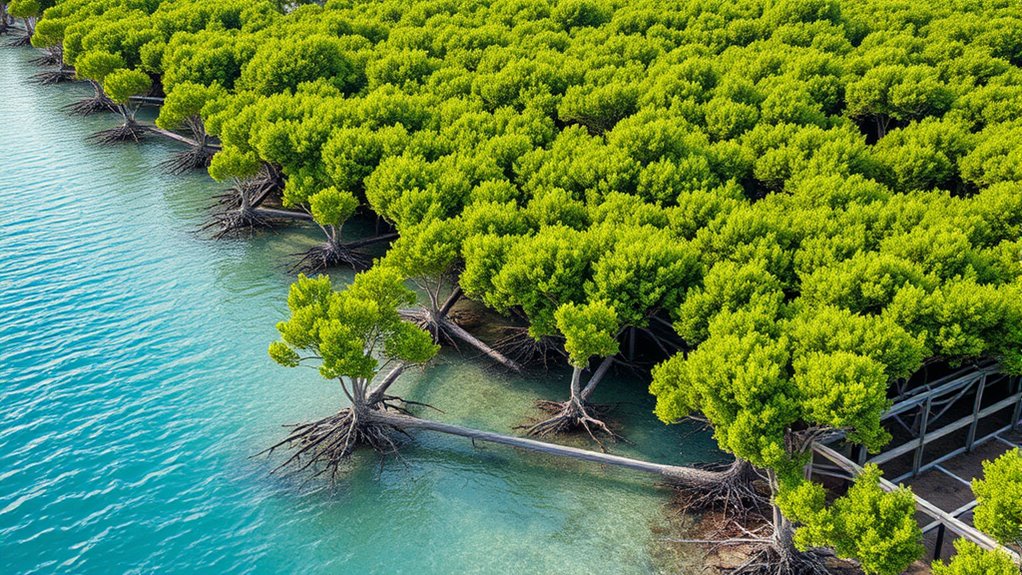
Have you ever wondered how artificial mangroves can protect coastlines and restore ecosystems? These innovative structures are designed as submerged breakwaters, mimicking natural root systems to serve as barriers against waves and erosion. Their effectiveness depends on key variables like wave height, wavelength, water depth, structure height, porosity, and width. Engineers use sophisticated numerical models to predict how these structures interact with waves, analyzing how much energy is reflected, transmitted, or dissipated. Multiple-row arrangements—ranging from one to twenty rows—are tested to optimize wave damping, with porosity and dimensions playing essential roles in shaping flow patterns and protection levels. The goal is to craft a design that maximizes coastal defense while allowing water movement and sediment flow, which are critical for healthy ecosystems. Restoration success is also influenced by ongoing maintenance and adaptive management strategies. Artificial mangroves are increasingly adopted as cost-effective alternatives to natural barriers, especially along coastlines with cohesive soils where traditional engineering solutions may fall short. They help reduce erosion by breaking up wave energy and stabilizing sediments, which supports the integrity of tidal flats and shorelines. Their physical structure also mimics natural root networks, providing shelter for various aquatic species and promoting ecological resilience. These setups are particularly useful in areas where natural mangroves have been depleted or lost due to urban development or reclamation projects. Strategically deploying artificial mangroves in regions prone to strong winds and storm surges can considerably reinforce coastal defenses, protecting communities and infrastructure from destructive waves.
Beyond physical protection, artificial mangroves contribute to pollution mitigation and ecological restoration. They can be constructed as anti-pollution shelterbelts that filter urban sewage and heavy metals from runoff, with some species like Sonneratia and Laguana capable of removing over half of typical urban pollutants. Pollutant removal Ring-shaped forest belts, about 15 to 20 meters wide, create a barrier that filters pollutants while resisting the impact of wind and waves. Using native and exotic species enhances biodiversity, fostering ecological balance even in heavily polluted zones. These structures exhibit high survival rates because they are adapted to withstand stressors like water contamination and tidal fluctuations, making them durable tools for restoration.
In addition to shielding coastlines, artificial mangroves support habitat creation and biodiversity. They offer niches for various aquatic organisms, encouraging the growth of fish, crustaceans, and birds. When designed properly, these structures help recreate the biophysical conditions needed for natural mangroves to thrive, such as proper hydrology and inundation regimes. Restoration efforts often involve experimental zones where water quality, tidal flooding, and disturbance levels are monitored to optimize planting strategies. Overall, artificial mangroves serve as versatile tools—combining coastal protection, pollution control, ecological rehabilitation, and habitat creation—making them indispensable components in safeguarding and restoring vulnerable coastlines.
artificial mangrove breakwater
As an affiliate, we earn on qualifying purchases.
As an affiliate, we earn on qualifying purchases.
Frequently Asked Questions
How Long Do Artificial Mangroves Typically Last?
You wonder how long artificial mangroves last. Their lifespan varies based on materials used, environmental conditions, and maintenance efforts. Generally, they endure from several years up to a few decades, especially when regularly inspected, repaired, and managed. Factors like wave energy, sediment buildup, and storm impacts influence durability. With proper upkeep and adaptive strategies, you can extend their functional lifespan, providing effective coastal protection over the years.
Are Artificial Mangroves Environmentally Sustainable?
Are artificial mangroves environmentally sustainable? You can consider their potential, but sustainability hinges on careful construction, consistent conservation, and constant climate consciousness. While they mimic natural mangroves’ marvelous functions, challenges like pollution, urban expansion, and complex ecosystems threaten their success. You need ongoing monitoring, meaningful maintenance, and adaptive strategies to guarantee these engineered ecosystems genuinely support biodiversity, bolster resilience, and responsibly sequester carbon for the long haul.
What Materials Are Used to Build Artificial Mangroves?
You’re asking about the materials used to build artificial mangroves. You’ll find lightweight concrete that floats and promotes marine growth, high-strength concrete for structural elements, and bio-enhancing admixtures to encourage marine life. Recycled materials help reduce environmental impact, while textured surfaces mimic natural organisms like coral. These materials are designed to withstand extreme weather, stabilize shorelines, and foster ecosystems, combining durability with ecological benefits for effective coastal protection.
Can Artificial Mangroves Support Local Wildlife?
Did you know that natural mangroves support over 2,000 species? While artificial mangroves can attract some wildlife, their ability to support local species varies. You might see birds nesting or fish seeking shelter, but they often don’t match the diversity of natural forests. To truly support wildlife, artificial structures need proper design and long-term maintenance, or they may only provide limited habitat compared to natural mangroves.
How Do Artificial Mangroves Compare Cost-Wise to Natural Ones?
You’re wondering how artificial mangroves compare cost-wise to natural ones. Natural mangrove restoration costs between $14,000 and $45,000 per hectare, making it much cheaper than artificial structures, which can cost millions per kilometer. While artificial options involve high upfront costs for construction and technology, natural mangroves offer ongoing benefits with lower initial investments. Overall, natural mangroves are more cost-effective and provide sustainable, long-term coastal protection.

Great Lakes shore erosion protection: Structural design examples
As an affiliate, we earn on qualifying purchases.
As an affiliate, we earn on qualifying purchases.
Conclusion
So, next time you’re stuck in traffic on a flooded street, just thank those “artificial mangroves.” Who knew that plastic, concrete, and a bit of imagination could turn your coastal disaster into a trendy new park? Maybe someday, we’ll replace all natural beauty with synthetic solutions, because why bother with nature’s messy, unpredictable charm? Until then, enjoy your new plastic paradise—just don’t forget to bring your floaties.
submerged wave energy dissipators
As an affiliate, we earn on qualifying purchases.
As an affiliate, we earn on qualifying purchases.

Artificial mangrove habitat creation and reconstruction(Chinese Edition)
As an affiliate, we earn on qualifying purchases.
As an affiliate, we earn on qualifying purchases.