

Robotic swarms mimic nature’s perfect coordination to tackle complex tasks efficiently. Just like flocks of birds or swarms of bees, these bots use simple rules for seamless collaboration. They operate with distributed algorithms, so each robot adapts to local conditions independently. This enables quick task division and enhances overall operation speed. With applications in agriculture, search and rescue, and hazardous environments, the potential for these coordinated systems is immense, and there’s much more to discover about their future impact.
Key Takeaways
- Robotic swarms utilize emergent behavior, allowing multiple bots to coordinate tasks without central leadership, similar to natural systems like flocks of birds.
- Distributed algorithms enable each robot to make independent decisions based on local information, fostering rapid adaptation to environmental changes.
- Task division among robots enhances efficiency, as each bot evaluates its surroundings to contribute effectively to collective goals, outperforming singular robots.
- Applications of robotic swarms range from agriculture monitoring to search and rescue operations, showcasing their adaptability in various challenging environments.
- Future developments in swarm robotics promise to revolutionize industries by leveraging coordinated efforts for innovative problem-solving and increased productivity.
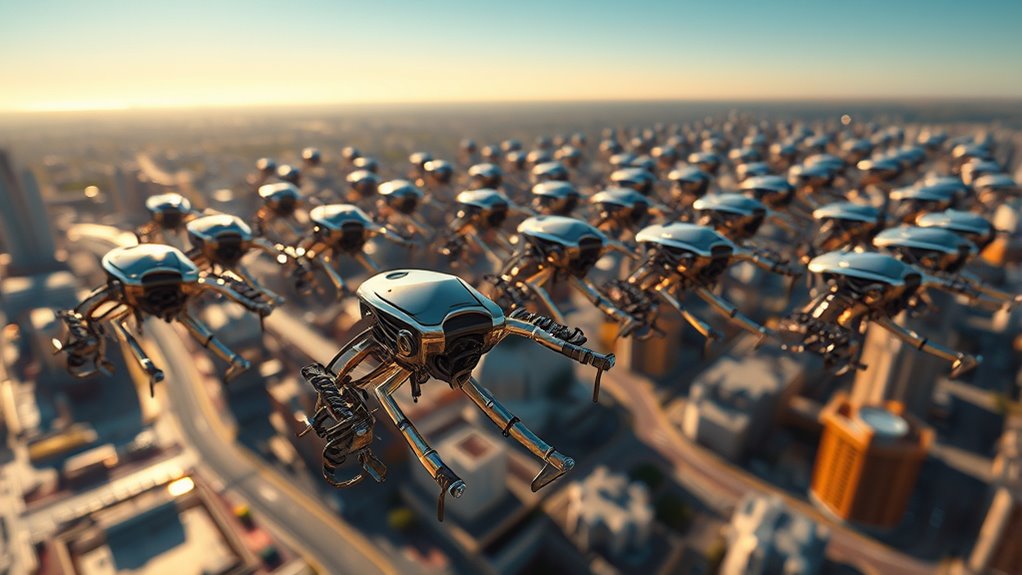
Have you ever wondered how a flock of birds or a swarm of bees moves in perfect harmony? It’s fascinating how these creatures coordinate their actions without a leader, relying on simple rules to achieve complex behaviors. This phenomenon is known as emergent behavior, and it’s a principle that’s finding its way into the world of robotics. By mimicking natural systems, researchers are developing robotic swarms that can tackle intricate tasks efficiently and with remarkable precision.
The harmony of nature inspires robotic swarms, utilizing emergent behavior to solve complex tasks efficiently and precisely.
In the domain of robotic swarms, distributed algorithms play a vital role. Instead of a single robot directing the others, each bot operates independently, making decisions based on local information. This decentralized approach allows the swarm to adapt quickly to changing environments and challenges. For example, if one robot encounters an obstacle, it can instantly modify its trajectory and communicate that adjustment to nearby bots. This way, the entire swarm can seamlessly respond to new conditions without waiting for instructions from a central authority.
Imagine a scenario where you need a group of robots to locate and retrieve items scattered across a large area. Using distributed algorithms, these robots can divide the task among themselves. Each bot assesses its surroundings and decides how to contribute to the mission. Some may prioritize searching while others focus on retrieval. This collaboration leads to a faster and more efficient operation than if a single robot attempted the task alone. In essence, the emergent behavior of the swarm allows for a level of efficiency that’s difficult to achieve with traditional robotic systems.
The applications for robotic swarms are vast. In agriculture, you might find swarms of drones working together to monitor crop health, optimizing resource use. In search and rescue missions, swarms can cover large areas quickly, increasing the chances of locating survivors. They could even be deployed in hazardous environments, where human presence is risky, to gather critical data.
As you explore the potential of robotic swarms, think about how they reflect the beauty of nature. By harnessing principles of emergent behavior and employing distributed algorithms, these robots not only enhance productivity but also inspire new ways of problem-solving. You’re witnessing an exciting evolution in robotics, one that holds promises for the future, reshaping industries and improving lives. As these swarms develop, who knows what amazing feats they’ll achieve next?

The Autonomous Drone Architect: Build and deploy intelligent aerial robotics systems using ROS, Python, and PX4 orchestration
As an affiliate, we earn on qualifying purchases.
As an affiliate, we earn on qualifying purchases.
Frequently Asked Questions
How Do Robotic Swarms Communicate With Each Other?
Robotic swarms communicate using distributed algorithms and communication protocols. These algorithms allow each bot to share information about its environment and tasks efficiently. You’ll find that bots exchange signals, such as light or sound, to coordinate their actions. This decentralized approach enables them to respond quickly to changes, ensuring that they work together seamlessly. By leveraging these methods, swarms can tackle complex tasks more effectively than individual robots operating alone.
What Industries Benefit Most From Robotic Swarms?
You’ll find that industries like agricultural automation and environmental monitoring benefit most from robotic swarms. In agriculture, these coordinated bots efficiently manage tasks like planting, watering, and harvesting, maximizing yield while minimizing labor costs. For environmental monitoring, they can collect data across vast areas, tracking changes in ecosystems and pollution levels. By harnessing the power of swarms, these industries enhance productivity, sustainability, and data accuracy, leading to better decision-making and resource management.
Are Robotic Swarms Safe for Human Interaction?
Are robotic swarms safe for human interaction? Generally, yes, but ethical concerns and privacy issues can’t be overlooked. You’ve got to consider how these systems are programmed and monitored to guarantee they operate safely around people. While many designs prioritize safety, instances of malfunction can pose risks. It’s essential for developers to implement strict guidelines and for users to stay informed about how these technologies impact their personal space and security.
How Are Robotic Swarm Algorithms Developed?
You develop robotic swarm algorithms by focusing on algorithm optimization and decentralized control. Start by defining the tasks the swarm needs to accomplish, then simulate various scenarios to test performance. You’ll adjust parameters to optimize efficiency and guarantee each bot can operate independently while maintaining communication with others. Through iterative testing and refinement, you enhance the algorithms, allowing the swarm to adapt and respond effectively to dynamic environments.
Can Robotic Swarms Be Used for Disaster Response?
Absolutely, robotic swarms can revolutionize disaster response like a flock of birds maneuvering through a storm. With their autonomous navigation capabilities, these swarms can quickly assess hazardous areas, locate survivors, and deliver supplies. Their scalability allows for rapid deployment, meaning you can adjust the number of bots based on the situation’s severity. By leveraging these advanced technologies, you enhance rescue efforts and save lives when it matters most.

Search and Rescue Robots (Searchlight Books ™ — Exploring Robotics)
As an affiliate, we earn on qualifying purchases.
As an affiliate, we earn on qualifying purchases.
Conclusion
In the world of robotic swarms, the future looks bright. These coordinated bots are set to tackle complex tasks that would leave traditional robots in the dust. With their ability to work together seamlessly, they’re not just thinking outside the box; they’re redefining it entirely. As technology advances, you can bet these swarms will be buzzing around, making our lives easier and more efficient. So, get ready—innovation is just around the corner!

Exploring Generative AI for Collaborative Robots in Agriculture 6.0
As an affiliate, we earn on qualifying purchases.
As an affiliate, we earn on qualifying purchases.
hazardous environment surveillance robots
As an affiliate, we earn on qualifying purchases.
As an affiliate, we earn on qualifying purchases.