Neuromorphic chips are designed to think like a brain by mimicking neural structures and functions, using spiking neurons that respond only to input changes. They process information in parallel, adapt through synaptic plasticity, and operate with extremely low energy. These chips support real-time learning and are ideal for applications like robotics and edge computing. If you keep exploring, you’ll discover how they revolutionize technology with their efficiency and adaptability.
Key Takeaways
- Neuromorphic chips mimic brain structure using spiking neurons and synaptic plasticity for natural information processing.
- They operate on event-driven signals, enabling low-power, real-time responsiveness similar to biological neural activity.
- These chips integrate processing and memory, supporting on-chip learning and continuous adaptation.
- They offer scalable architectures capable of complex, parallel tasks with significantly reduced energy consumption.
- Applications include robotics, healthcare, and edge computing, where efficient, brain-like computation is essential.
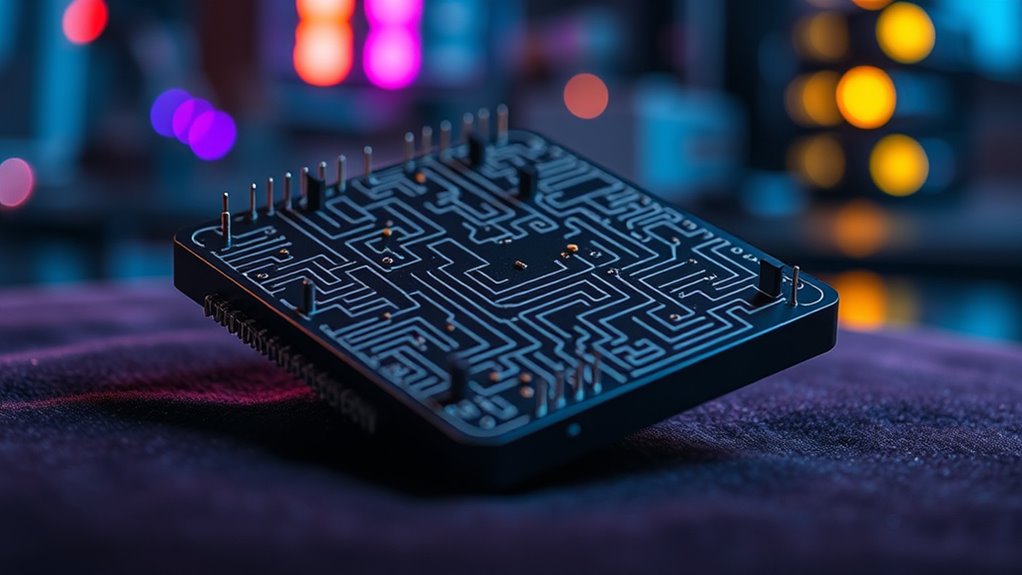
Neuromorphic chips are innovative computing devices designed to mimic the structure and function of biological neural networks. They use spiking neurons to replicate the communication pulses found in the brain, enabling a more natural processing of information. Unlike traditional computers that process data continuously, these chips operate on an event-driven basis. This means they only respond when inputs change, markedly reducing unnecessary computations and energy use. When an input spike occurs, the chip reacts immediately, making the system highly efficient and responsive.
To emulate the brain’s synaptic connections, neuromorphic chips employ artificial synaptic devices and analog circuits. These components mimic the signals transferred between neurons, allowing the chip to adapt and learn from its environment. This adaptive capacity is inspired by synaptic plasticity, where connections between neurons strengthen or weaken based on activity. As a result, neuromorphic chips can support on-chip learning mechanisms, enabling real-time updates without external software intervention. This feature makes them particularly suited for dynamic environments where continuous learning is essential.
Compared to conventional computing, neuromorphic systems offer numerous advantages. They consume far less energy—up to orders of magnitude less than CPUs and GPUs—making them ideal for applications requiring long-term, continuous operation. Their ability to process information in parallel allows for multitasking and faster computation of complex functions. Low latency is a key benefit, especially for real-time sensory applications like robotics or autonomous systems, where quick decision-making is critical. Additionally, neuromorphic architectures are scalable, capable of integrating many neurons and synapses efficiently, which enhances their capacity to handle large, complex neural networks.
The architecture of neuromorphic chips is built upon spiking neural networks (SNNs). These networks process and store data through discrete signal changes, using analog signals rather than binary ones. This approach contrasts with traditional von Neumann architectures, which separate processing and memory units, often creating bottlenecks. Instead, neuromorphic chips integrate these functions, closely mimicking biological brains. Their artificial synapses adjust strength dynamically, enabling the system to learn and adapt over time, improving performance without external updates. Additionally, researchers are exploring hardware implementations that optimize the physical design for better efficiency and scalability.
Several projects exemplify this technology. SpiNNaker is a digital multicore system designed for real-time neural simulation, while BrainScaleS uses analog and mixed-signal wafer-scale systems to run models much faster than real time. Both serve as platforms for advancing neuromorphic research and inspire commercial development. The industry increasingly explores applications in robotics, healthcare, and edge computing, where their low power, adaptability, and real-time processing capabilities can revolutionize how machines perceive, learn, and respond.
Frequently Asked Questions
How Do Neuromorphic Chips Differ From Traditional Processors?
You might wonder how neuromorphic chips differ from traditional processors. They use a parallel, brain-inspired architecture that combines processing and memory, unlike traditional CPUs with separate units. Instead of binary signals, they rely on spikes that encode information through timing, making them more energy-efficient. This design allows them to handle complex, real-time tasks better, especially in low-power environments like sensors or autonomous systems.
What Materials Are Used to Build Neuromorphic Hardware?
You use a variety of materials to build neuromorphic hardware. Silicon-based CMOS technology forms the foundation, enabling large-scale integration of artificial neurons and synapses. To improve performance and reduce power, researchers incorporate emerging materials like memristors for synaptic emulation, graphene for high-speed connections, and phase-change materials for fast, nonvolatile memory. Combining these with advanced device architectures and sustainable materials helps create more efficient, brain-like computing systems.
Can Neuromorphic Chips Learn and Adapt Like a Human Brain?
They say you are what you learn, and neuromorphic chips prove that’s true. You can think of these chips as mini-brains, capable of learning and adapting on their own. They use synaptic plasticity to change connections based on experience, much like human brains. With real-time updates, parallel processing, and energy efficiency, they continuously evolve without needing reprogramming, making them smart enough to handle new environments like a human would.
What Are the Primary Challenges in Developing Neuromorphic Technology?
You’re facing several challenges in developing neuromorphic technology. The lack of unified standards makes regulatory approval tough, especially in sensitive fields. You also deal with complex algorithm development, scaling issues, and integrating with existing systems. Manufacturing costs and physical limitations hinder large-scale production. Additionally, building a supporting ecosystem, creating validation applications, and addressing cybersecurity concerns are critical for widespread adoption and success in real-world use cases.
How Soon Will Neuromorphic Chips Be Widely Available Commercially?
You’re wondering when neuromorphic chips will become widely available. Based on current trends, expect early commercialization between 2025 and 2030. You’ll see initial applications in edge vision, surveillance, and IoT monitoring by 2026-2027. Broader adoption in automotive, robotics, and healthcare will follow, likely after 2028. Keep in mind, challenges like high costs and tech hurdles may influence the pace, but growth remains rapid.
Conclusion
As you explore neuromorphic chips, you’ll notice how their design mimics the brain’s architecture, creating a fascinating coincidence—machines thinking like humans. This convergence of biology and technology hints at a future where your devices could learn and adapt just like you do. It’s no coincidence that as these chips evolve, so does your potential to unleash smarter, more intuitive technology. In this coincidence lies the promise of a truly intelligent future.