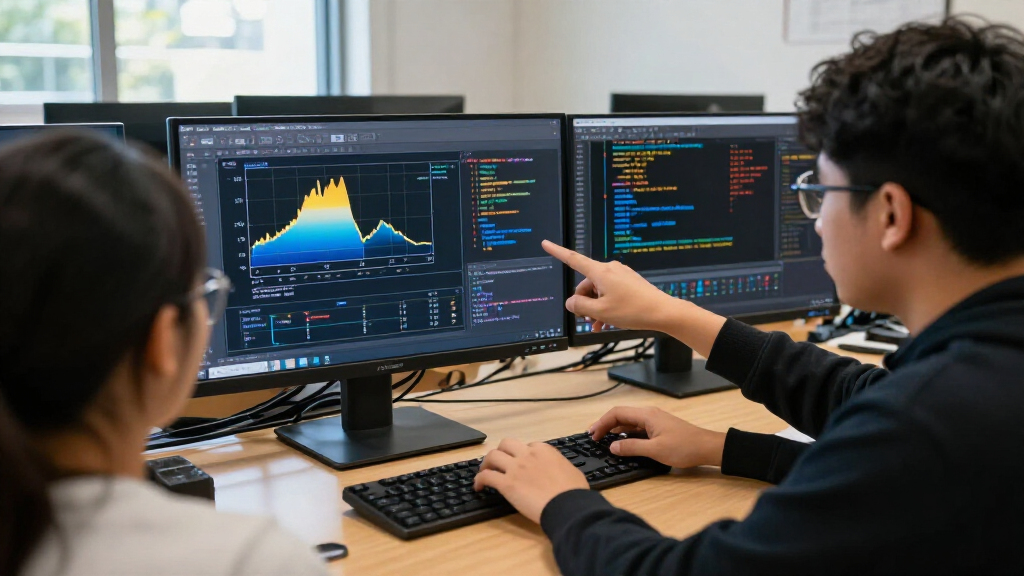
🔍 Read the full analysis: How PyTorch Handles Gradients During Model Training on ThorstenMeyerAI.com

Prime made for students and young adults
- Fast, free delivery for dorm and study essentials
- Prime Video and Amazon Music included
- Member-only deals
TL;DR
PyTorch calculates gradients by recording operations on tensors and using autograd to apply the chain rule during backpropagation. Those gradients guide updates to a model’s weights; accelerator support and optional compilation affect how training runs, not the basic learning process.
PyTorch trains models by calculating gradients—the quantities that indicate how changes to model parameters affect a loss—then using an optimizer to adjust those parameters. A November 22 explainer from ThorstenMeyerAI.com describes the process through tensors, autograd and the training loop, the core mechanics behind training many neural networks.
PyTorch is an open-source Python library for building and training neural networks. Its central data structure is the tensor, a multidimensional array that can hold inputs, model parameters and intermediate results. Tensors have a shape, data type and device, such as a CPU or supported accelerator. Mathematical operations on them produce new values used in a model’s calculations.
When a tensor is marked as requiring gradients, PyTorch’s autograd system records operations involving it. During training, a model uses its parameters to produce a prediction; a loss function measures the difference between that prediction and the target. Calling backpropagation on the loss makes autograd work backward through the recorded operations, applying the chain rule to calculate each parameter’s gradient.
An optimizer uses those gradients to update model parameters. In a typical loop, a batch of data passes through the model, the loss is calculated, gradients are computed, and the optimizer takes a step. Gradients are normally reset before the next batch because PyTorch accumulates them by default. This sequence repeats over batches and training rounds; the particular model, loss, optimizer and data determine what is learned.
How Gradients Change Model Weights
Gradients provide the direction and scale of parameter updates under a chosen loss function. They do not guarantee that a model will learn a useful task: results depend on factors including data quality, model design, optimization settings and training duration. But without calculating gradients for trainable parameters, the usual gradient-based training loop cannot make those updates.
Understanding the sequence also helps explain practical training problems. If gradients are not cleared, they can accumulate across batches; if a parameter is not connected to the loss calculation, it may not receive a useful gradient. These behaviors can affect training, though the exact cause of any issue depends on the code and setup.
The framework also sits between model code and computing hardware. The source says native PyTorch backends are available for hardware from several vendors, including Google and AWS, and reports new TPU and Trainium efforts announced October 20, 2026. That could make some hardware changes easier, but it does not establish that switching chips is cost-free or that performance will match across devices.
Popular right now

Breville Barista Pro Espresso Machine with Grinder, Brushed Stainless Steel

Breville Barista Express Espresso Machine with Built-In Grinder, Black Sesame

Samsung 65-Inch M70H Series 4K Mini LED Smart TV (2026)
As an affiliate, we earn on qualifying purchases.
PyTorch’s Eager Training Design
PyTorch’s design runs Python operations as the program reaches them, building the calculation graph dynamically. The supplied explainer quotes the project’s documentation: “what you run is what you differentiate.” That approach links gradient calculation to the operations actually performed, rather than requiring users to define a separate static graph for every computation.
The explainer describes five pieces of the training workflow: tensors, autograd, accelerators, the training loop and torch.compile. Accelerators such as GPUs can handle much of the numerical work; they do not replace autograd’s role in computing gradients. The optional torch.compile feature can optimize execution, while the underlying training logic remains the model’s calculations, loss, gradients and parameter updates.
PyTorch began in 2016, with its first public release in January 2017, according to the source’s account of the project and its 2019 research paper. Governance moved to the PyTorch Foundation under the Linux Foundation on September 12, 2022. The supplied material says version 2.15 was released October 28, 2026, and lists 3,117 commits from 583 contributors since version 2.14.
““What you run is what you differentiate.””
— PyTorch documentation, as quoted by ThorstenMeyerAI.com
Limits of the Available Details
The source is an explainer, not a report of a new change to PyTorch’s gradient algorithm. It provides no benchmark results comparing gradient calculation across hardware, and no measurements of how much torch.compile improves training speed. It also does not specify a particular model, dataset or optimizer against which readers could assess training outcomes.
The supplied material says example code was tested with PyTorch 2.12, while its current-version discussion refers to 2.15. It does not provide the full code or a version-by-version comparison of autograd behavior. Its TPU and Trainium discussion says porting can be simplified but that peak performance may require changes; the extent of those changes will depend on workloads and hardware.
What to Watch in Training Tools
There is no specific follow-up event or new gradient feature identified in the supplied material. The next practical questions for developers are whether their training code runs correctly on a target device, whether performance meets their needs, and whether any device-specific changes are required. Those points call for workload-specific testing rather than assumptions based on framework support alone.
PyTorch’s release history and hardware-backend updates will provide further developments to track. For model builders, the training loop remains the immediate reference point: check that the loss is computed as intended, gradients reach the parameters that should learn, gradients are reset between batches, and optimizer updates behave as expected.
Key Questions
What does a gradient tell PyTorch?
A gradient measures how a change in a model parameter affects the loss, locally. An optimizer uses gradients to update parameters during training.
How does PyTorch calculate gradients?
Autograd records operations on tensors that require gradients. When backpropagation is called on a loss, it works backward through those operations using the chain rule.
Why reset gradients during training?
PyTorch accumulates gradients by default. A training loop generally clears them before computing gradients for the next batch, so updates do not unintentionally combine with previous batches.
Do GPUs calculate gradients instead of autograd?
No. Autograd determines gradients from recorded operations; a GPU or other supported accelerator can execute the numerical operations on its device.
Does moving a PyTorch model to another chip require only one code change?
That was the stated TorchTPU goal described in the source. The same material cautions that reaching peak performance may require code changes, so portability and performance depend on the model and hardware.
Source: ThorstenMeyerAI.com