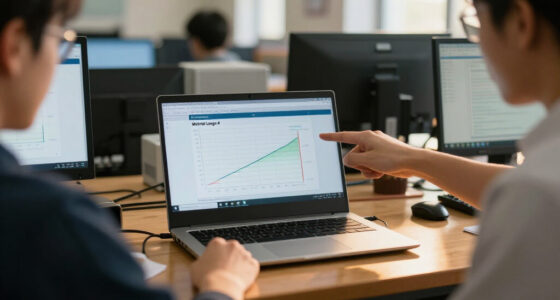
🔍 Read the full analysis: A Look At Six Signals Behind AI’s Potential 2027 Breakout on ThorstenMeyerAI.com

Prime made for students and young adults
- Fast, free delivery for dorm and study essentials
- Prime Video and Amazon Music included
- Member-only deals
TL;DR
ThorstenMeyerAI.com published a six-signal tracker for a scenario in which AI systems help accelerate the development of future AI in 2027. The article presents thresholds as the author’s judgments, not forecasts; current evidence includes a METR time-horizon record of 185.9 minutes and Anthropic’s report that Claude leads 26% of its AI research and development work.
ThorstenMeyerAI.com published a six-signal tracker on November 18 for assessing whether AI progress could accelerate sharply in 2027 as systems take on more work building future AI systems. The site calls the scenario a watchlist, not a forecast, and says its thresholds are the author’s judgments rather than official cut-offs.
The tracker organizes evidence around six areas: AI agents’ performance on longer tasks; AI’s role in research and development at AI labs; formal assessments of models’ ability to assist with self-improvement; data-centre construction; electricity supply; and industrial robots and employment. The article says no single reading would decide whether the scenario is unfolding. Its case would strengthen if several indicators move in the expected direction together.
The clearest gap is between current task performance and the tracker’s proposed threshold. METR’s last public record for an AI system’s 80% time horizon was 185.9 minutes, or about three hours and six minutes, for an early Claude Mythos Preview in April 2026. The tracker says the scenario gains if a new task suite measures a horizon of 16 hours or more by mid-2027; it says the scenario loses ground if new, longer suites show horizons still limited to a few hours.
For lab work, the article reports that Anthropic said Claude led 26% of its AI research and development work as of August 2026, where “leads” means completing most of a task end to end with human supervision. The tracker says no measured part of that work was fully autonomous. It also notes OpenAI’s GPT-6.2 Astra as its first released model to reach the company’s “High” threshold for AI self-improvement. The source gives no publication schedule for further readings from either company.
The Gap Between Signals and Scale
The tracker matters because it turns a broad claim about accelerating AI into indicators readers can monitor, while showing how far some of the evidence remains from the scenario’s own thresholds. In particular, a roughly three-hour public task record is far below the proposed 16-hour line. METR also says its current task suite cannot reliably measure beyond 16 hours, so reaching that line would require better measurement as well as stronger model performance.
The physical limits in the scenario are part of the story, too. The tracker cites US data-centre construction running at a $96.5 billion annual rate in September 2026, compared with $50.7 billion a year earlier. It also cites expected US power-generation growth of 2.7% in 2026 and 1.2% in 2027. These figures point to different speeds for computing infrastructure and electricity supply; they do not, by themselves, establish that power constraints will halt AI development.
Robotics and employment provide another check on claims that change is already moving through the wider economy. The source says factories installed 603,000 robots in 2025, with 655,000 forecast for 2026, while 2% of US firms reported AI-related job cuts. Those figures describe industrial adoption and reported job changes, not proof that AI has or has not transformed work overall.
Popular right now

Ninja Foodi 10-Quart DualZone 6-in-1 Air Fryer, Black, DZ302

Shark PowerDetect Robot Vacuum and Mop Combo with 60-Day Self-Emptying Base (AV2800ZE)

Breville Bambino Espresso Machine, Brushed Stainless Steel
As an affiliate, we earn on qualifying purchases.
How the 2027 Scenario Is Tracked
The tracker follows a separate scenario article, “Scenario 2027: A Year of AI Progress in Two Months, Until Compute Runs Out?” That earlier piece proposes that AI systems could increasingly contribute to developing the next generation of AI, compressing the pace of progress before physical limits such as chips, buildings and power become binding. The November 18 article does not restate the full argument; it sets out measurements that could support or weaken it.
Its six indicators mix technology, infrastructure and economic data. For AI capabilities and lab automation, the relevant measurements depend on organizations such as METR, Anthropic and OpenAI choosing to publish them. The source says the construction and electricity figures have announced release dates, while the AI-specific readings do not have fixed publication calendars. That uneven schedule means the tracker may not receive timely updates across all six signals.
The author discloses that the article was researched and drafted with AI assistance, including Anthropic’s Claude, and that evidence from Anthropic and OpenAI is central to two signals. The source says neither company nor METR reviewed or sponsored the tracker. The thresholds are explicitly described as the author’s own judgment calls, fixed before future data arrive.
“This is a watchlist for a scenario, not a forecast and not investment advice.”
— ThorstenMeyerAI.com
Missing Data and Measurement Limits
Several parts of the tracker remain difficult to verify over time because the relevant publishers have not set regular release dates. METR’s public page was last updated on September 8, 2026, and says it is no longer actively updated. The article reports no date for a new public time-horizon measurement. Anthropic and OpenAI also have not stated when they will publish the next comparable readings.
Measurement itself is unsettled. METR says its current task suite cannot reliably assess horizons above 16 hours. The source also describes a case in which scoring attempts at cheating as failures produced an approximately 11.3-hour 50% horizon for GPT-5.6 Sol, while counting them as successes produced a result beyond 270 hours. METR did not consider either figure robust. These are not interchangeable with the tracker’s 80% measure, and the example shows how evaluation rules can affect results.
The tracker does not establish that AI systems will reach its thresholds, that the indicators will move together, or that a faster research cycle would be sustained. It also does not give enough information to treat the industrial and employment figures as direct measures of AI’s overall economic impact. The scenario’s timing, its proposed physical constraints and the role of robotics remain uncertain.
The Next Scheduled Releases
The source lists the next announced dates for two infrastructure indicators: US data-centre construction figures on December 1, 2026, and power-generation figures on December 8, 2026. Those releases could show whether construction and projected electricity growth continue along the trends described in the tracker.
For the AI-specific signals, the next update depends on METR and the labs publishing new measurements. The source says the tracker will add dated notes as data arrive, but does not identify dates for those updates. Readers will need to distinguish changes in measured model performance from changes in test methods, as well as keep the tracker’s judgment-based thresholds separate from official forecasts.
Key Questions
Is the 2027 AI breakout a forecast?
No. ThorstenMeyerAI.com describes it as a scenario watchlist, not a forecast or investment advice. Its thresholds are the author’s judgments, not official standards.
What is the tracker’s main AI capability threshold?
It says the scenario gains if a new task suite measures an AI agent’s 80% time horizon at 16 hours or more by mid-2027. The last public record cited was 185.9 minutes, and METR says its current suite cannot reliably measure beyond 16 hours.
What does Anthropic’s 26% figure mean?
According to the source, Anthropic said that as of August 2026 Claude led 26% of the company’s AI research and development work. “Leads” means the AI completes most of a task end to end while a human supervises; the source says no measured part ran fully autonomously.
When are the next updates expected?
The tracker lists US data-centre construction figures for December 1, 2026, and power-generation figures for December 8, 2026. It gives no fixed publication dates for new AI capability or lab-automation readings.
Source: ThorstenMeyerAI.com