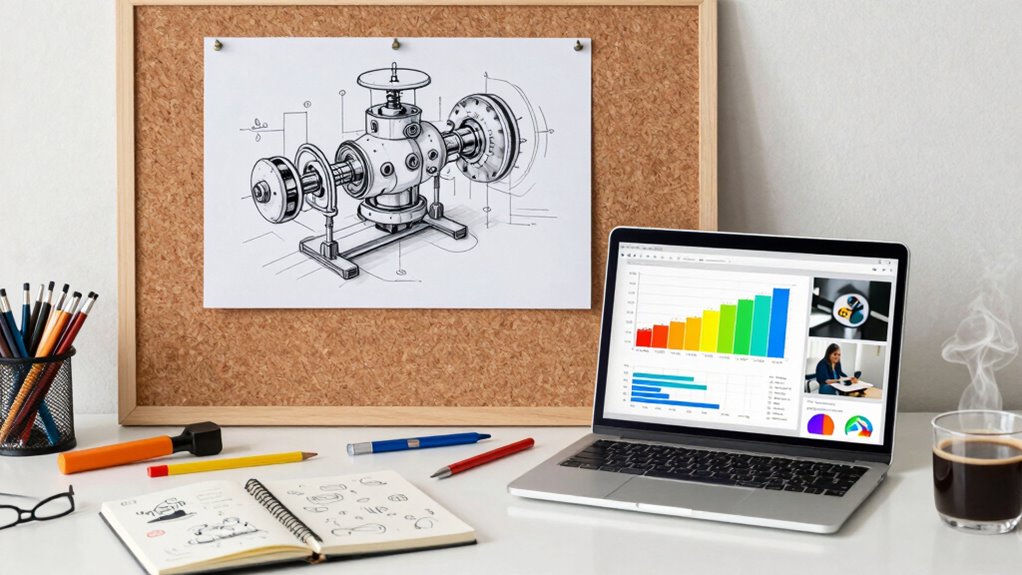

To test your wild idea quickly and cheaply, start with market research like surveys or interviews to understand demand and gather feedback. Quickly create a simple prototype or MVP focused on core features to observe real user reactions. Use an iterative process to refine your idea based on feedback, avoiding unnecessary work. Combining these strategies helps you validate your concept early and adapt fast. Stay with us to discover how to turn this approach into successful results.

Prime made for students and young adults
- Fast, free delivery for dorm and study essentials
- Prime Video and Amazon Music included
- Member-only deals
Key Takeaways
- Conduct market research early through surveys or interviews to validate demand and understand target audience needs.
- Develop a minimum viable product (MVP) to test core concepts quickly and gather real user feedback.
- Use iterative cycles to refine your idea based on feedback, minimizing time and resource waste.
- Focus on rapid prototyping to experiment with ideas without full-scale development.
- Prioritize learning and flexibility, allowing for pivoting based on validated insights.

Coming up with a wild idea for your business or project is exciting, but testing it can feel overwhelming and time-consuming. You might worry about pouring months into development only to find out your concept doesn’t resonate with your target audience. That’s where smart testing methods come into play. Instead of diving straight into full-scale development, you can use techniques like market research and rapid prototyping to validate your idea quickly and efficiently.
Market research helps you understand whether there’s genuine demand for your concept. Rather than building a product first, you start by gathering insights directly from potential users. Conduct surveys, interviews, or online polls to uncover their pain points, preferences, and willingness to pay. This process saves you from investing in features or solutions that might not solve a real problem or appeal to your audience. It also helps you identify who your early adopters are, so you can tailor your approach accordingly.
Once you have a clearer picture from your market research, you can move on to rapid prototyping. This technique involves creating a simplified version of your idea — a minimal viable product (MVP) or a mockup that demonstrates core functionalities. The goal isn’t perfection but rather speed and learning. By quickly building a prototype, you can put your concept into the hands of real users and observe their reactions. It allows you to gather valuable feedback, identify flaws, and understand what resonates, all without wasting months on development. The key is to keep the prototype simple and focused on the most critical features.
Using rapid prototyping also encourages an iterative mindset. You can make small adjustments based on user feedback and test again, gradually refining your idea without starting from scratch each time. This approach minimizes risk and helps you learn fast. Remember, your goal isn’t to launch a perfect product but to validate whether your wild idea has a real chance of success.
Combining market research with rapid prototyping creates a lean, efficient path to testing your idea. You avoid unnecessary expenses and time-consuming development by focusing on understanding your market and validating your assumptions early. This strategy helps you make smarter decisions, pivot if needed, and ultimately bring your innovative idea to life with confidence, not guesswork. Embracing market validation early in the process can significantly increase your chances of success and prevent costly missteps.
As an affiliate, we earn on qualifying purchases.
Frequently Asked Questions
How Do I Identify a Truly Wild Idea Worth Testing?
You identify a truly wild idea worth testing by using brainstorming techniques that push boundaries and spark creativity. Focus on generating bold, unconventional concepts without judgment. Then, quickly move to idea validation by seeking honest feedback from potential users or experts. If your idea sparks genuine interest or solves a real problem, it’s worth exploring further. Trust your instincts, but always validate to avoid investing in false positives.
What Skills Are Essential for Rapid Idea Testing?
Think of yourself as a skilled sailor charting uncharted waters. You need sharp skills like market research and user feedback to steer quickly and avoid storms. Being adaptable and open-minded helps you pivot when the tide turns. Analytical thinking and quick decision-making are essential to test ideas fast. With these skills, you’ll efficiently gather insights, refine your concept, and keep your journey on course without wasting months chasing dead ends.
How Can I Measure Success During Quick Tests?
You can measure success during quick tests by analyzing market research data and gathering customer feedback. Look for signs that your idea resonates, such as increased engagement or positive responses. Track key metrics like conversion rates or user interest. Customer feedback provides direct insights, helping you refine your approach. If your tests generate promising signals from market research and positive reactions, you’re on the right track.
What Common Pitfalls Should I Avoid in Early Testing?
Avoid common pitfalls in early testing by not overestimating user engagement or misallocating resources. Don’t focus solely on initial enthusiasm; measure sustained engagement to gauge true interest. Also, don’t invest too heavily upfront—keep resource allocation flexible to pivot quickly if needed. Be cautious of biases or assumptions that can cloud your judgment. Regularly validate your ideas with real users, and stay adaptable to avoid wasting time or effort on unviable concepts.
How Do I Pivot if My Initial Test Fails?
Think of your idea as a ship steering through choppy waters—if it hits a reef, you need to steer differently. When your initial test fails, engage in creative brainstorming to explore new angles. Conduct a thorough risk assessment to understand what went wrong, then pivot by adjusting your approach based on insights gained. Stay flexible, learn from setbacks, and keep refining your idea to reach calmer waters.
minimum viable product prototype kit
As an affiliate, we earn on qualifying purchases.
As an affiliate, we earn on qualifying purchases.
Conclusion
Think of testing your wild idea like planting a seed. You don’t need to wait years for a forest—just water it with quick experiments, nurture it with feedback, and watch tiny sprouts of success emerge. Each small step is a breeze of fresh air, guiding you toward a forest of possibilities without wasting months in the dark. Embrace the process, and soon, your wild idea will bloom into something extraordinary.
rapid prototyping tools for startups
As an affiliate, we earn on qualifying purchases.
As an affiliate, we earn on qualifying purchases.
user feedback collection devices
As an affiliate, we earn on qualifying purchases.
As an affiliate, we earn on qualifying purchases.
Fall Picks
fall essentials
As an affiliate, we earn on qualifying purchases.