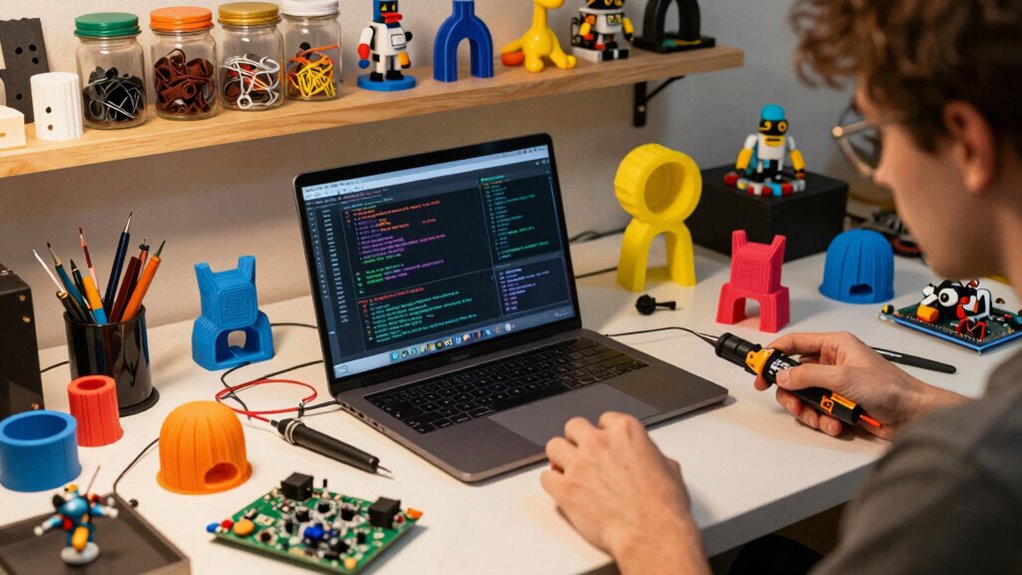

Online maker culture fuels your scientific curiosity by providing platforms where you can share ideas, access virtual labs, and collaborate globally. You can tinker, build, and experiment using open-source resources and community support, breaking physical and institutional barriers. Active participation helps you troubleshoot, refine projects, and learn new skills. As you explore these digital ecosystems, you’ll discover how collective curiosity drives innovation—keeping you inspired and involved in open, collaborative discovery. Keep exploring to find out more.

Prime made for students and young adults
- Fast, free delivery for dorm and study essentials
- Prime Video and Amazon Music included
- Member-only deals
Key Takeaways
- Online maker communities enable real-time sharing of experiments, fostering immediate feedback and collaborative scientific exploration.
- Virtual labs and open-source platforms provide accessible resources for DIY research and innovation.
- Digital platforms facilitate active participation in scientific projects, encouraging curiosity-driven tinkering and experimentation.
- Collective documentation and technical knowledge enhance troubleshooting, refining, and advancing maker-led scientific endeavors.
- Global online networks democratize access to scientific tools, inspiring curiosity and fostering inclusive innovation.

Have you ever wondered how the rise of online communities is transforming maker culture and fueling scientific curiosity? Today, the digital world acts as a hub where DIY innovation flourishes and open source experiments thrive. As a maker or curious explorer, you’re no longer confined by physical boundaries or traditional institutions. Instead, you tap into vast networks of enthusiasts, scientists, and inventors who enthusiastically share ideas, improvements, and findings in real-time. This interconnected environment empowers you to experiment boldly, learn from others, and contribute to a global pool of knowledge.
Online platforms like GitHub, Instructables, and Hackaday serve as virtual laboratories where open source experiments are freely accessible. These repositories let you download schematics, code, and instructions to build or modify devices, encouraging a culture of open collaboration. You can take a project from concept to execution, then adapt and improve it based on your needs or discoveries. This openness accelerates innovation, as you don’t have to start from scratch—you’re building upon a foundation laid by countless others. It’s a collective effort that propels scientific curiosity beyond the limits of traditional research. Open source collaboration fosters a community-driven approach that enhances collective problem-solving.
Your participation in DIY innovation isn’t just passive; it’s active engagement that pushes the boundaries of what’s possible. By tinkering with open source designs or developing your own experiments, you become part of a community that values shared knowledge. The online environment fosters this collaborative spirit, allowing you to seek advice, troubleshoot issues, or co-create solutions with people worldwide. The democratization of scientific tools and data means you can contribute to projects like climate monitoring, biomedical research, or renewable energy development, all from your home lab. Furthermore, understanding scientific data and analysis techniques enables you to interpret results more accurately and make meaningful improvements.
Moreover, the accessibility of online information fuels your curiosity and encourages you to ask questions and seek answers through hands-on experimentation. Whether you’re building a robot, coding a sensor, or analyzing data, the digital ecosystem offers endless resources and mentorship opportunities. You don’t need a formal lab or academic background—just the willingness to explore, learn, and share. This seamless blend of maker culture and scientific inquiry transforms you from a passive observer into an active participant in the scientific process, inspiring innovation that’s open, inclusive, and driven by collective curiosity.
Additionally, understanding project documentation and technical specifications helps you troubleshoot and improve your creations more effectively, leveraging the collective knowledge shared within online maker communities.
As an affiliate, we earn on qualifying purchases.
Frequently Asked Questions
How Do Online Maker Communities Ensure Safety and Accuracy?
Online maker communities guarantee safety and accuracy by implementing strict safety protocols and encouraging peer review. You can share your projects, and others review your work to catch potential hazards or errors. Community members often discuss best practices and safety guidelines, helping everyone learn and improve. This collaborative process promotes reliable, safe projects, and assures everyone stays informed about proper techniques, reducing risks while fostering innovation and curiosity.
What Are the Best Platforms for Beginner Maker Scientists?
If you’re a beginner maker scientist, platforms like Instructables and Hackaday are your best bets. They make DIY electronics and 3D printing techniques seem so simple, you’ll wonder if you’re secretly a genius. These sites offer step-by-step guides, community support, and safety tips, so you can jump right into creating without fear. Who knew that becoming a scientist could be as easy as pressing a button?
How Do Makers Fund Their Experiments and Projects?
You fund your experiments through crowdfunding strategies like Kickstarter or Indiegogo, where you showcase your project and attract backers. Additionally, you seek sponsorship opportunities from companies interested in supporting maker projects, providing resources or financial backing. Combining these approaches helps you gather the necessary funds, build a community around your work, and gain credibility, making it easier to turn your innovative ideas into reality.
Can Online Maker Culture Influence Formal Scientific Research?
Yes, online maker culture can influence formal scientific research by crowdsourcing innovation and encouraging grassroots experimentation. When you share ideas and collaborate online, you help bridge the gap between amateurs and professionals, often leading to new insights or solutions. This open exchange accelerates scientific progress, inspires formal studies, and democratizes research, making scientific discovery more accessible and inclusive for everyone involved in the maker community.
How Do Intellectual Property Rights Work in Online Maker Collaborations?
You should know that in online maker collaborations, about 60% use open licenses to manage intellectual property, promoting sharing and innovation. Collaborative licensing allows creators to specify how others can use, modify, or distribute their work. This system encourages transparency and trust within the community, making it easier to protect original ideas while fostering collective progress. Understanding these rights helps you contribute confidently and ethically to online projects.
As an affiliate, we earn on qualifying purchases.
Conclusion
As you dive deeper into the digital domain, maker culture and scientific curiosity become your compass and map, guiding you through a universe of endless discovery. Like a spark igniting a fire, online communities fuel your passion, turning curiosity into creation. Embrace this vibrant mosaic of innovation, where your ideas take flight and transform into tangible wonders. In this interconnected world, your journey is the brushstroke on the canvas of endless possibility.
As an affiliate, we earn on qualifying purchases.
As an affiliate, we earn on qualifying purchases.
Fall Picks
fall essentials
As an affiliate, we earn on qualifying purchases.