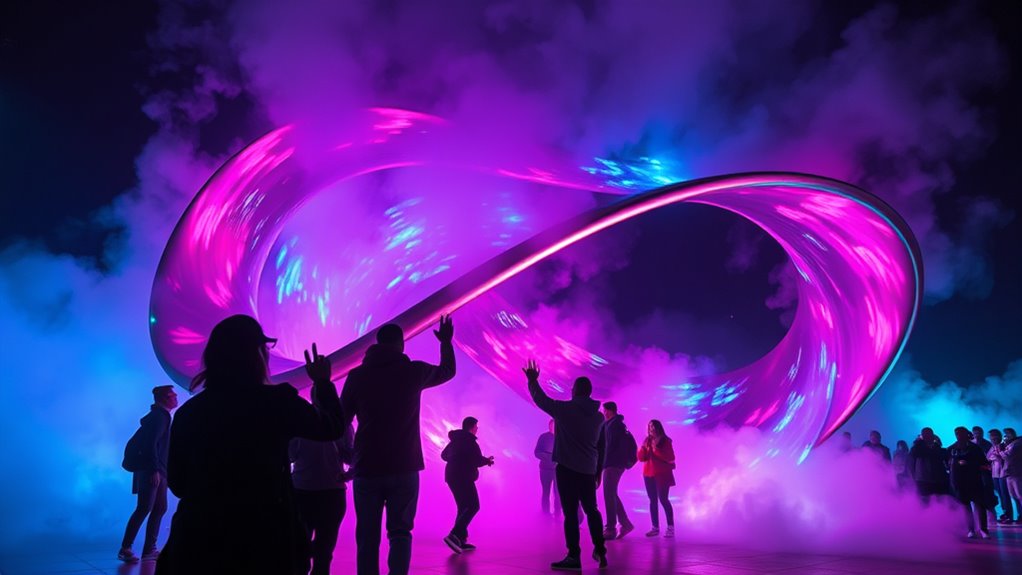

Dynamic art installations powered by Edge AI transform your experience by creating real-time interactions that respond to your movements and emotions. You become an active participant as the artwork shifts in color and shape based on your presence. This technology adapts to your feelings, making the art uniquely yours. It not only enhances engagement but also fosters deeper connections. Discover how these installations push creative boundaries and explore new themes as you interact more with this fascinating evolution.

Prime made for students and young adults
- Fast, free delivery for dorm and study essentials
- Prime Video and Amazon Music included
- Member-only deals
Key Takeaways
- Edge AI enables real-time interaction in art installations, creating immersive experiences that respond to viewer movements and actions.
- Audience engagement transforms observers into participants, with artworks altering based on proximity and viewer actions.
- Installations utilize sensors to analyze emotional responses, adapting elements to enhance viewer interaction and connection.
- Technology in art provokes discussions on societal issues, exploring the relationship between art, technology, and human connection.
- Dynamic art experiences powered by Edge AI promise unique, personalized encounters, revolutionizing how audiences engage with art.

As technology continues to evolve, artists are increasingly integrating Edge AI into their installations, creating immersive experiences that engage audiences in new ways. You might find yourself stepping into a space where the art seems to respond to your presence, adapting and transforming based on your movements and interactions. This is the magic of Edge AI, which allows for real-time processing and interaction, making each viewer’s experience unique and dynamic.
Imagine walking into a gallery filled with interactive projections that change as you move closer or farther away. These installations invite you to become part of the artwork itself. As you approach, the colors might shift, or the shapes could morph, reflecting your actions and decisions. This level of audience participation turns traditional art appreciation on its head, making you not just an observer but an integral part of the artistic narrative.
Step into a gallery where your movements transform the art, turning you into a vital part of the experience.
You may also encounter installations that use Edge AI to analyze your emotional responses. Sensors and cameras track your expressions and movements, allowing the artwork to adapt accordingly. For instance, if you seem intrigued, the installation might amplify certain elements, drawing you further in. If you appear disengaged, it may change direction, trying to recapture your attention. This kind of responsiveness creates a dialogue between you and the art, fostering a deeper connection.
Interactive projections powered by Edge AI can also be used to tell stories. As you navigate through the installation, different pathways might disclose based on your choices, guiding you through a personalized narrative. Each decision you make influences the outcome, emphasizing the role of audience participation in shaping the experience. You’re no longer simply a viewer; you’re an active participant in a living, breathing artwork.
Moreover, Edge AI allows artists to push the boundaries of creativity, experimenting with how technology can enhance human connection. By leveraging data and analytics, they can create installations that not only engage but also provoke thought about the relationship between technology and art. You might find yourself reflecting on how these interactions mirror your own life experiences or societal issues, igniting conversations long after you leave the gallery. In this context, the trustworthiness of AI outputs can significantly influence the effectiveness of these interactive experiences.
In this ever-evolving landscape, Edge AI is revolutionizing how we experience art. It’s not just about seeing; it’s about feeling, interacting, and participating in a way that’s never been possible before. So, when you step into one of these installations, remember that your presence matters, and the art is waiting for you to engage.
interactive art installation sensors
As an affiliate, we earn on qualifying purchases.
As an affiliate, we earn on qualifying purchases.
Frequently Asked Questions
What Are Some Examples of Edge AI in Other Industries?
Edge AI transforms various industries. In smart manufacturing, it optimizes production lines by analyzing data in real-time, reducing downtime and improving efficiency. In healthcare diagnostics, it helps you detect anomalies in medical images quickly, allowing for faster decision-making and treatment plans. These applications show how edge AI enhances operational capabilities, streamlines processes, and ultimately improves outcomes across different sectors, making them more efficient and responsive to real-time needs.
How Does Edge AI Enhance Viewer Engagement in Art Installations?
Edge AI transforms art installations into a living canvas, where every viewer’s presence stirs the brush. By integrating sensors, you tap into real-time feedback, allowing the artwork to respond dynamically to your movements and emotions. This interaction deepens your engagement, as you don’t just observe—you become part of the experience. The artwork evolves alongside you, creating a vibrant dialogue that enhances your connection and immerses you in a unique, sensory journey.
What Are the Technical Requirements for Creating Edge AI Art?
To create edge AI art, you’ll need specific hardware considerations like powerful edge devices, sensors, and possibly cameras to gather data. For software frameworks, consider using TensorFlow Lite or PyTorch Mobile, as they’re optimized for edge computing. You’ll also want to make certain your system can handle real-time processing to respond to viewer interactions. Combine these elements effectively, and you’ll lay a solid foundation for your edge AI art project.
Are There Specific Artists Known for Using Edge AI in Their Work?
Yes, there are specific artists known for using edge AI in their work. Innovative artists like Refik Anadol and Mario Klingemann are considered AI pioneers, blending technology with creativity. They push boundaries by incorporating AI algorithms into their art, creating stunning visual experiences. You’ll find their works at exhibitions, showcasing how they harness the power of AI to redefine traditional art forms and engage audiences in new ways.
How Can Audiences Interact With Edge AI Art Installations?
You can interact with edge AI art installations through gesture recognition, creating a unique relationship between you and the artwork. While your movements breathe life into static pieces, the art responds with real-time feedback, transforming your gestures into vibrant displays. This juxtaposition of your physical presence and the digital world invites a deeper engagement, allowing you to explore creativity in ways that are both personal and immersive. Embrace the interaction and let the art evolve with you.
As an affiliate, we earn on qualifying purchases.
Conclusion
So, next time you walk into an art installation that seems to know you better than your therapist, don’t be alarmed. It’s just edge AI, blending art and technology to create a mesmerizing experience—or maybe it just wants to sell you a data package. After all, who needs to connect with human emotions when you can connect with algorithms? Embrace the future, where your feelings are just another data point in the glorious chaos of modern art!
emotion sensing interactive display
As an affiliate, we earn on qualifying purchases.
As an affiliate, we earn on qualifying purchases.
As an affiliate, we earn on qualifying purchases.
Halloween Picks
halloween
As an affiliate, we earn on qualifying purchases.