
📊 Full opportunity report: AI Changelog Digest For Open-source Maintainers on IdeaNavigator AI — validation score, market gap, and execution plan.

Get school and study supplies delivered free — and shop member deals
- Fast, free delivery on millions of items
- Access to Prime Big Deal Days deals on October 6–7
- Prime Video, Amazon Music and more included
TL;DR
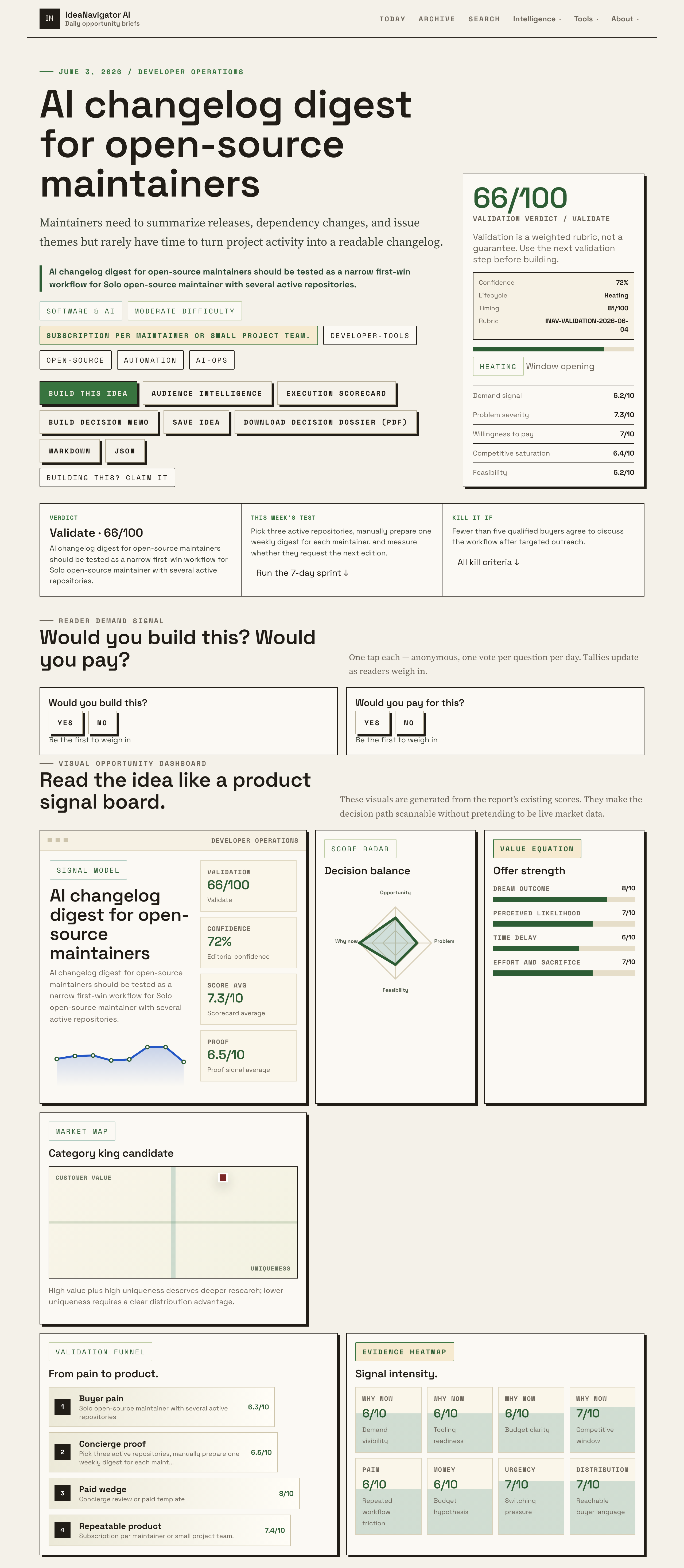
A prototype AI changelog digest for solo open-source maintainers is being tested. It automates summarizing releases, pull requests, and issues, promising to streamline project updates.
An AI-powered digest tool designed to help solo open-source maintainers automatically generate weekly summaries of project activity is currently in a testing phase. This development aims to address a common challenge faced by maintainers: efficiently summarizing releases, dependency changes, and issues without dedicating extensive time to documentation.
The proposed AI changelog digest reads data from repositories’ release feeds, merged pull requests, and top issues, then drafts a concise, maintainable email summary for the project. The initial focus is on a narrow workflow suitable for maintainers managing several active repositories, with the goal of reducing manual effort.
This initiative is driven by the realization that modern repository metadata and AI summarization capabilities make it feasible to automate these routine but time-consuming tasks. The prototype will be tested by selecting three active repositories, with maintainers manually preparing one weekly digest for comparison and validation purposes. Success will be measured by whether maintainers request continued use of the generated summaries.
The model proposes a subscription-based revenue, targeting individual maintainers or small teams, aligning with the developer operations market. The approach aims to validate whether the automated summaries can effectively replace or supplement manual updates, ultimately streamlining project communication and release management.
Potential Impact on Open-Source Maintenance Efficiency
This development could significantly reduce the time and effort required for solo maintainers to produce accurate and timely project updates, which is often a bottleneck in open-source project management. Automating changelog generation can improve transparency, encourage more frequent releases, and enhance community engagement by providing clearer, more consistent documentation of project activity.
While the concept is promising, it remains in early testing, and the effectiveness of AI-generated summaries in real-world scenarios has yet to be fully validated. If successful, this tool could become a standard part of the open-source maintainer’s toolkit, especially for projects without dedicated developer relations teams.
AI-powered changelog generator for open-source projects
As an affiliate, we earn on qualifying purchases.
As an affiliate, we earn on qualifying purchases.
Advances in AI and Repository Data Utilization Enable Automation
Recent improvements in AI summarization and the increasing availability of repository metadata—such as release feeds, pull request data, and issue tracking—have created new opportunities for automating routine documentation tasks. The idea of an AI-driven changelog digest is emerging as a practical solution for solo maintainers managing multiple repositories, who often lack the time to manually compile comprehensive updates.
This initiative follows broader trends in developer operations, where automation aims to reduce manual workload and improve project transparency. The concept has been discussed within open-source communities and developer tools circles, but practical testing of such tools is only now beginning.
“Automating changelog summaries could transform how solo maintainers manage their projects, saving time and improving communication.”
— an anonymous researcher
automated project update email tool
As an affiliate, we earn on qualifying purchases.
As an affiliate, we earn on qualifying purchases.
Effectiveness and Adoption of AI Changelog Summaries Still Uncertain
It is not yet clear how accurately the AI can generate useful, comprehensive summaries across different types of repositories and project sizes. The initial testing will reveal whether maintainers find the summaries sufficiently reliable and whether they prefer automated over manual updates. Additionally, questions remain about long-term adoption, integration with existing workflows, and potential limitations in capturing nuanced project details.
repository activity summarization software
As an affiliate, we earn on qualifying purchases.
As an affiliate, we earn on qualifying purchases.
Next Steps Include Broader Testing and Feedback Collection
The next phase involves deploying the prototype with three selected repositories, collecting feedback from maintainers, and measuring their engagement with the summaries. Based on initial results, developers will refine the AI models and user interface. Success could lead to wider adoption and potential commercialization, with plans to expand features and integration options in future updates.
AI tool for open-source maintainers
As an affiliate, we earn on qualifying purchases.
As an affiliate, we earn on qualifying purchases.
Key Questions
How will the AI generate changelogs?
The AI will analyze repository release feeds, merged pull requests, and top issues to create a concise summary of recent activity, highlighting key changes and updates.
Who is the target user for this tool?
Solo open-source maintainers managing multiple repositories who lack the time to manually compile weekly or release summaries.
Is this tool available for use now?
The tool is currently in a testing phase with initial validation planned; it is not yet publicly available for general use.
What are the potential benefits of using this AI digest?
It could save time, improve documentation consistency, and enhance communication with project contributors and users.
What are the main challenges ahead?
Ensuring the accuracy and completeness of summaries, integrating seamlessly into existing workflows, and encouraging adoption among maintainers.
Source: IdeaNavigator AI
Halloween Picks
halloween
As an affiliate, we earn on qualifying purchases.