To recreate primordial soup, you need to simulate Earth’s early conditions by combining simple gases like methane, ammonia, and water vapor, then providing energy through lightning or heat. These react to form organic molecules such as amino acids and sugars, which can polymerize into more complex compounds. Experiments like the Miller-Urey setup show this process is possible. Keep exploring to discover how scientists believe these molecules sparked the origin of life.
Key Takeaways
- Laboratory experiments like Miller-Urey simulate early Earth conditions, producing organic molecules such as amino acids.
- Early Earth’s reducing atmosphere and energy sources (lightning, UV radiation) facilitated organic compound formation.
- Alternative sites like hydrothermal vents provided stable, mineral-rich environments conducive to complex chemistry.
- Organic molecules can form spontaneously from inorganic precursors like cyanide, ammonia, and carbon dioxide.
- These processes suggest life’s building blocks emerged through chemical evolution in Earth’s primordial environments.
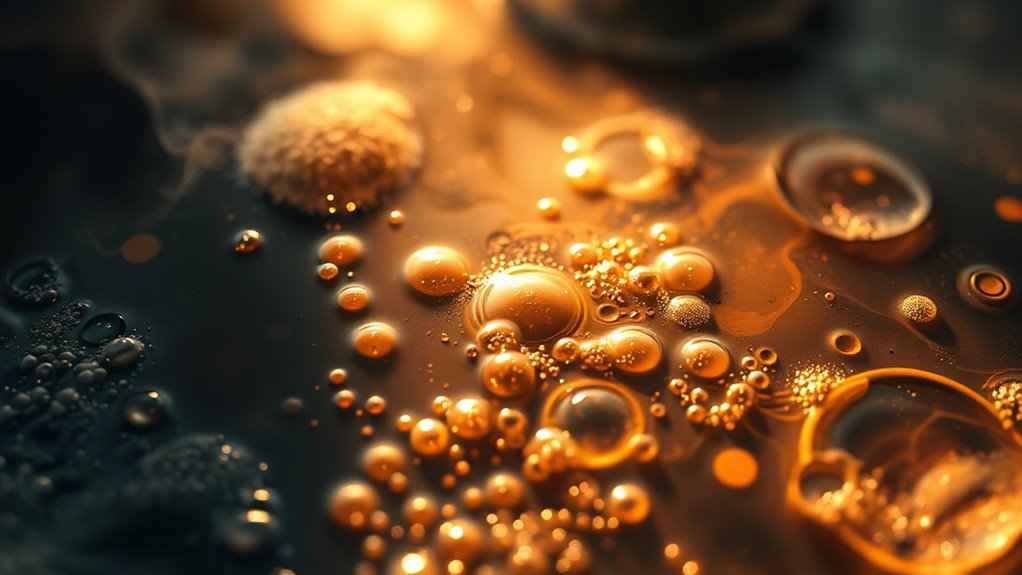
The primordial soup theory explains how life may have begun billions of years ago in Earth’s early oceans. If you imagine yourself back in time, you’d find a planet with a reducing atmosphere, rich in methane, ammonia, hydrogen, and water vapor. Without oxygen, these gases interacted under the influence of ultraviolet radiation and lightning, driving chemical reactions that formed simple organic molecules like amino acids, sugars, and components of proteins. These molecules didn’t stay isolated; instead, they accumulated in the ocean’s waters, creating a nutrient-rich “soup” that served as the cradle for life’s emergence.
Proponents like Alexander Oparin and J.B.S. Haldane independently proposed that this primitive water body could act as a chemical reactor, fostering complex organic chemistry. Haldane vividly described the oceans as gradually building up organic substances until they reached a “hot dilute soup” consistency, setting the stage for more intricate molecular assembly. This idea isn’t just theoretical—scientific experiments in the 20th century provide strong support. In 1953, Stanley Miller and Harold Urey simulated early Earth conditions by creating an environment with gases resembling those of the primordial atmosphere, then introducing electric sparks to mimic lightning. Their experiment produced amino acids, demonstrating that basic building blocks of life can form naturally under plausible conditions.
While the primordial soup hypothesis gained significant backing, critics have questioned whether the early atmosphere’s composition was accurately represented. Some suggest that alternative locations, like hydrothermal vents on the ocean floor, might have played a more vital role by providing chemical energy and stable environments for complex reactions. These vents could have offered the necessary heat and mineral-rich environments for life to originate, shifting the focus away from surface pools. Still, the idea that organic molecules could spontaneously form and polymerize in the ocean remains compelling. Laboratory studies have shown that amino acids, nucleotides, and sugars can combine through chemical pathways involving cyanide, ammonia, and carbon dioxide, producing molecules like orotate, a nucleotide precursor. These reactions resemble processes occurring within modern cells, hinting at evolutionary continuity.
The timeline for this process is believed to fall between 3.7 and 4 billion years ago, during Earth’s Hadean eon. During this period, conditions were ripe for organic chemistry to flourish. If you consider how these molecules could have polymerized into larger structures like proteins and nucleic acids, it’s clear that the primordial soup could have provided the foundational chemistry for life. Although scientists continue debating the precise mechanisms and locations, the primordial soup hypothesis remains a central theory, illustrating how simple inorganic molecules could have transformed into the complex, self-replicating systems that eventually led to living organisms.

Miller Electric Plasma Torch Consumable Kit
- Product Type: Plasma Torch Consumable Kit
As an affiliate, we earn on qualifying purchases.
As an affiliate, we earn on qualifying purchases.
Frequently Asked Questions
Could Extraterrestrial Life Have Influenced Primordial Soup Formation?
You might wonder if extraterrestrial life influenced primordial soup formation. It’s possible because meteorites like carbonaceous chondrites contain organic molecules, amino acids, and proteins that could enrich Earth’s early environment. Interplanetary dust particles also transport organic material from space. These extraterrestrial sources could have provided essential building blocks, boosting chemical reactions in Earth’s primordial waters and helping spark the development of life as we understand it.
What Role Did Volcanic Activity Play in Early Chemical Reactions?
You’re asking about volcanic activity’s role in early chemical reactions. Volcanic eruptions released gases like CO2, methane, and ammonia, creating a reducing atmosphere that fueled organic synthesis. Geothermal vents provided high temperatures and chemical gradients, supporting complex reactions. Volcanic lightning and heat supplied energy to form amino acids and sugars. Plus, volcanic minerals and clay surfaces acted as catalysts, helping assemble molecules necessary for life’s origins.
How Did Lipids Contribute to the Development of Early Cell Membranes?
When it comes to early cell membranes, lipids played a crucial role in laying the groundwork for life. You can think of them as the building blocks that created primitive bubbles, or vesicles, capable of encapsulating genetic material. These simple fatty acids naturally assembled in water, forming stable structures. Their interactions with environmental factors and other organic compounds helped protocells grow, divide, and evolve into the first true cells.
Are There Modern Environments That Mimic Primordial Soup Conditions?
You’ll find modern environments that resemble primordial soup conditions in places like hydrothermal vents, where mineral-rich fluids create chemical gradients similar to early Earth. Enceladus’s subsurface ocean also offers organic compounds formed abiogenically. Additionally, acidic hot springs and volcanic lakes provide energy and chemical diversity needed for organic synthesis. These environments support complex molecules, offering valuable insights into how life’s building blocks could have naturally formed.
What Challenges Exist in Recreating Primordial Soup in Laboratories?
You face several challenges when trying to recreate primordial soup in labs. Accurately mimicking early Earth conditions proves difficult, especially maintaining reactive intermediates and simulating physical environments. Polymerization in water is tricky since peptide bonds break down easily. Additionally, identifying the right mix of organic molecules and replicating long-term processes are complex, often limited by time constraints and environmental factors, making it tough to fully reproduce early prebiotic chemistry.

LINKTOR Chemistry Molecular Model Kit (444 Pieces), Student or Teacher Set for Organic and Inorganic Chemistry Learning, Motivate Enthusiasm for Learning and Raising Space Imagination, A Fullerene Set
- Suitable for All Education Levels: 444-piece kit for students from Grade 7 to graduate
- Includes Fullerenes and Basic Components: 136 atoms, 158 bonds, 150 parts for Carbon-60
- Two Types of Models: Ball-and-stick and space-filling models
As an affiliate, we earn on qualifying purchases.
As an affiliate, we earn on qualifying purchases.
Conclusion
As you imagine the primordial soup, picture it as a bubbling cauldron of potential, where life’s first sparks ignite like tiny fireworks. From these humble beginnings, the complex tapestry of life begins to weave itself, transforming simple molecules into vibrant organisms. Just as a seed holds the promise of a towering tree, that ancient soup holds the secrets of our origins. You’re standing at the dawn of life’s grand story, watching it unfold from the depths of time.
LINKTOR Chemistry Molecular Model Kit (444 Pieces), Student or Teacher Set for Organic and Inorganic Chemistry Learning, Motivate Enthusiasm for Learning and Raising Space Imagination, A Fullerene Set
- Suitable for All Education Levels: 444-piece kit for students from Grade 7 to graduate
- Includes Fullerenes and Basic Components: 136 atoms, 158 bonds, 150 parts for Carbon-60
- Two Types of Models: Ball-and-stick and space-filling models
As an affiliate, we earn on qualifying purchases.
As an affiliate, we earn on qualifying purchases.

English Solar System Sun Earth Moon Orbital Model, Educational Planetarium Project Kit for Science Astronomy Teaching, Earth Moon Sun Rotation Model for Kids
- DIY Solar System Model: Create sun, earth, moon orbital model
- Includes Seasonal Plate: Shows seasons, solar terms, moon phases
- Educational Use: Ideal for science teaching and school projects
As an affiliate, we earn on qualifying purchases.
As an affiliate, we earn on qualifying purchases.