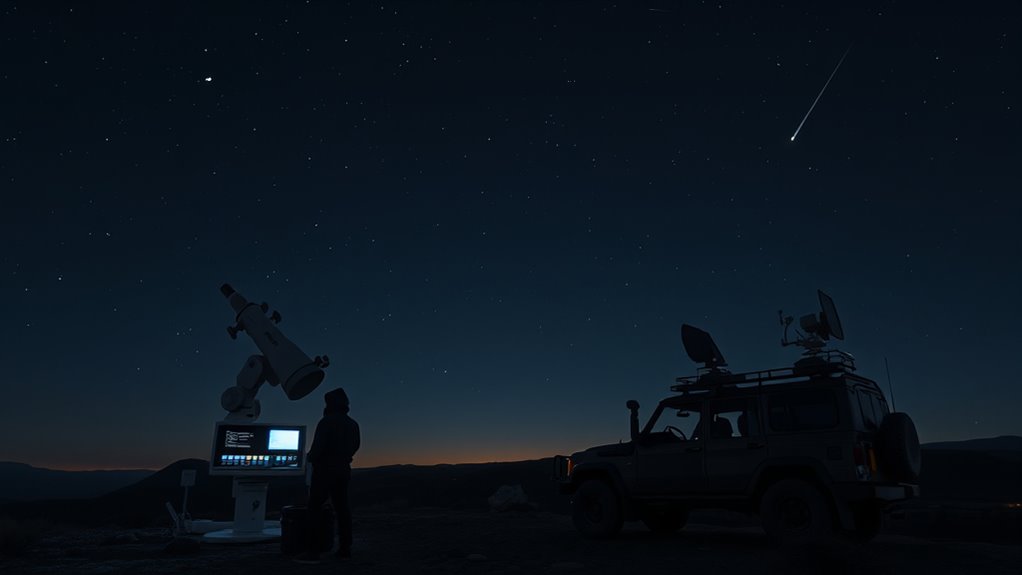

Interstellar object hunters use advanced sky surveys like LSST to identify visitors from beyond our solar system quickly. They rely on machine learning algorithms to sift through vast amounts of data, spotting fast-moving, faint objects before they disappear. Early detection allows for precise tracking and detailed study of these rare visitors. If you’re curious about how scientists track these celestial travelers and stay ahead of their fleeting appearances, you’ll discover more on this fascinating subject.
Key Takeaways
- Advanced sky surveys like LSST aim to detect and track interstellar objects quickly for timely follow-up.
- Machine learning algorithms analyze vast datasets to identify potential interstellar visitors efficiently.
- Early detection enables scientists to study ISO properties, origins, and composition in detail.
- Predictions suggest LSST could discover between 0 and 70 ISOs annually, enhancing understanding of interstellar visitors.
- Improved tracking methods will facilitate interstellar exploration and deepen insights into objects from beyond our solar system.
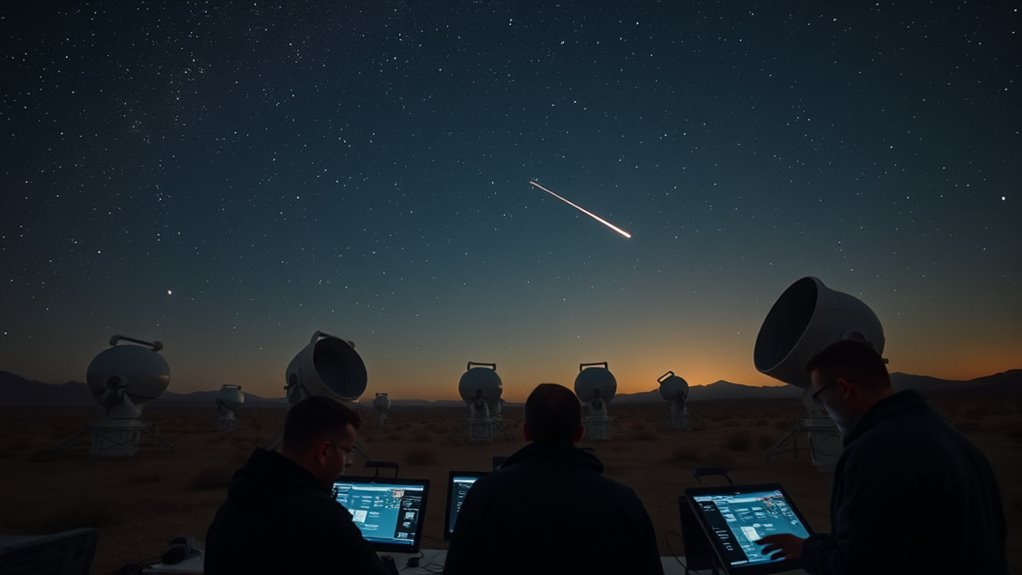
Have you ever wondered how scientists find tiny interstellar objects racing through our solar system? These objects, known as ISOs, are incredibly rare and challenging to detect because they move quickly and are transient visitors. Their fleeting appearances mean you need to be alert and ready to identify them in a blink. The sheer volume of data generated by modern sky surveys adds to the difficulty. For example, the upcoming Legacy Survey of Space and Time (LSST) will produce enormous amounts of information, making it tough to sift through everything efficiently. You can’t afford to overlook a potential ISO; missing one could mean missing the chance for essential follow-up observations. Because ISOs only appear briefly, rapid detection becomes critical. The shorter the observation window, the better your chances of catching these visitors before they slip away. LSST’s capabilities, with a limiting magnitude of about 24.5 and half-sky coverage, are designed to maximize the likelihood of discovering these fleeting objects. Size and albedo, or reflectivity, vary markedly among ISOs, complicating detection efforts even further. Some might be small and dark, blending into the background, while others are larger or more reflective, making them easier to spot. To tackle these challenges, scientists are turning to machine learning algorithms. These advanced systems can automatically analyze the massive datasets, helping to identify potential ISOs quickly and accurately. Algorithms like Random Forests, Neural Networks, and Gradient Boosting Machines are being trained to classify objects based on their observable features. Interestingly, derived values such as Digest2 scores often play a more important role than raw measurements, improving the system’s accuracy. Additionally, ongoing research into improving detection algorithms aims to further enhance identification accuracy and reduce false positives. The goal is to create methods that are both efficient and robust, reducing false positives that could lead to unnecessary follow-ups. Predictions suggest that LSST could detect anywhere from zero to 70 ISOs each year, depending on their size, reflectivity, and other properties. These estimates highlight the unpredictable nature of detection, but even a handful of discoveries each year would greatly enhance our understanding of these cosmic visitors. Over time, LSST might identify hundreds of ISOs, opening new windows into their composition and diversity. Early detection is essential because it allows scientists to plan follow-up observations while the ISO is still nearby. This timely identification can enable detailed characterization, much like what was attempted with the famous interstellar object 1I/‘Oumuamua. Ultimately, as detection methods improve and surveys like LSST continue to scan the sky, you’ll be part of a new era of interstellar exploration—tracking and understanding visitors from beyond our solar system.

DWARFLAB Dwarf Mini Smart Telescope – 1.85lb Ultra-Portable Astronomy Telescope for Astrophotography with Built-in Filters, Auto GOTO, AZ/EQ Mode and Cloud Processing, Ideal for All Ages
【Pocket-Sized & Ultra-Lightweight】 Weighing just 1.85 lbs (840g), the DWARF mini easily fits into a backpack or large…
As an affiliate, we earn on qualifying purchases.
As an affiliate, we earn on qualifying purchases.
Frequently Asked Questions
How Do Scientists Differentiate Interstellar Objects From Comets or Asteroids?
You can tell interstellar objects apart from comets or asteroids by analyzing their trajectories and physical properties. When you observe an object with a hyperbolic orbit and high velocity, it likely originates outside the solar system. Additionally, examining its shape, composition, and brightness variations helps identify differences. Spectral analysis and trajectory tracking are your key tools, revealing whether the object’s characteristics align with native solar system bodies or interstellar visitors.
What Tools or Technology Are Essential for Tracking Interstellar Visitors?
Think of tracking interstellar visitors as catching a fleeting comet in a camera’s flash—quick, precise, and demanding the right tools. You’ll need advanced survey telescopes like LSST and Pan-STARRS to capture rapid transient data, automated detection pipelines powered by machine learning to sift through millions of observations, and quick-response follow-up telescopes for detailed characterization. Together, these technologies form a high-tech net, ensuring no interstellar visitor slips by unnoticed.
How Often Do Interstellar Objects Pass Through Our Solar System?
You probably wonder how often interstellar objects pass through our solar system. Based on current estimates, roughly three arrive each day, though detection is limited. These objects spend about a decade crossing our planetary zone. Advances like the Rubin Observatory’s LSST will improve detection, predicting that over ten years, you’ll see 15–50 of these visitors. This increased observation will help refine how frequently these interstellar travelers come by.
Can Interstellar Objects Impact Earth or Cause Damage?
You might wonder if interstellar objects can impact Earth or cause damage. While they do pass through our solar system at high speeds, the chances of collision are extremely low. Their distant flybys and small sizes make impacts rare. Even if one did hit, the impact could be energetic, but current tracking systems help us identify and monitor these objects early, greatly reducing potential risks. Overall, impacts are very unlikely.
Are There Any Upcoming Missions to Study Interstellar Objects Closely?
Imagine you’re standing at the edge of a vast cosmic ocean, waiting for rare ships to pass by. Upcoming missions like NASA’s Interstellar Probe and SpaceX’s Starship are your vessels, designed to chase these fleeting visitors. You’ll see spacecraft racing at incredible speeds, aiming to study interstellar objects up close. With advances in technology and international teamwork, you’re on the verge of revealing secrets from beyond our solar system.

Sky-Watcher Sky-Watcher Heritage 130mm Tabletop Dobsonian 5-inch Aperture Telescope – Innovative Collapsible Design – Easy to Use, Perfect for Beginners, Black/White (S11705)
LARGE APERTURE: The Heritage 130mm provides users with over 5 inches of aperture, delivering breathtaking views at a…
As an affiliate, we earn on qualifying purchases.
As an affiliate, we earn on qualifying purchases.
Conclusion
As you follow these interstellar hunters, it’s clear we’re just beginning to understand what’s out there. Each new visitor offers a glimpse into distant worlds, challenging what we think we comprehend about our universe. Isn’t it exciting to imagine what discoveries lie ahead? With every passing object, you realize we’re on the brink of uncovering cosmic secrets that could change everything. So, are you ready to keep watching the skies and explore the unknown?

Celestron – Cometron 7×50 Astronomy Binoculars – Entry-Level for Stargazing and Comet Watching – Large 50mm Objective Lenses – Wide 6.6° Field of View – Multi-Coated Optics
EASY-TO-USE ASTRONOMY BINOCULARS FOR BEGINNERS: Cometron 7×50 binoculars are an easy, affordable way to learn the night sky…
As an affiliate, we earn on qualifying purchases.
As an affiliate, we earn on qualifying purchases.

India's Journey towards Excellence in Building Earth Observation Cameras
As an affiliate, we earn on qualifying purchases.
As an affiliate, we earn on qualifying purchases.